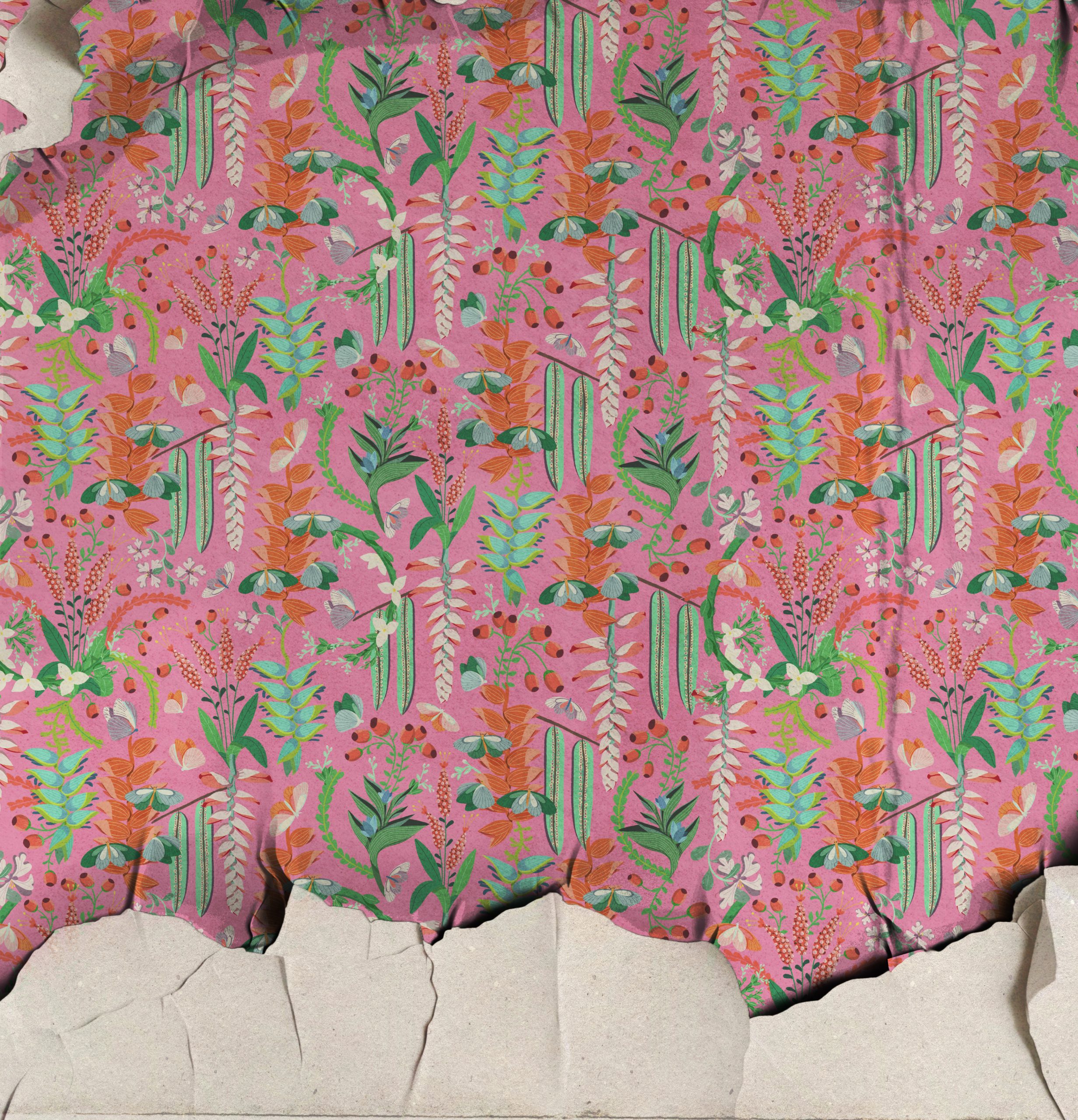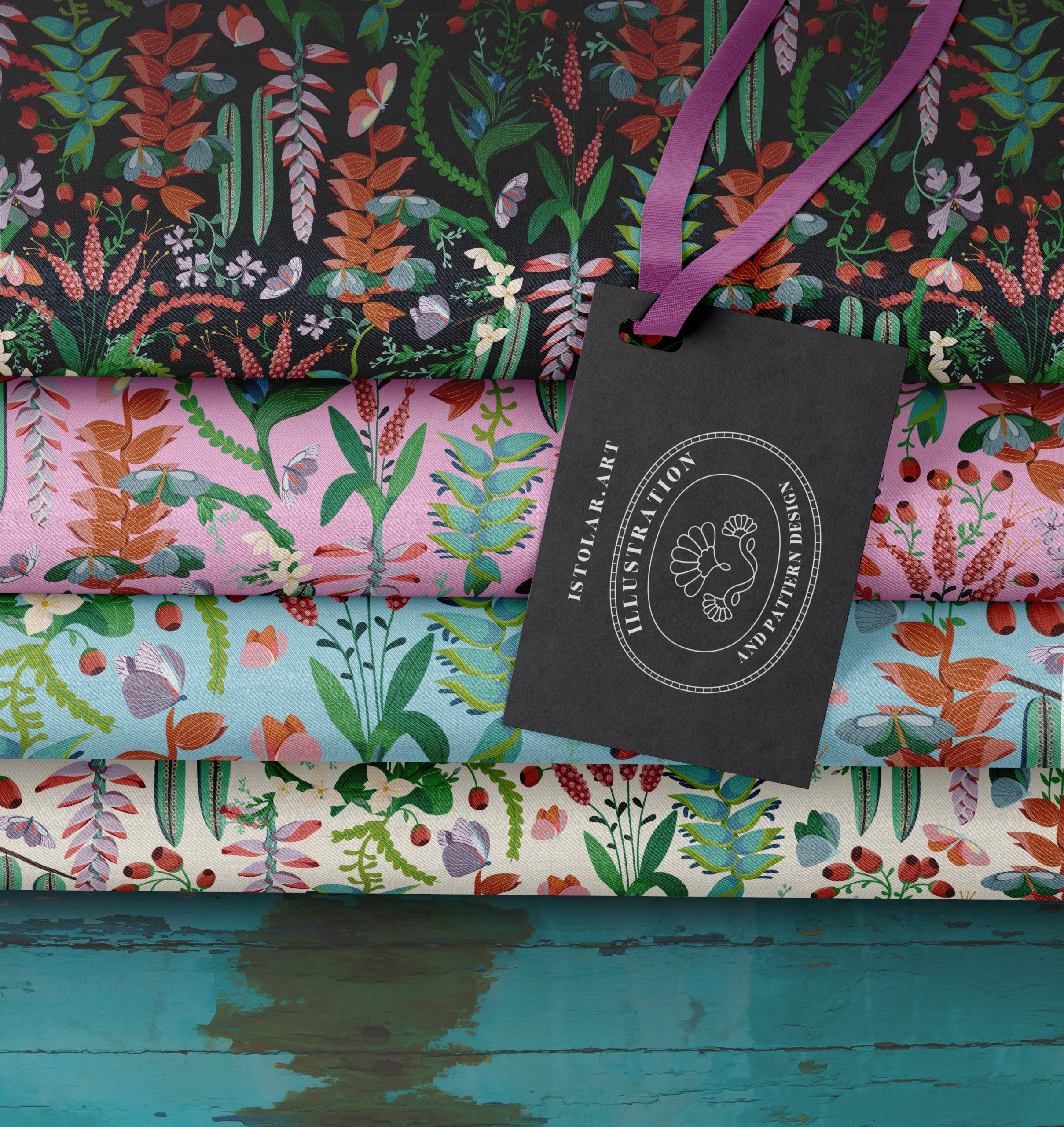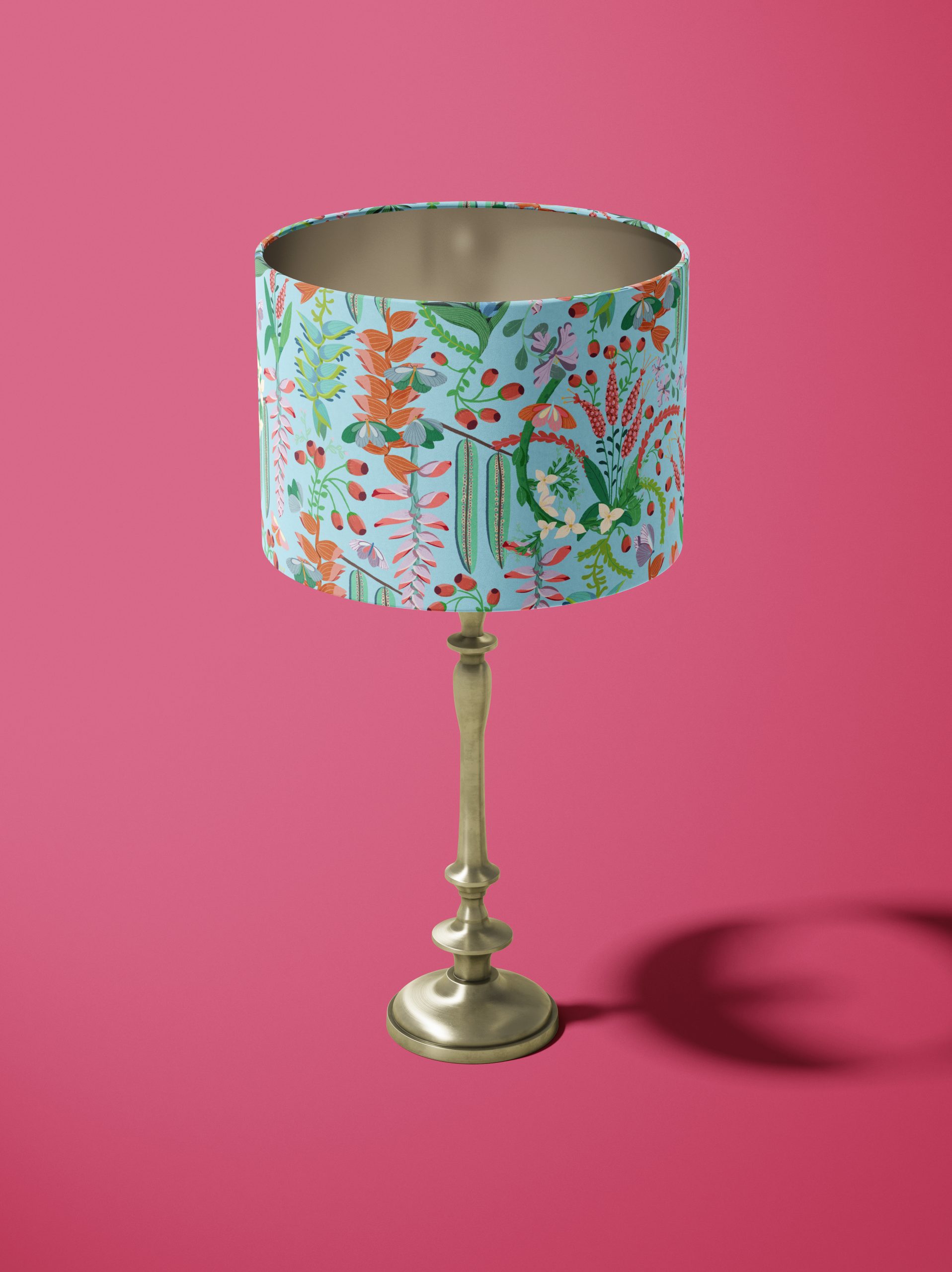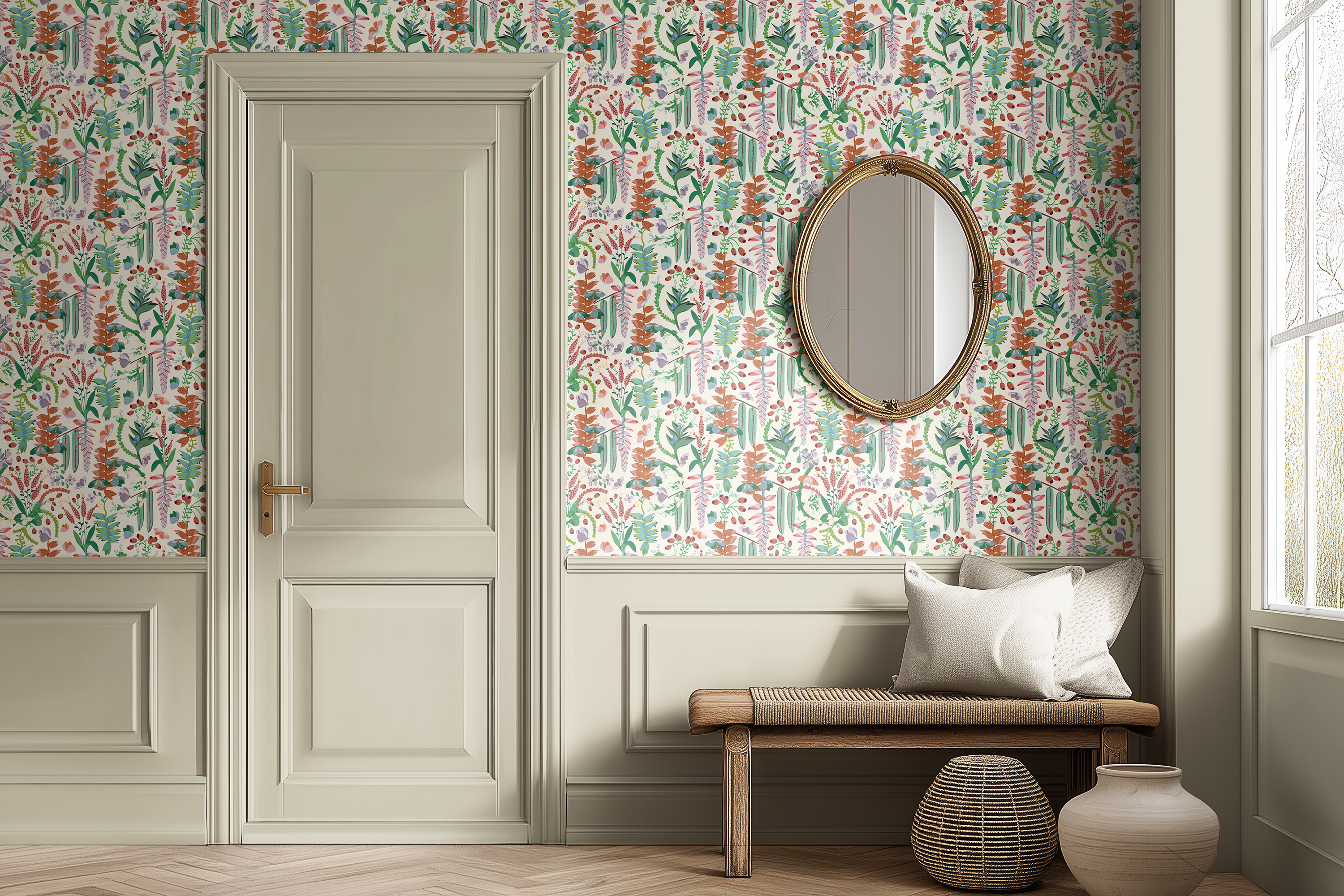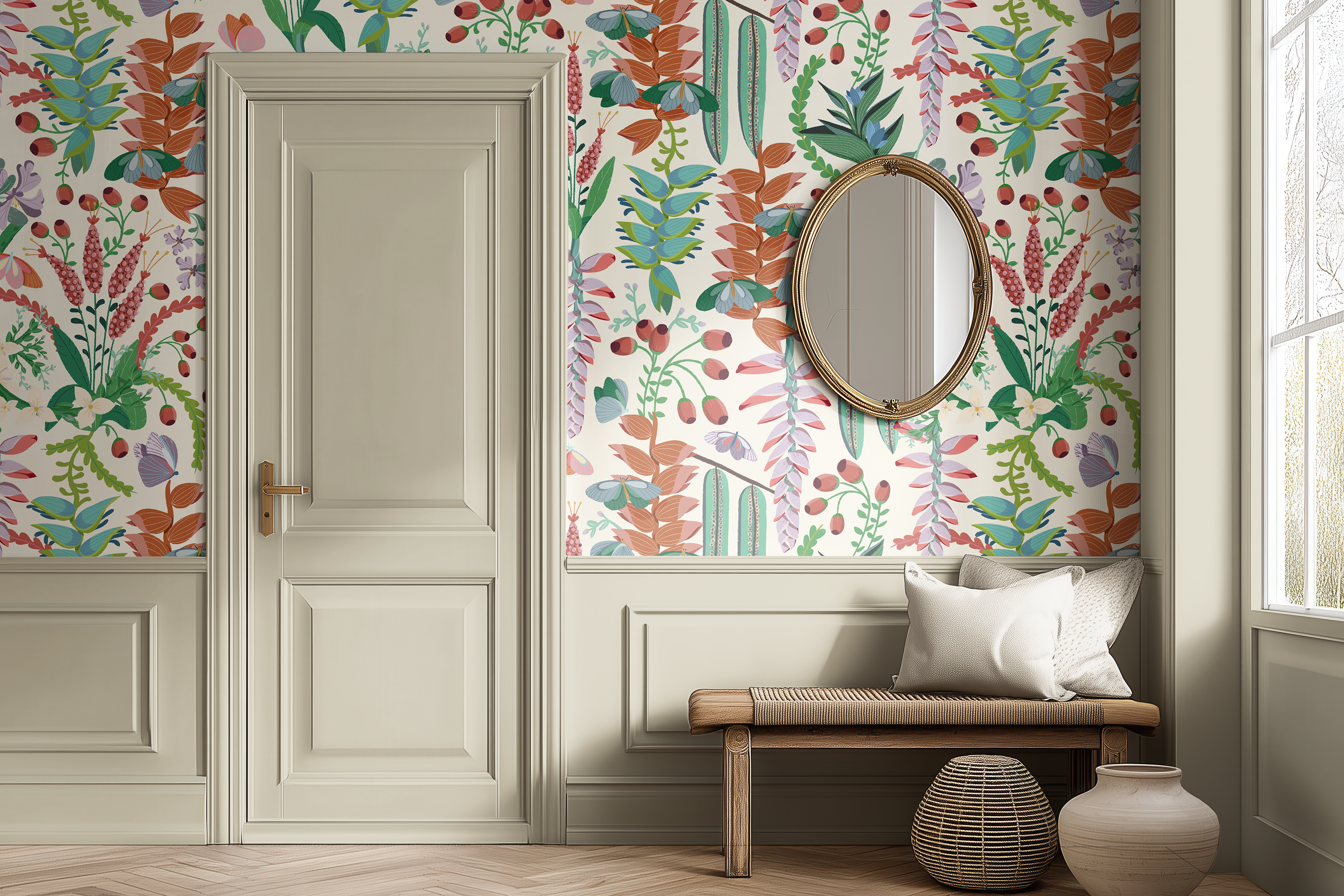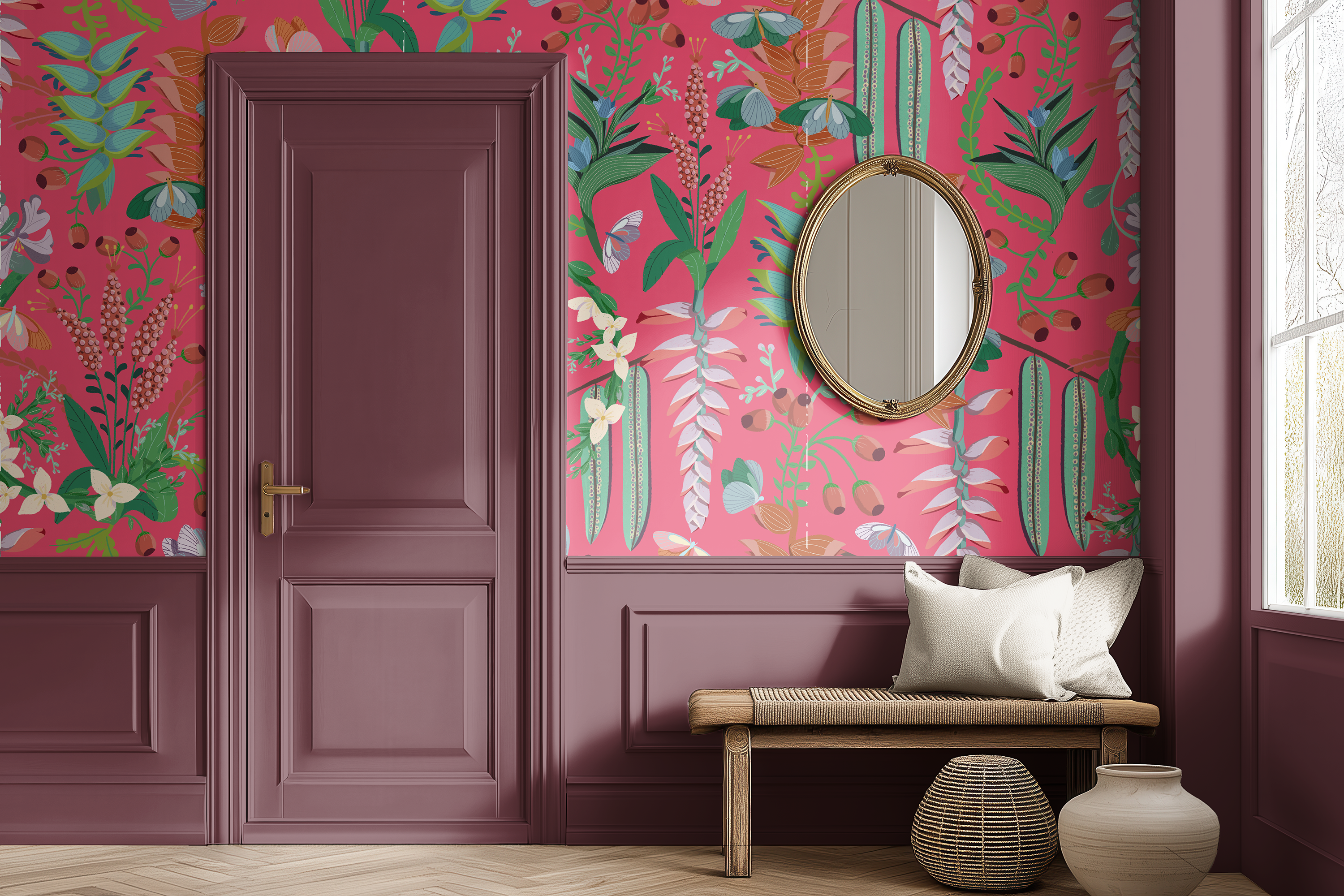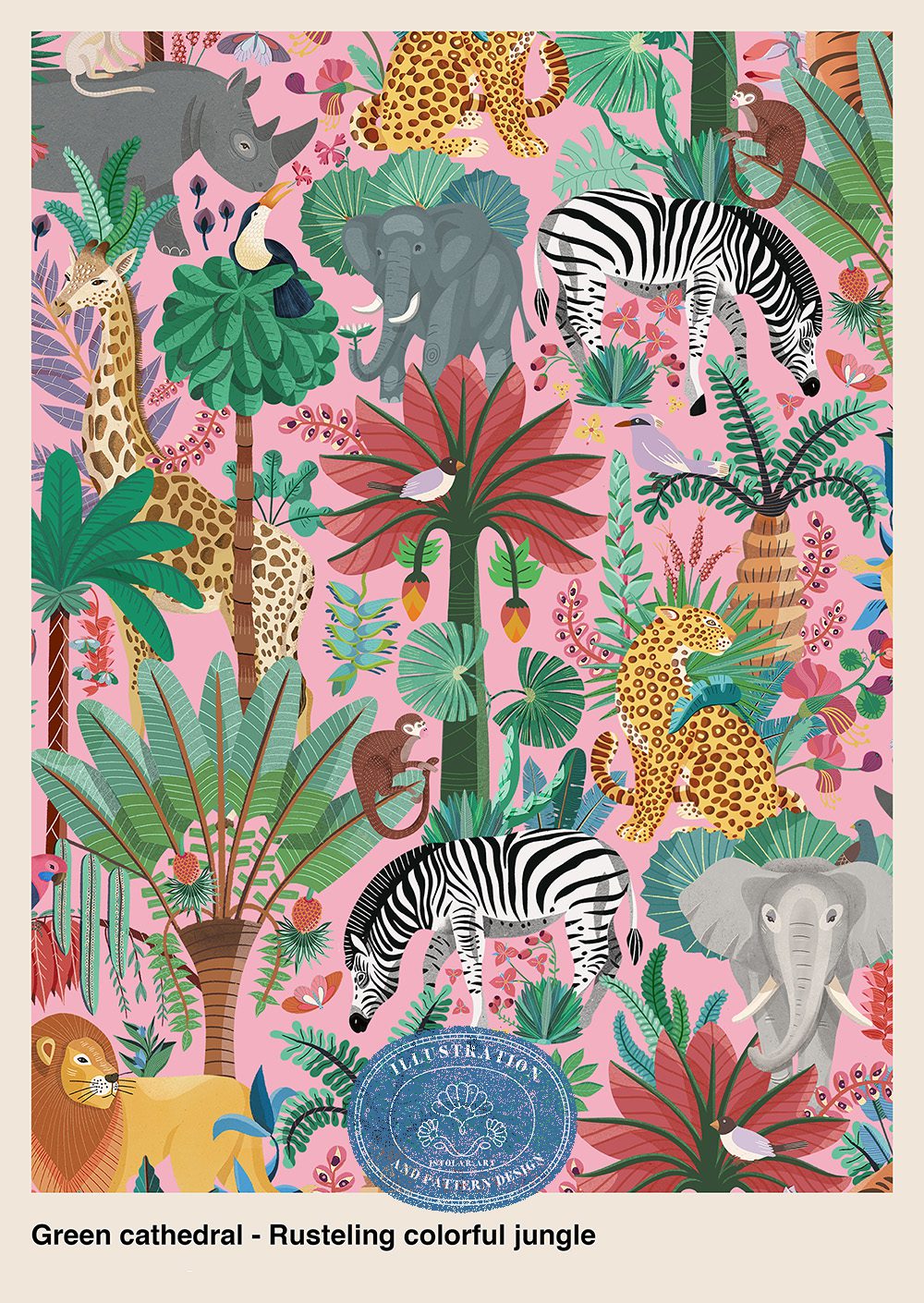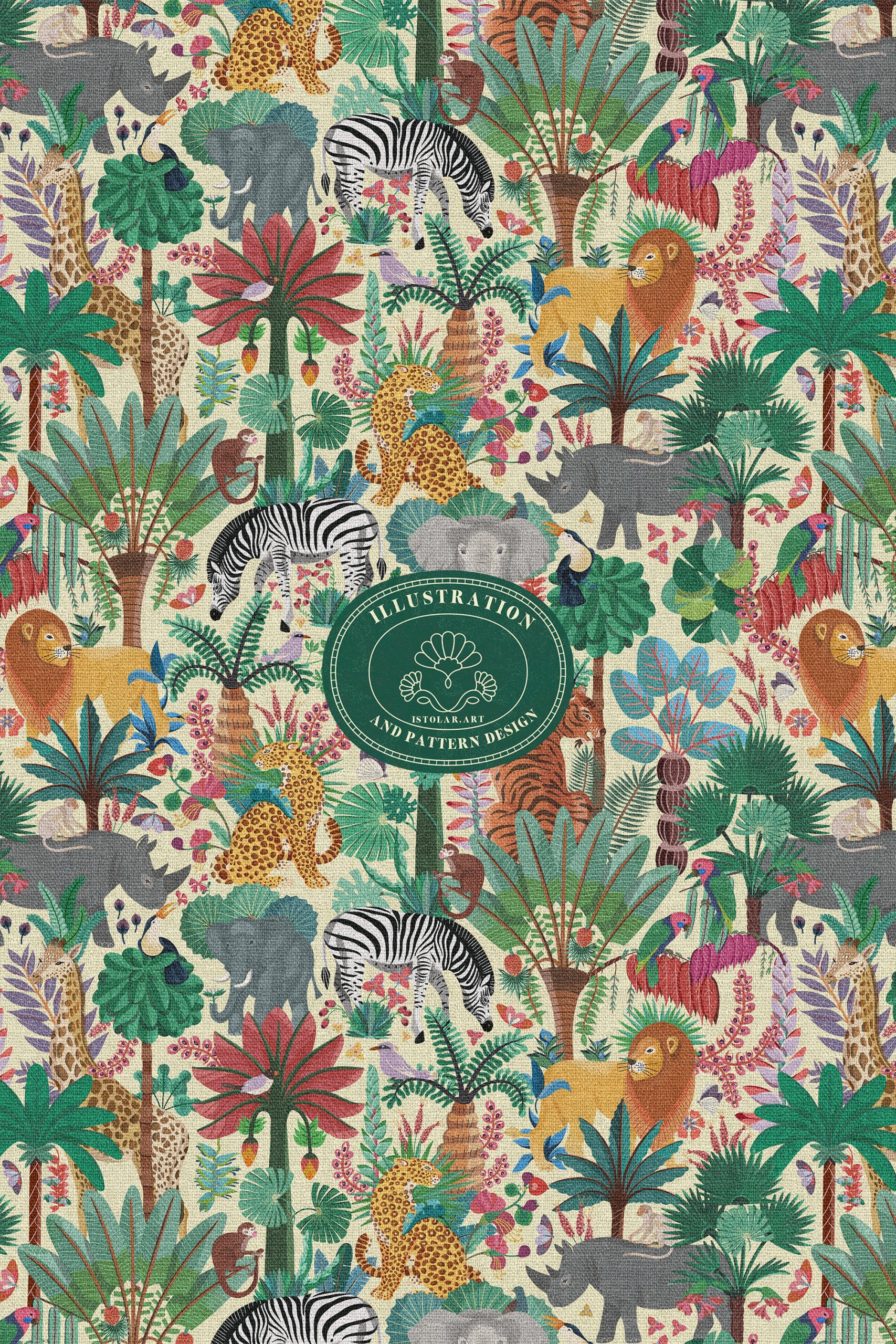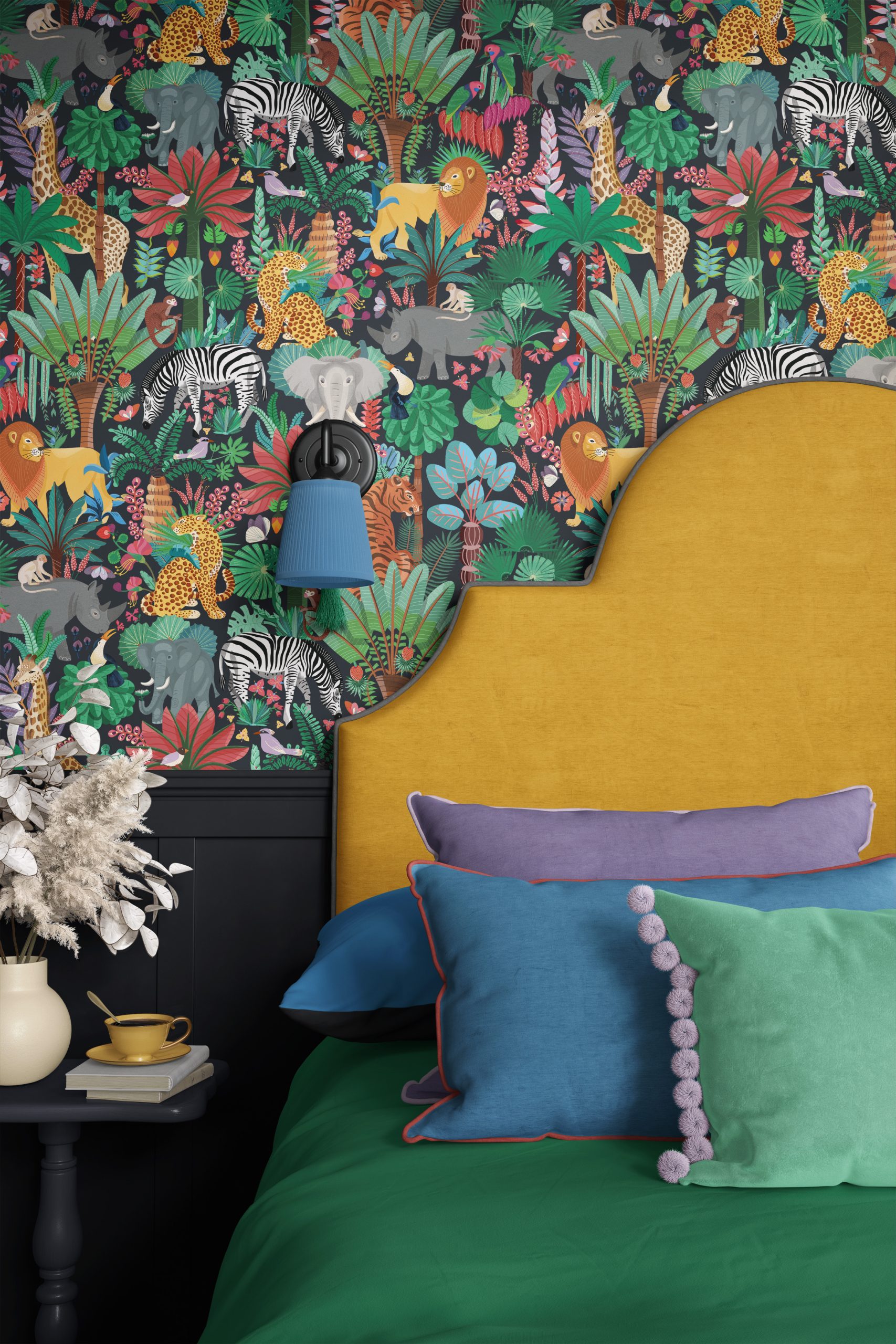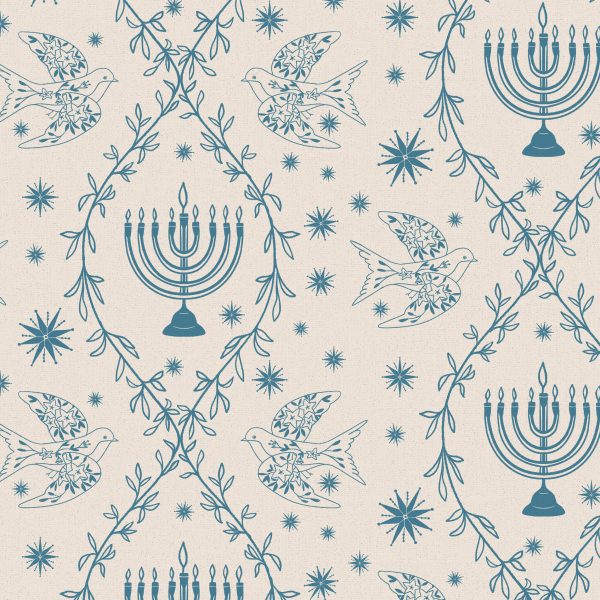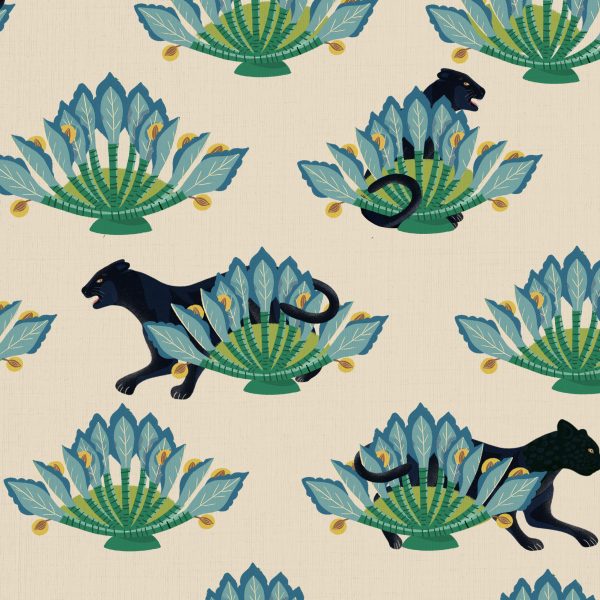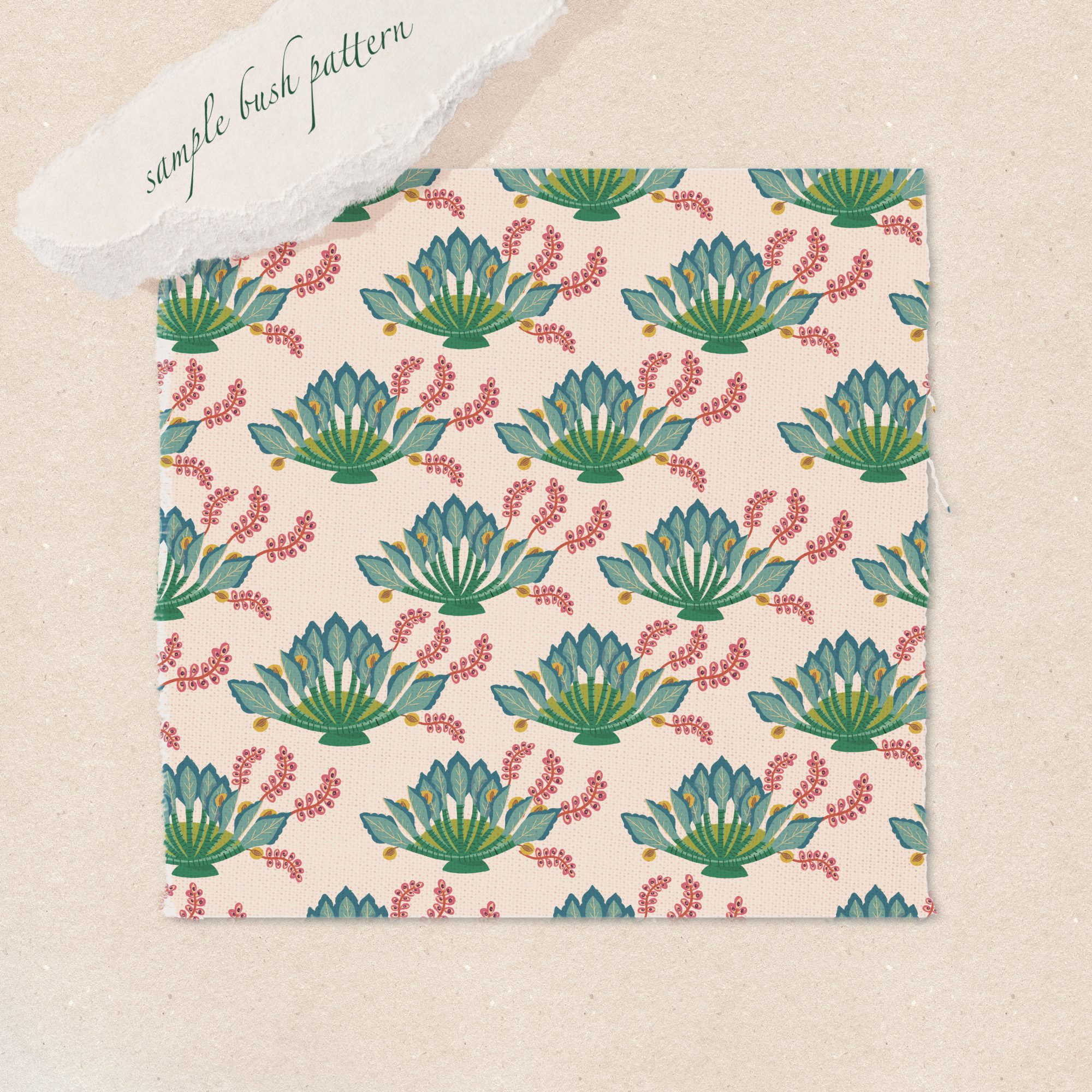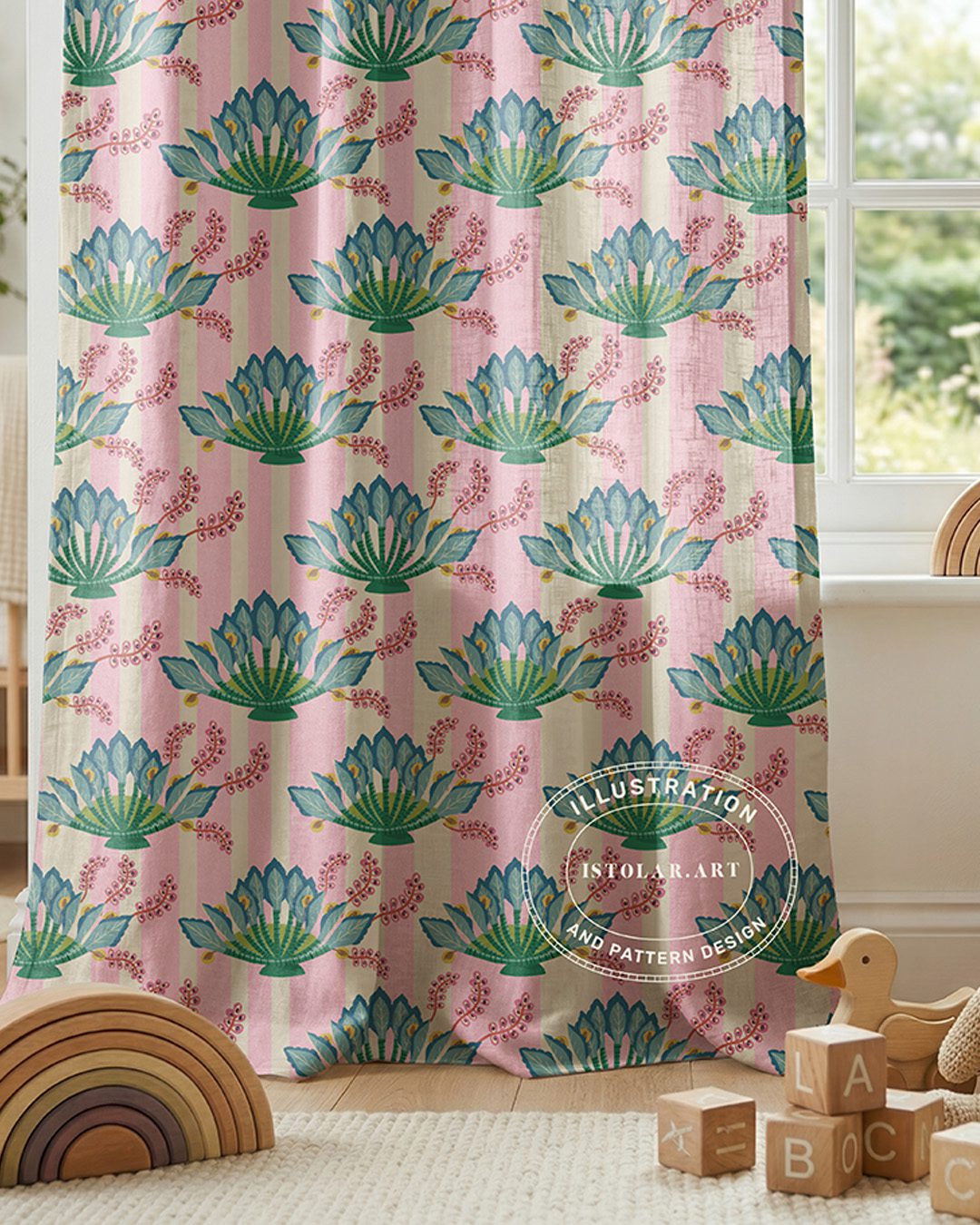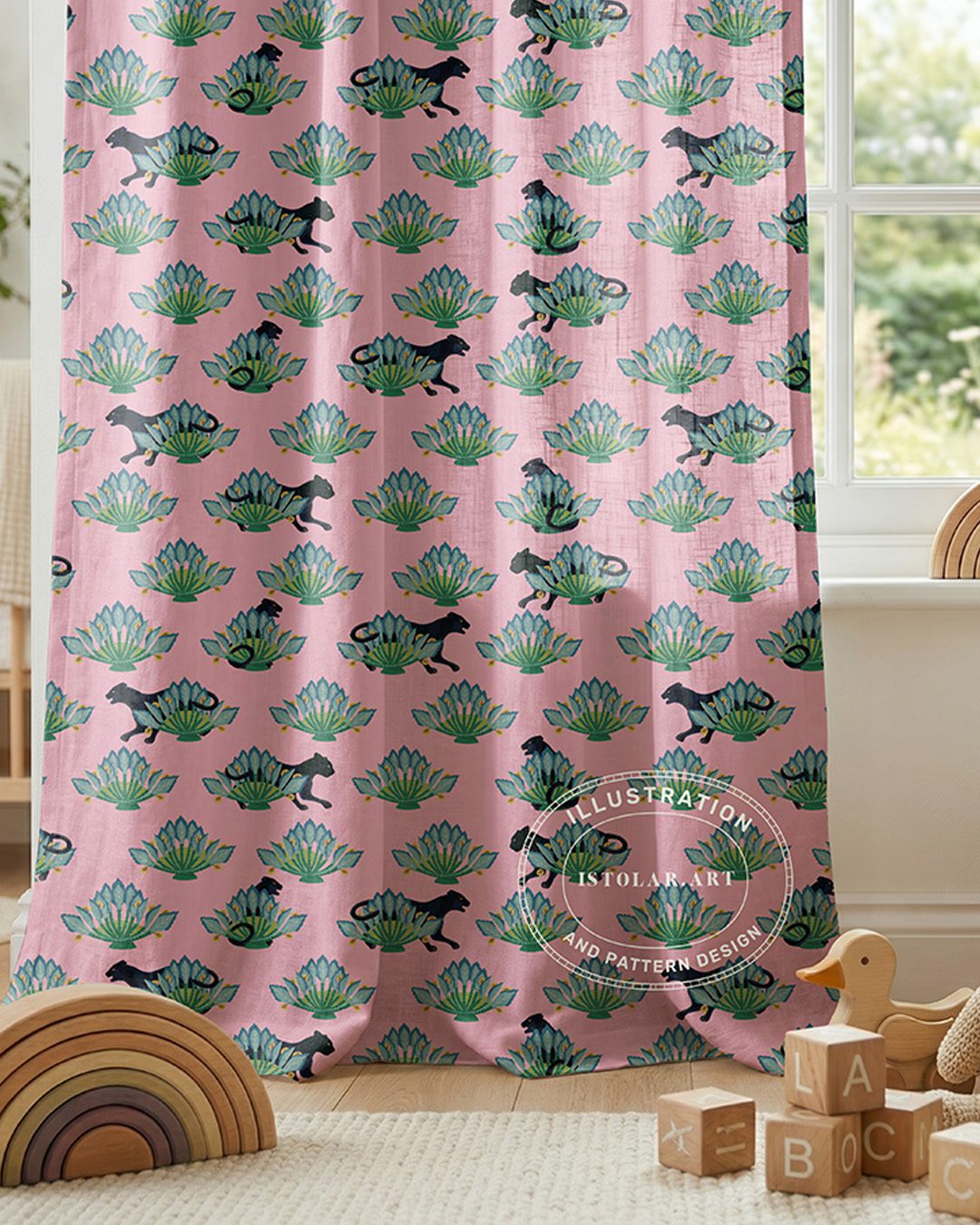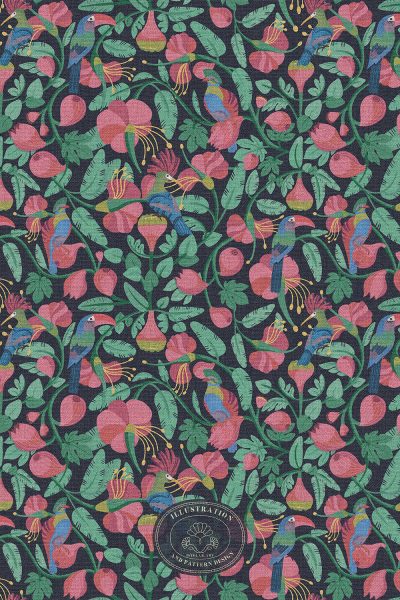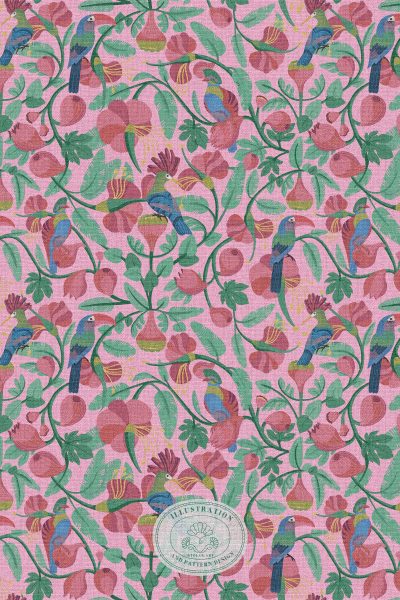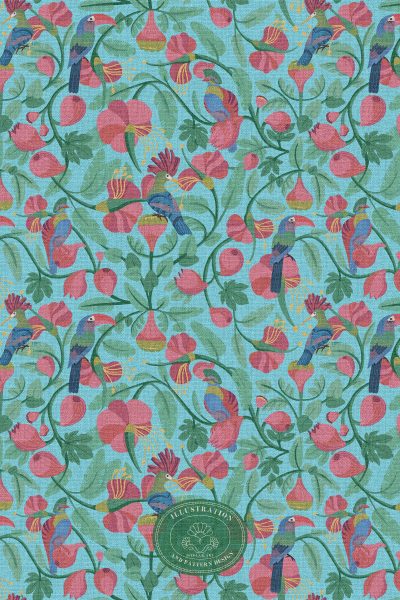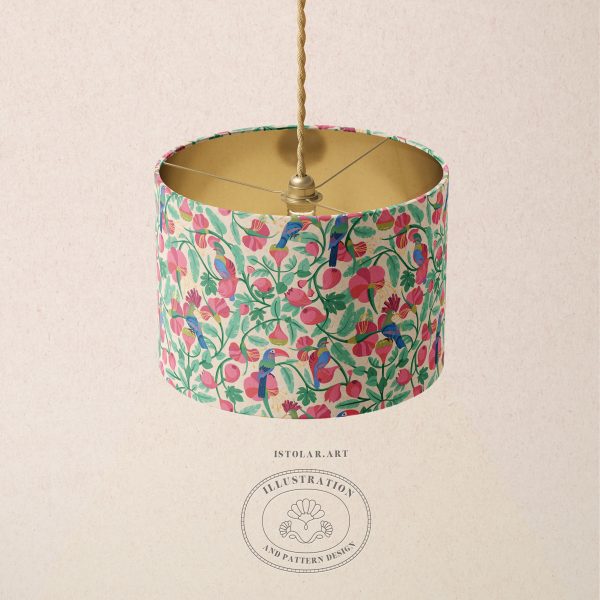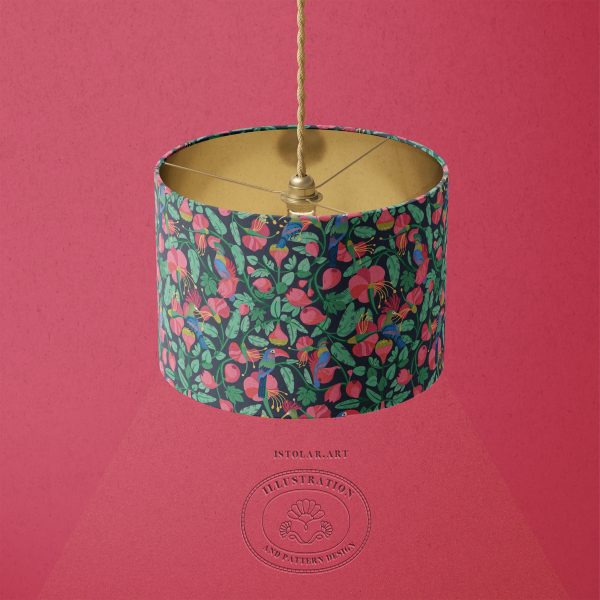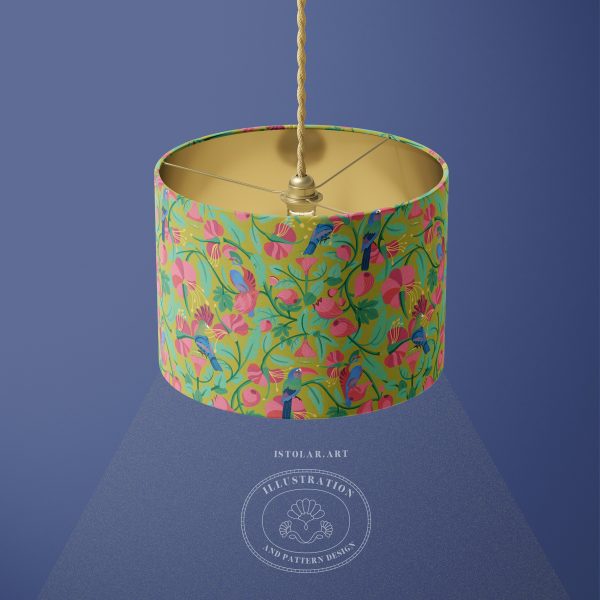
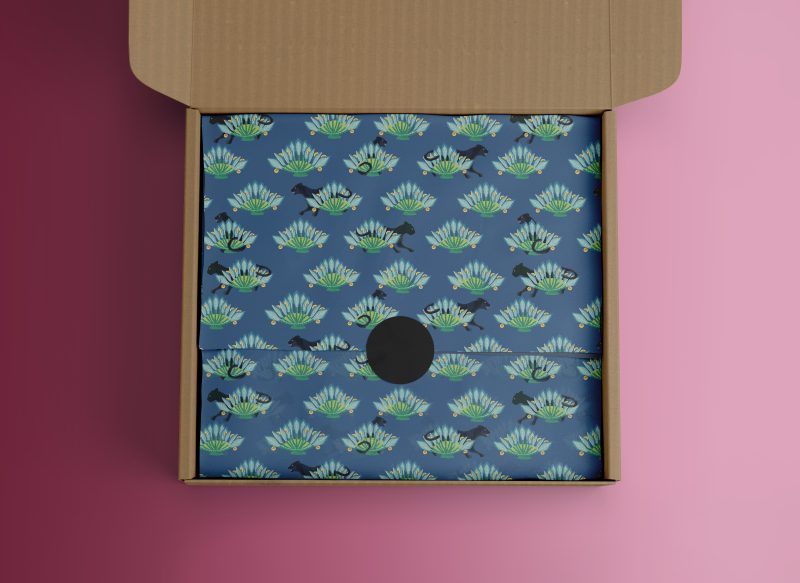
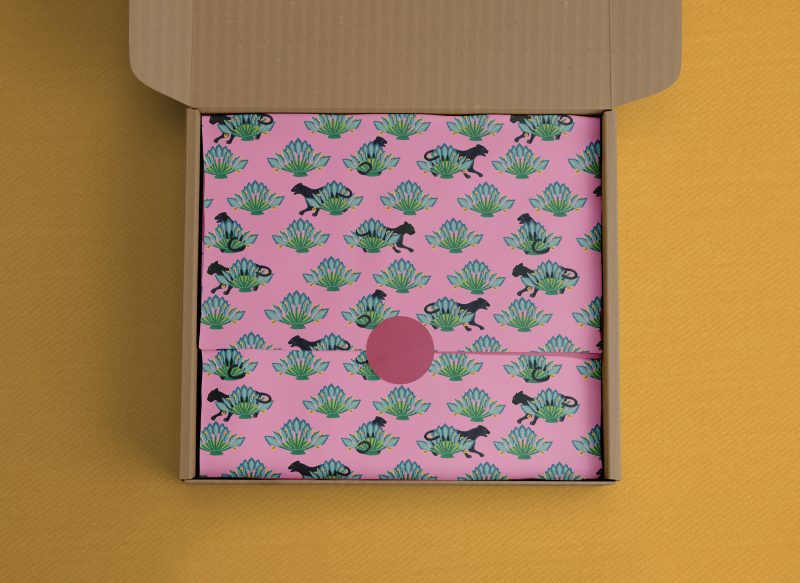
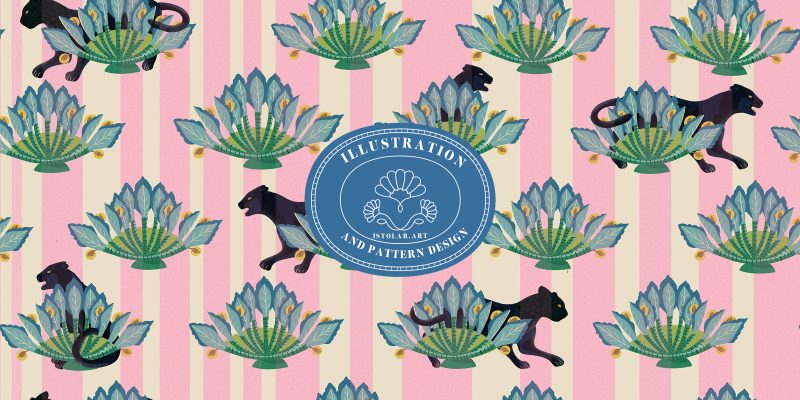
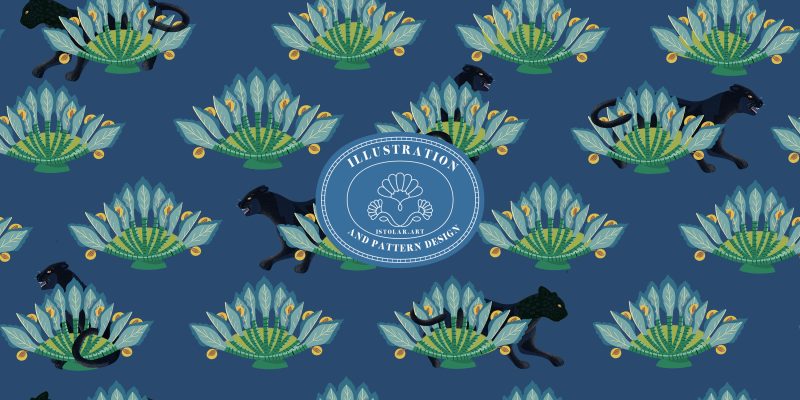
This seamless half-drop repeat arranges the motifs in staggered rows, creating a steady diagonal rhythm and smooth all-over continuity across the surface.
The design pairs the geometric discipline of Art Deco-inspired botanical fan forms with the organic grace of prowling black panthers, all rendered in a modern, graphic illustration style that keeps the composition crisp and decorative.
Timeless and trend-forward at once, the Art Deco geometry and curated, limited palette feel enduring, while the “hidden animal” storytelling adds a fresh, contemporary twist for tropical-themed collections. The overall effect reads like a high-end botanical study reimagined for a modern luxury brand, and it also sits comfortably within today’s “Jungalow” and “Modern Regency” interior directions.
Note on “Jungalow” “Jungalow” is a blend of jungle and bungalow: a warm, eclectic, bohemian look that mixes lush tropical elements with cozy, relaxed home vibes—think abundant greenery, handcrafted décor, and a lived-in sense of comfort. It’s not untamed jungle and not minimalist modern; it’s layered, creative, personal, and joyful without feeling strict or overly pared back
With the blue background, a “tropical night garden” vibe takes on jungle storytelling. The deep blue background shifts the collection into a nocturnal mood, making the cool greens feel more luminous and the panthers more integrated like shadows moving through foliage. Yellow accents pop more sharply against the darker field.W
The Pink Edition breathes new life into tropical design with a high-energy, maximalist palette. The soft, warm pink background flips the mood from classic jungle to playful/chic. The pink color twist feels more like a “resort cocktail” than rainforest realism. It reinterprets the mysterious jungle theme through a whimsical, high-fashion lens, making it feel energetic rather than somber.
FR
Ce motif sans raccord en demi-saut (half-drop) dispose les éléments en rangées décalées pour créer un rythme diagonal constant sur toute la surface.
Le design coordonne la structure géométrique des palmes en éventail d’inspiration Art déco avec les formes organiques de panthères noires en mouvement. Cet équilibre est rendu par une approche graphique moderne, avec des silhouettes décoratives nettes.
Ce motif est plutôt intemporel, mais a aussi des accents modernes ; la géométrie Art déco associée à une palette de couleurs restreinte lui confère un attrait classique, tandis que la narration de l’animal caché apporte le nouveau souffle de thématiques tropicales actuelles. Il évoque une étude botanique haut de gamme réécrite par exemple pour une marque de luxe contemporaine. Cette esthétique s’inscrit parfaitement dans les tendances de décoration intérieure «Modern Regency» ou «Jungalow».
Le terme «Jungalow» (contraction de jungle et bungalow) fait référence à un style chaleureux, éclectique et bohème. Il marie avec brio la luxuriance de la végétation tropicale et l’atmosphère accueillante et décontractée d’un intérieur habité.
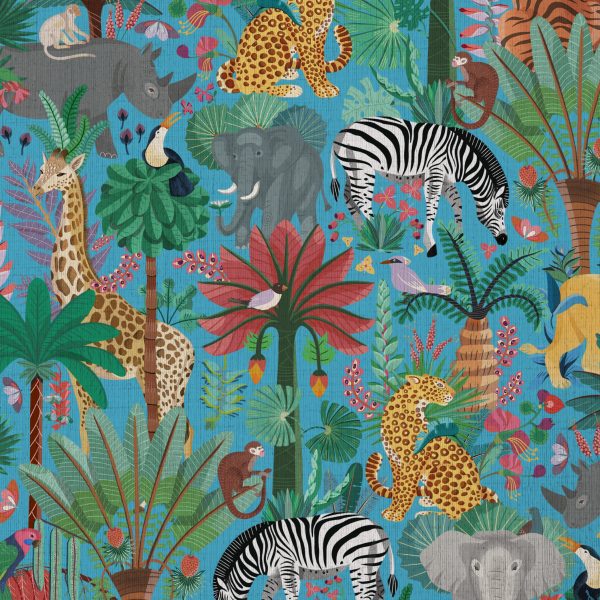
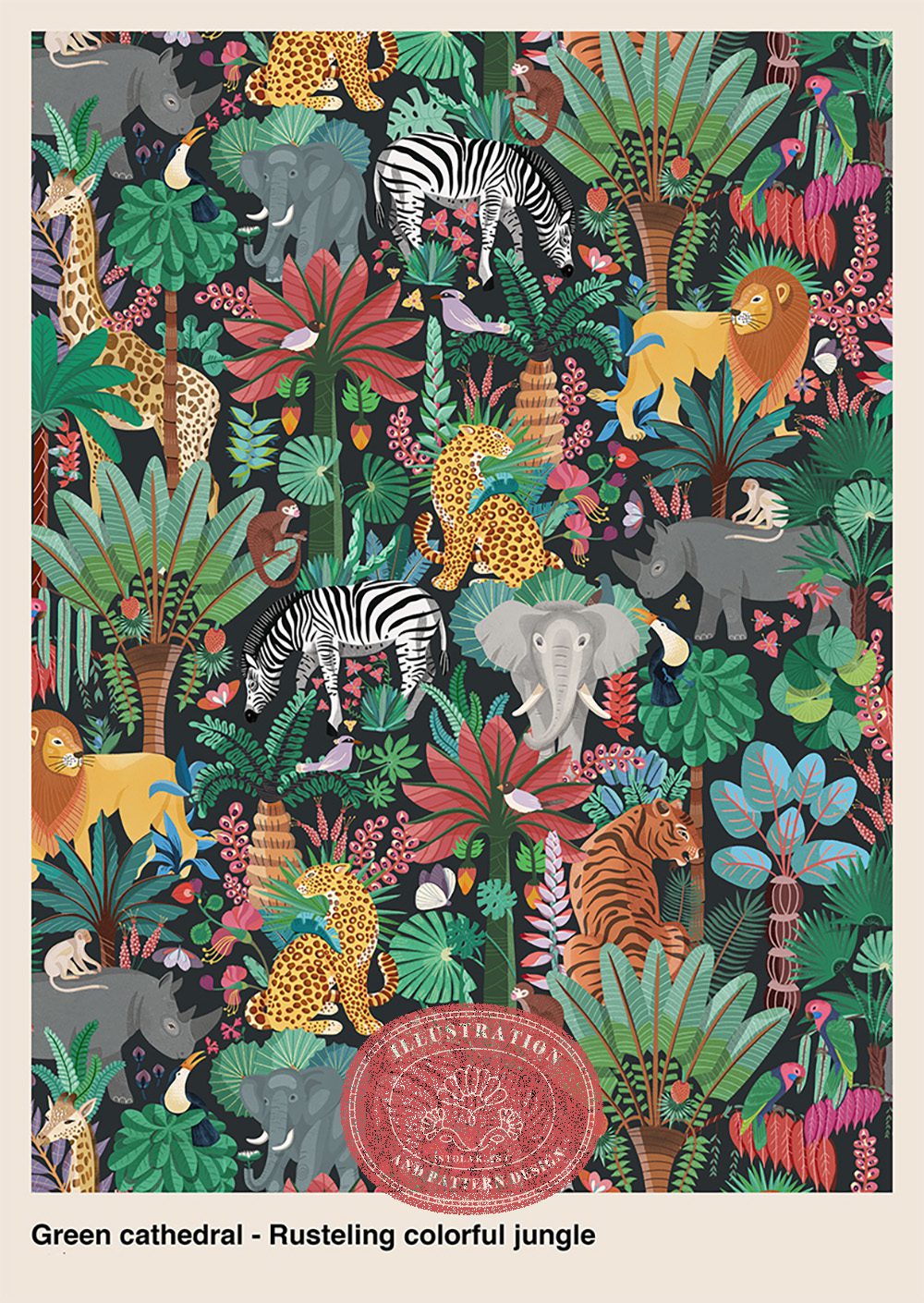
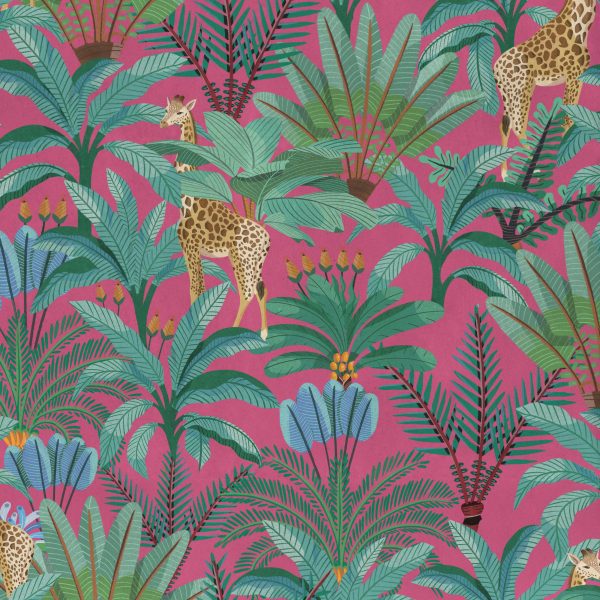
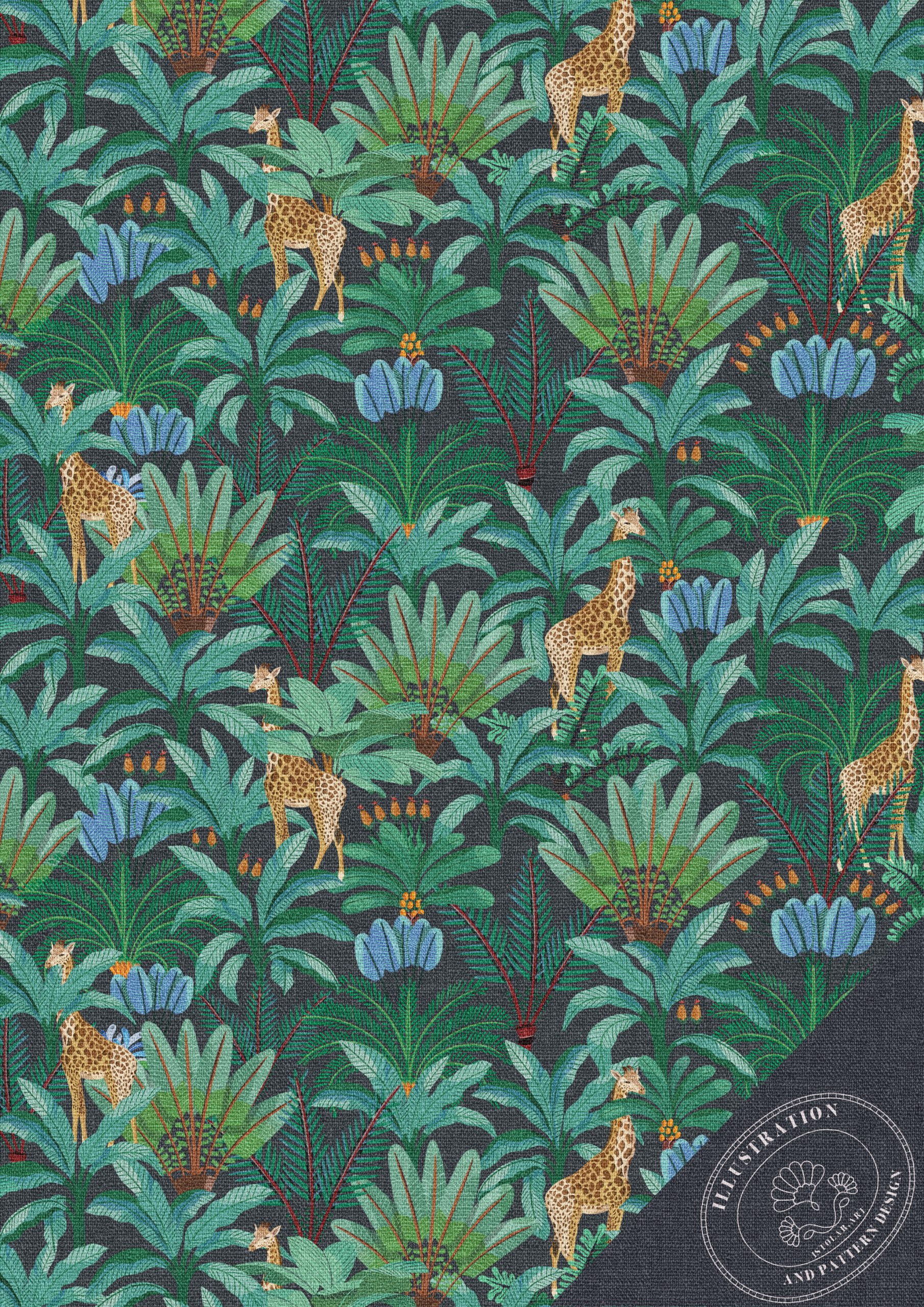
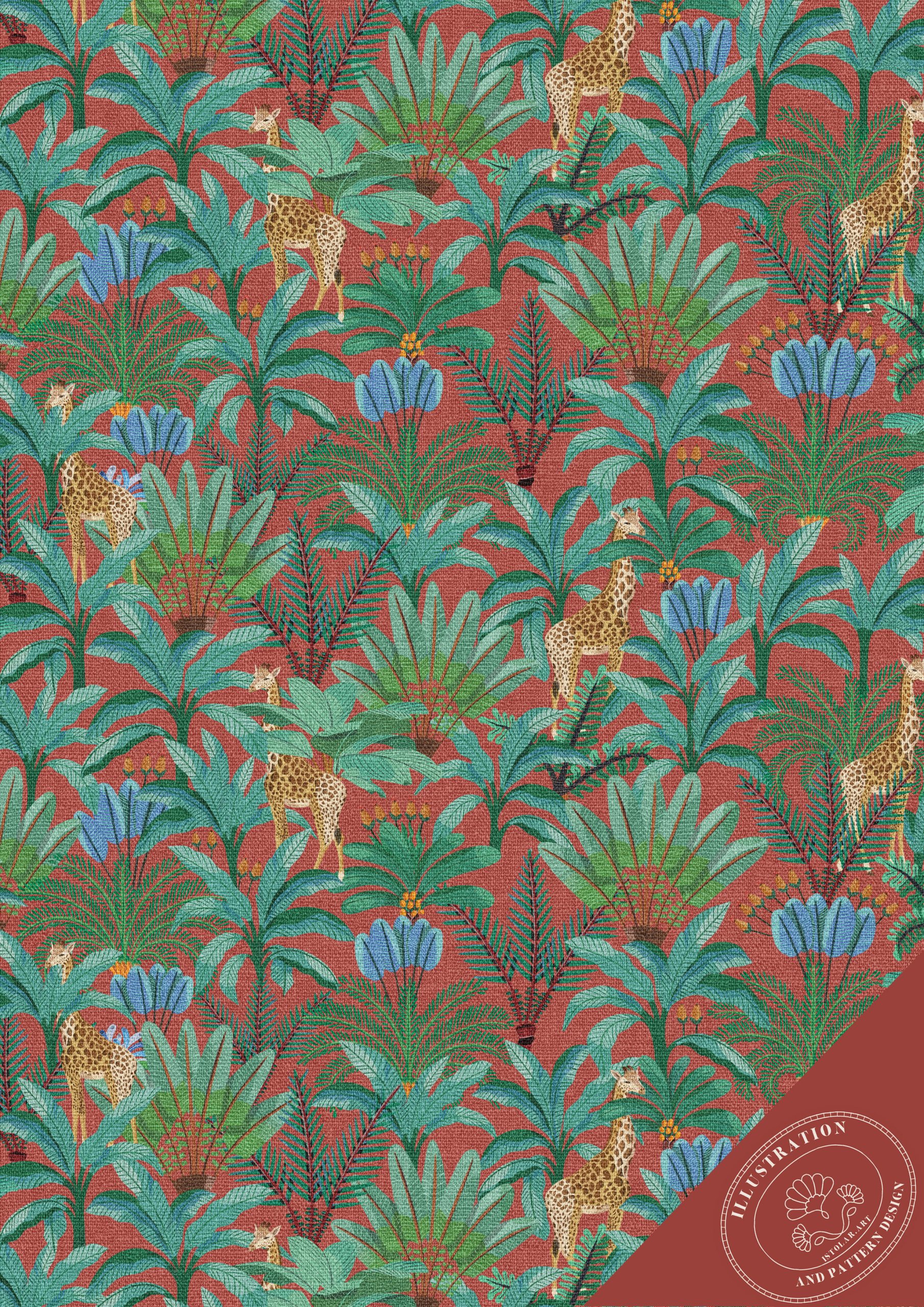
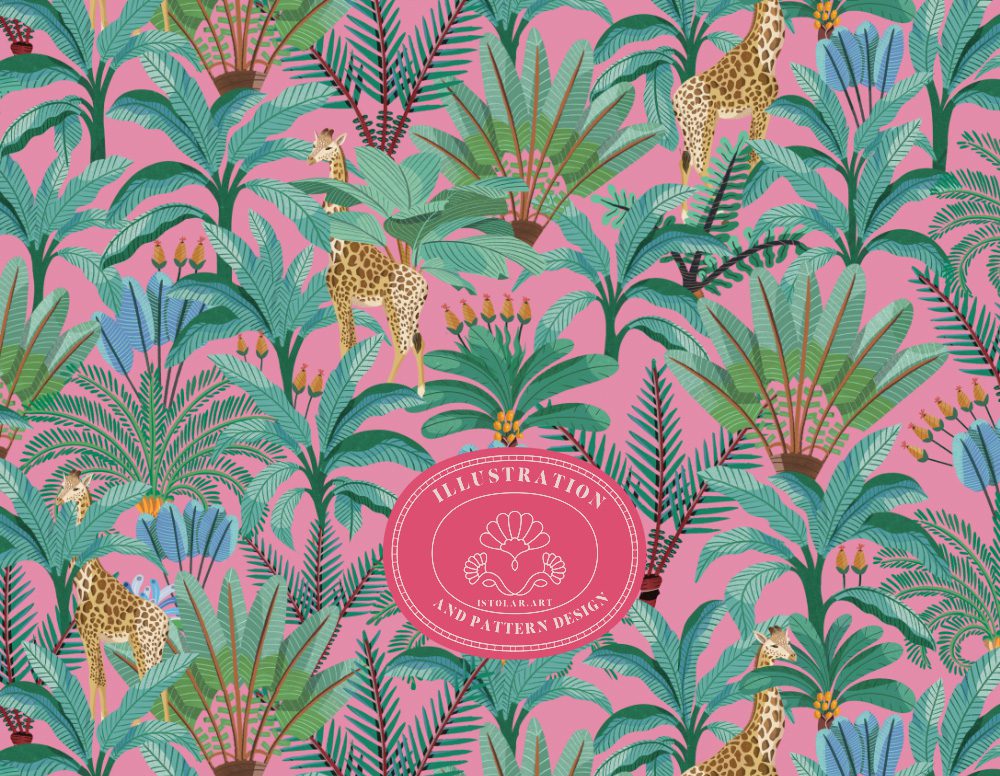
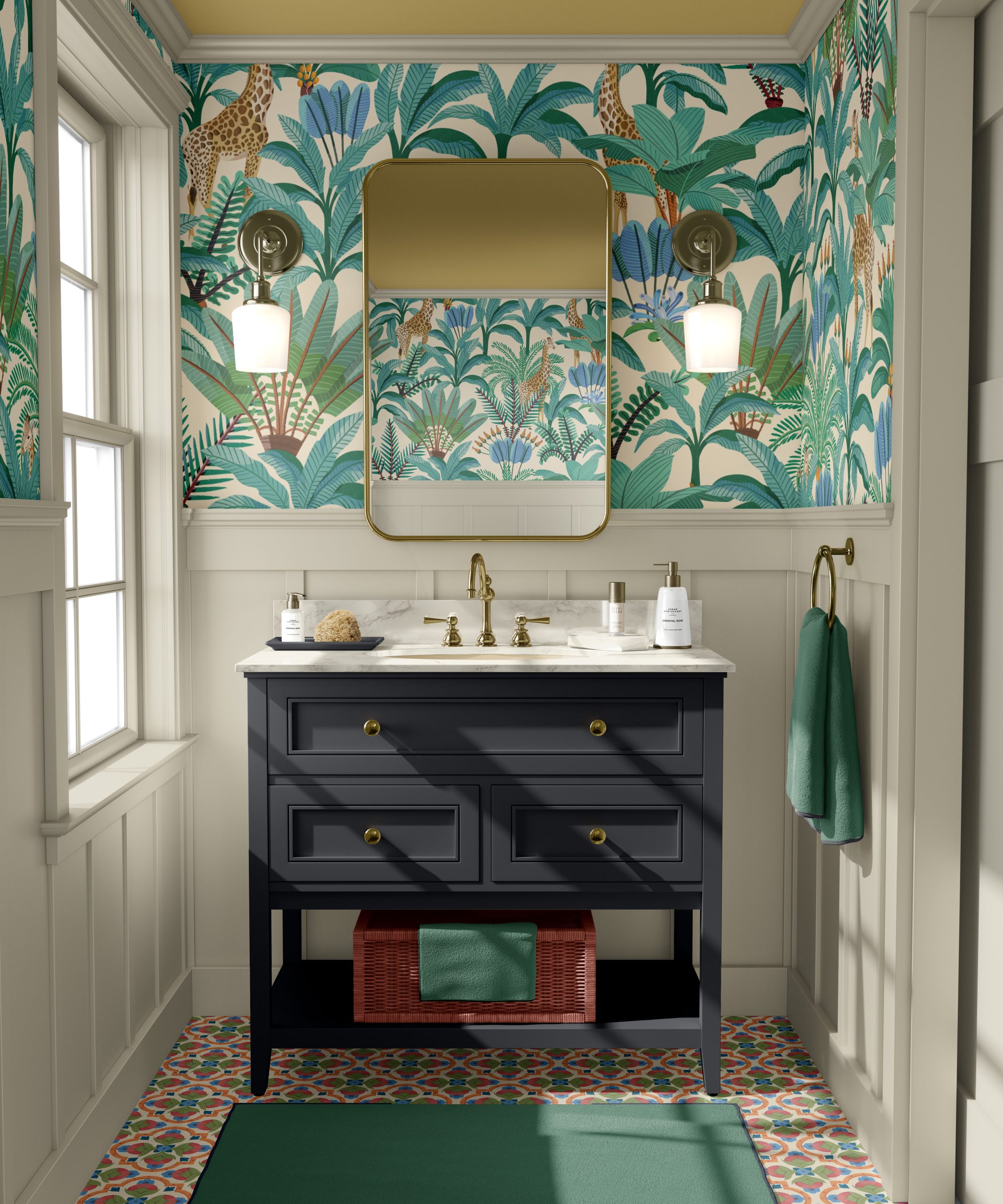
EN: This seamless pattern features spotted giraffes tucked between layered palm fronds and fan leaves, set on playful overlapping palm fronds build a near wall-to-wall canopy, while the animals appear as intermittent focal points. The “overlapping” technique creates a dense, immersive atmosphere. Spacing is intentionally tight, creating a lush rhythm without obvious rows, which helps the repeat feel natural and non-tracking on large surfaces.
The aesthetic of my design balances a contemporary flat illustration (graphic clarity) with the hand drawn decorative details of the palms and tropical foliage (arched fronds, fan palms, fern-like sprays).
The palette is composed of emerald, sage, and teal greens, accented by dusty blue and warm ochre.
FR: Ce motif sans raccord met en scène des girafes nichées au cœur de feuille de palmiers en éventail superposées. Ces palmes s’entrecroisent pour former une canopée presque continue, où les animaux apparaissent comme des points focaux intermittents. Cette technique de chevauchement crée une atmosphère dense et immersive. L’espacement, volontairement serré, génère un rythme luxuriant sans rangées apparentes, ce qui permet à la répétition de rester naturelle et d’éviter tout effet de marquage sur les grandes surfaces. Du feuillage tropical (grandes feuilles arquées, palmiers éventails) jaillissements de fougères).
L’esthétique du design équilibre une illustration plutôt plate (légèrement texturée, mais sans relief) contemporaine (recherche de clarté graphique) avec la richesse des détails décoratifs et le rendu dessins en qualité analogique.
La palette se compose de vert émeraude, sauge rehaussés par des touches de bleu canard et d’ocre chaleureux.
For instance, the pink background adds contemporary, fashion-forward contrast, making the overall mood vibrant, and escaping that way, the classic jungle imagery reinterpreted with a playful color story.
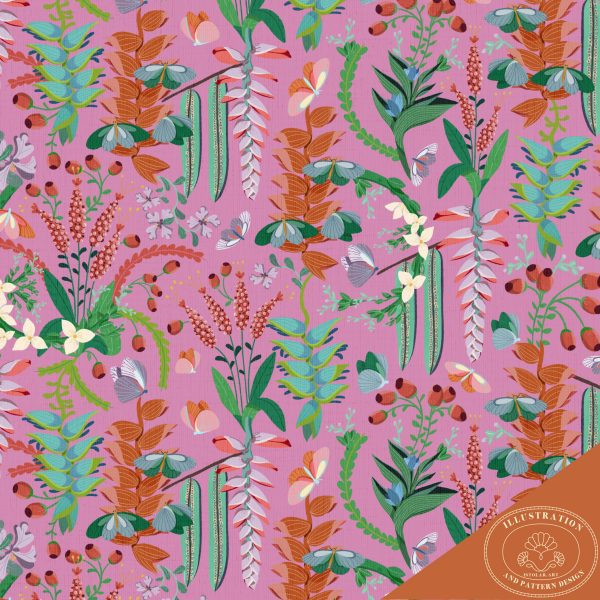
Designed as part of a coordinated tropical flower jungle collection, with tangled stem structures providing a strong visual signature and compatibility with companion botanical patterns.
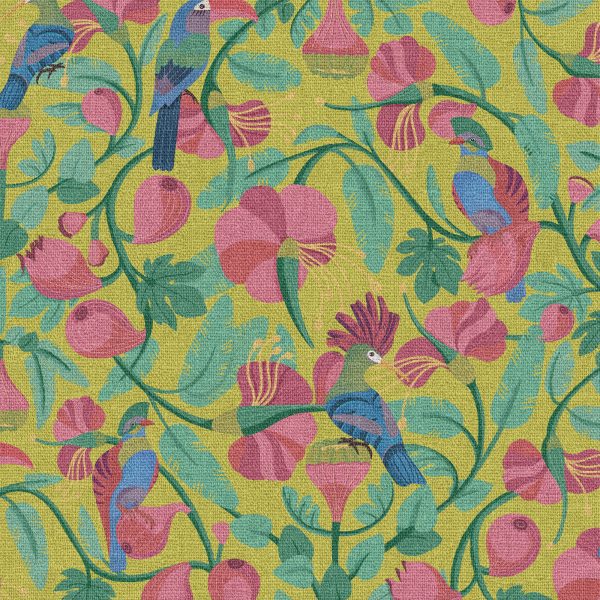
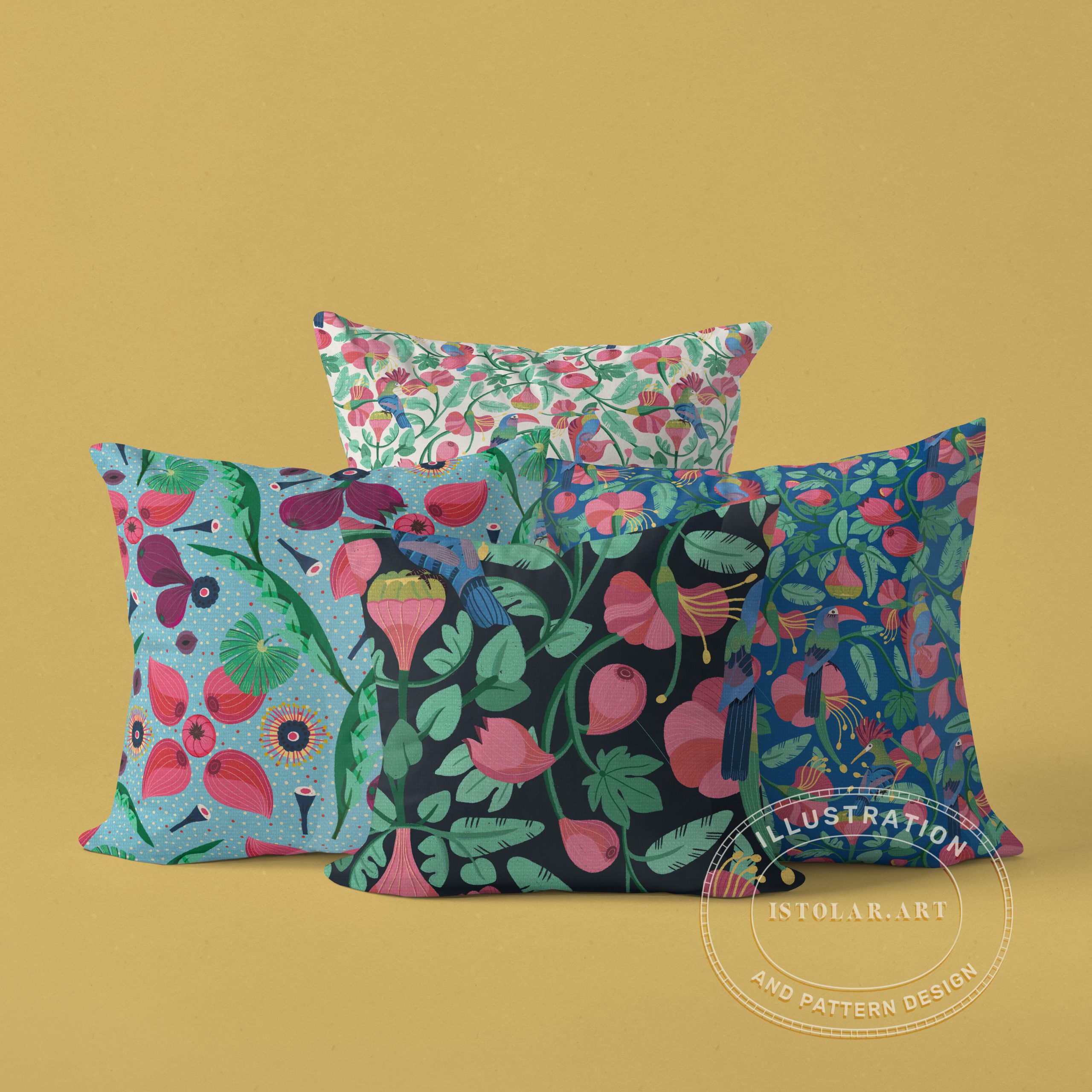
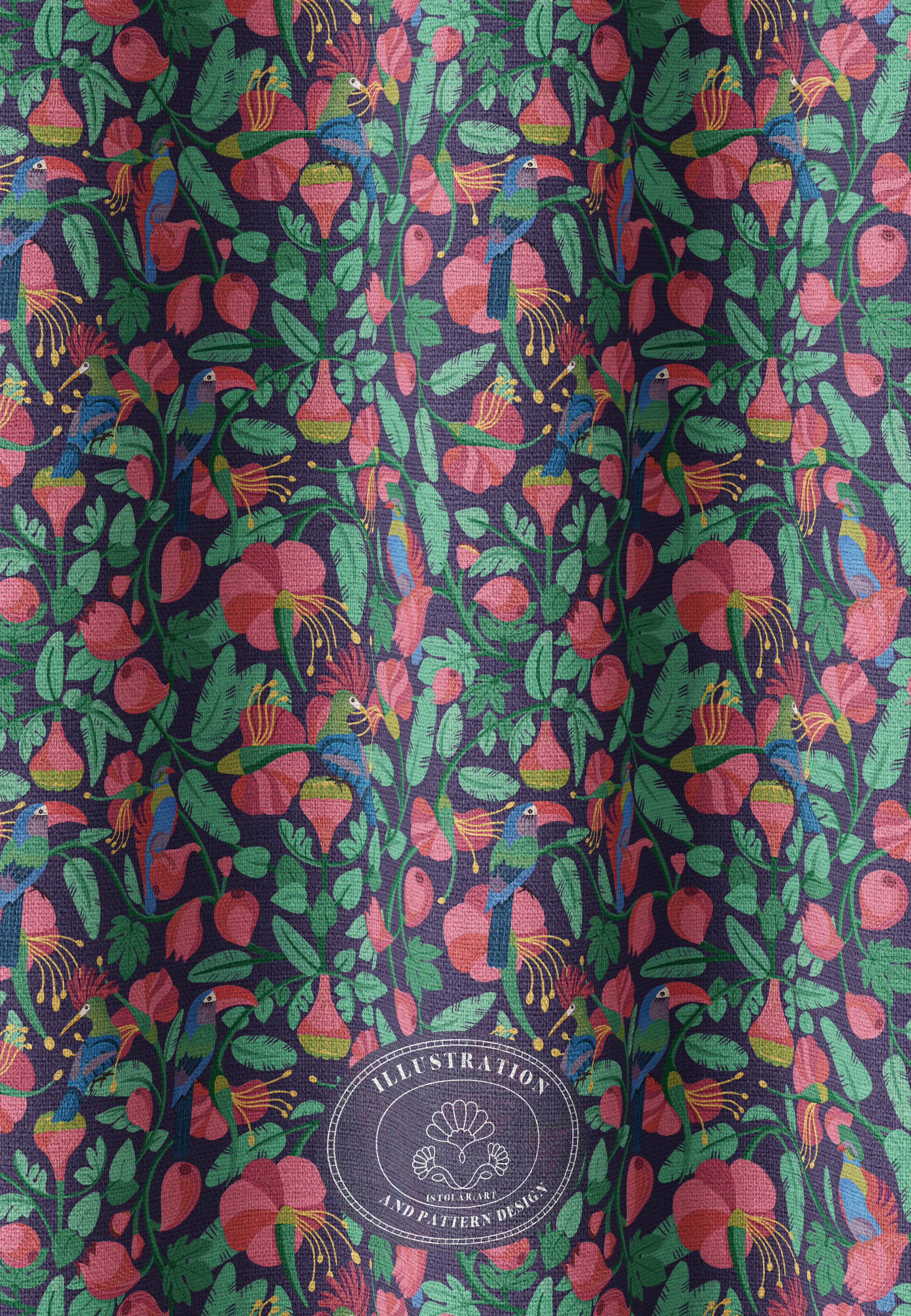
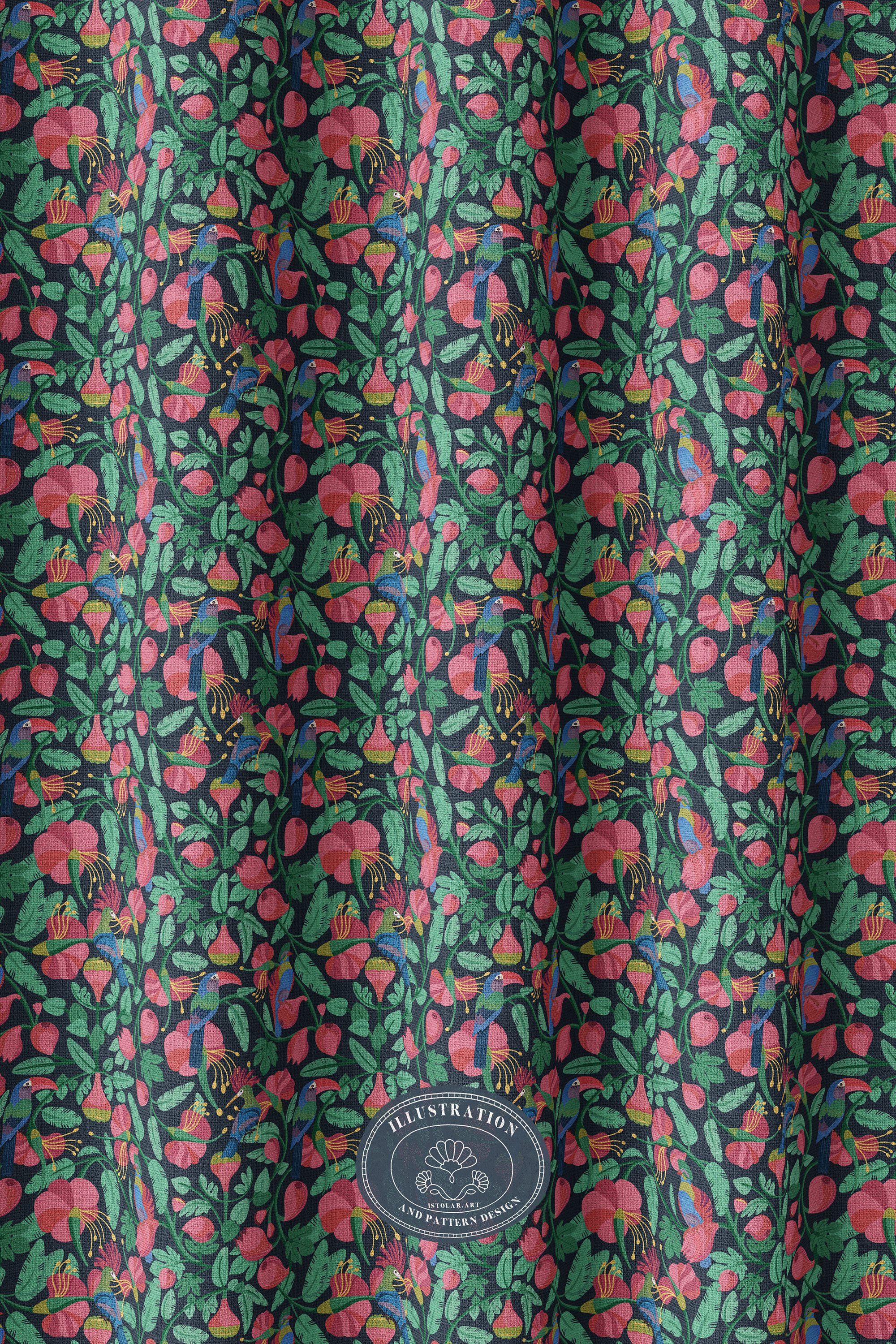
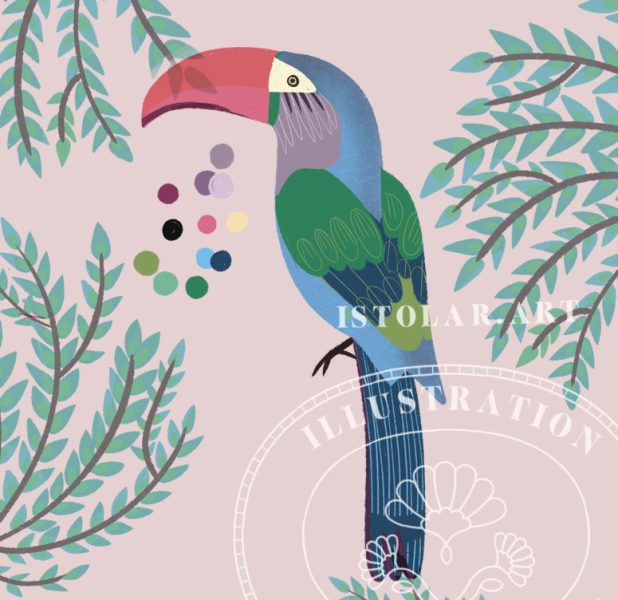
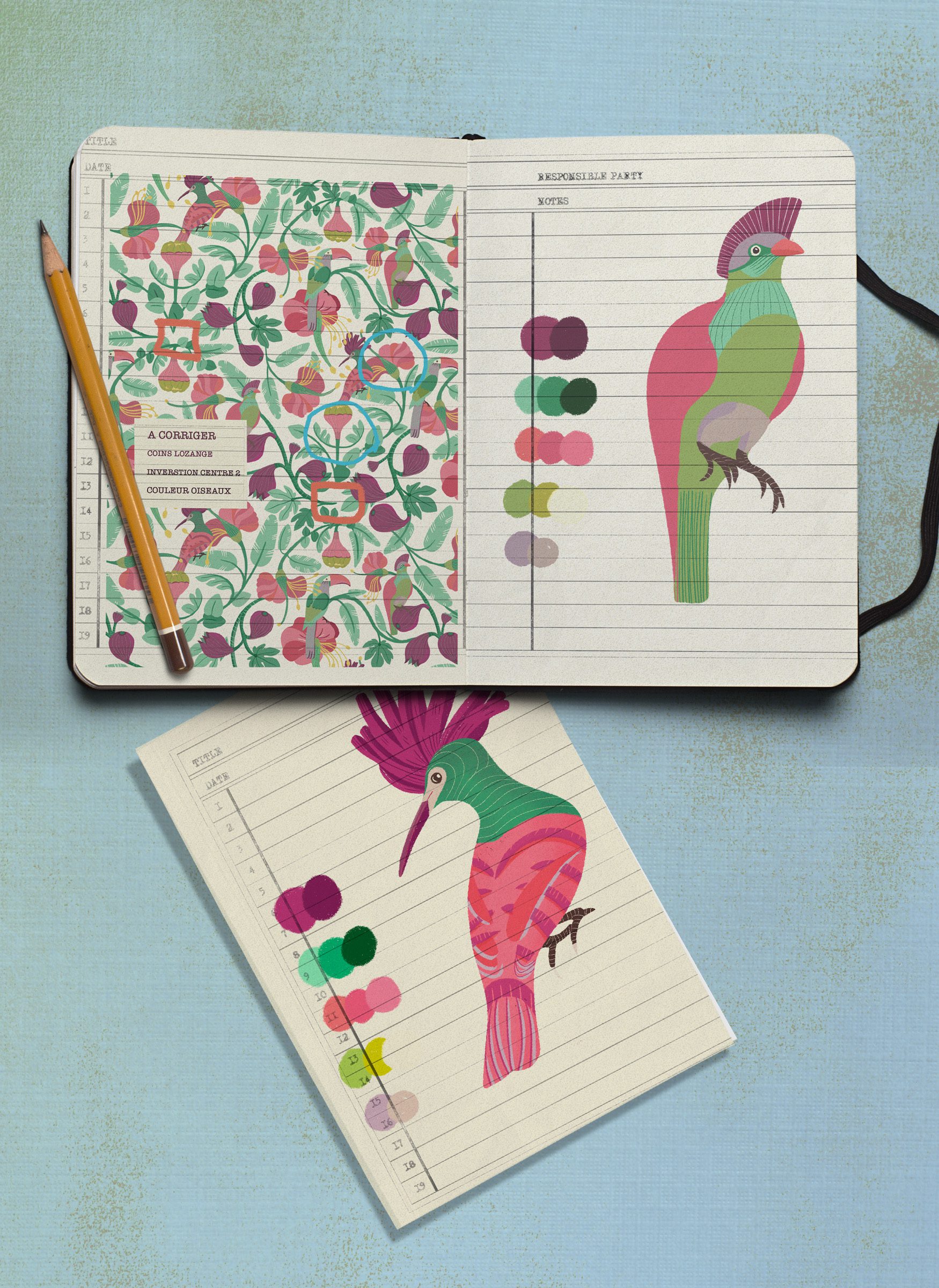
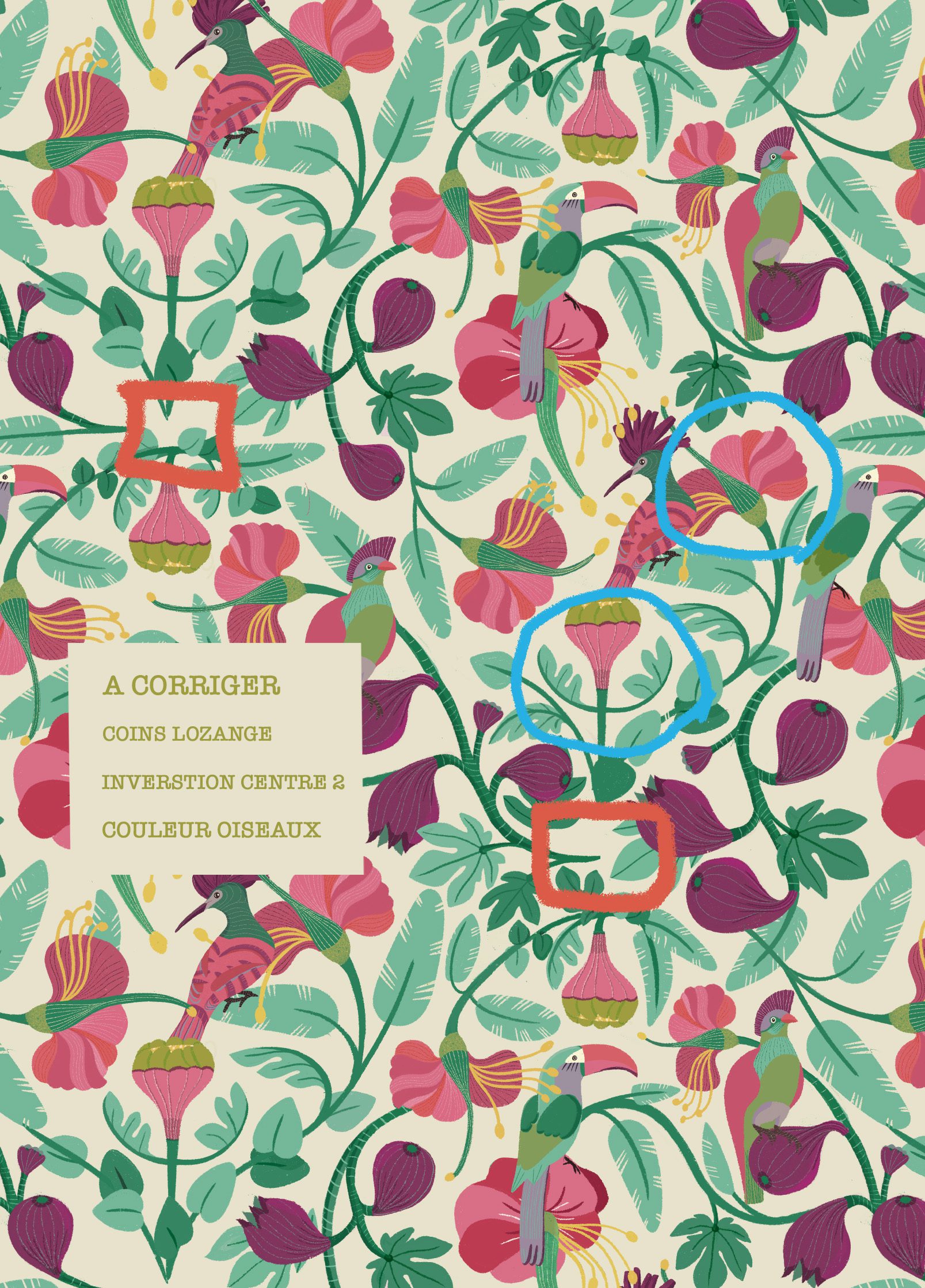
The bold, graphic silhouettes of the stylized tropical birds are perched among the flowing branches, the oversized blossoms, and the fig-like fruits, form a richly layered botanical scene. This seamless pattern, display a lush fig tree foliage and vibrant exotic birdlife.
Primary motifs, the tropical flowers and birds, are large enough to act as focal elements while the secondary elements (leaves, stems, buds, fruits) are scaled to support flow and visual cohesion. Tangled, vine-like stems create an interconnected structure that fills the surface evenly
The motif is editable. Each color is on a different layer so that any color modification can be made independently. It makes the design process much longer, but it is worth it 🙂
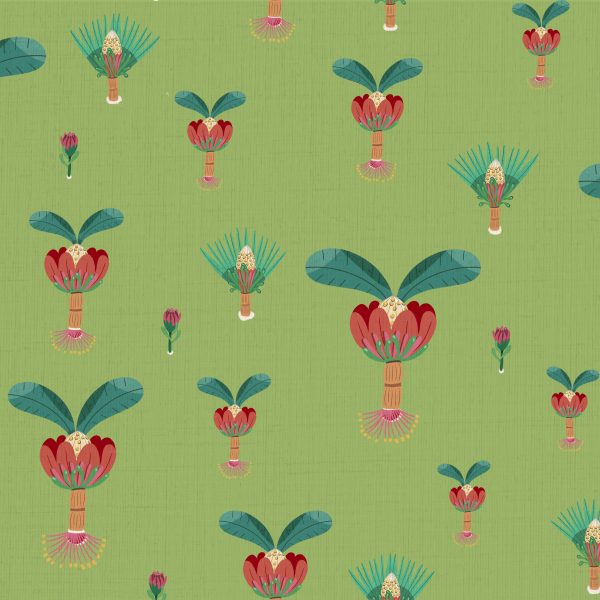
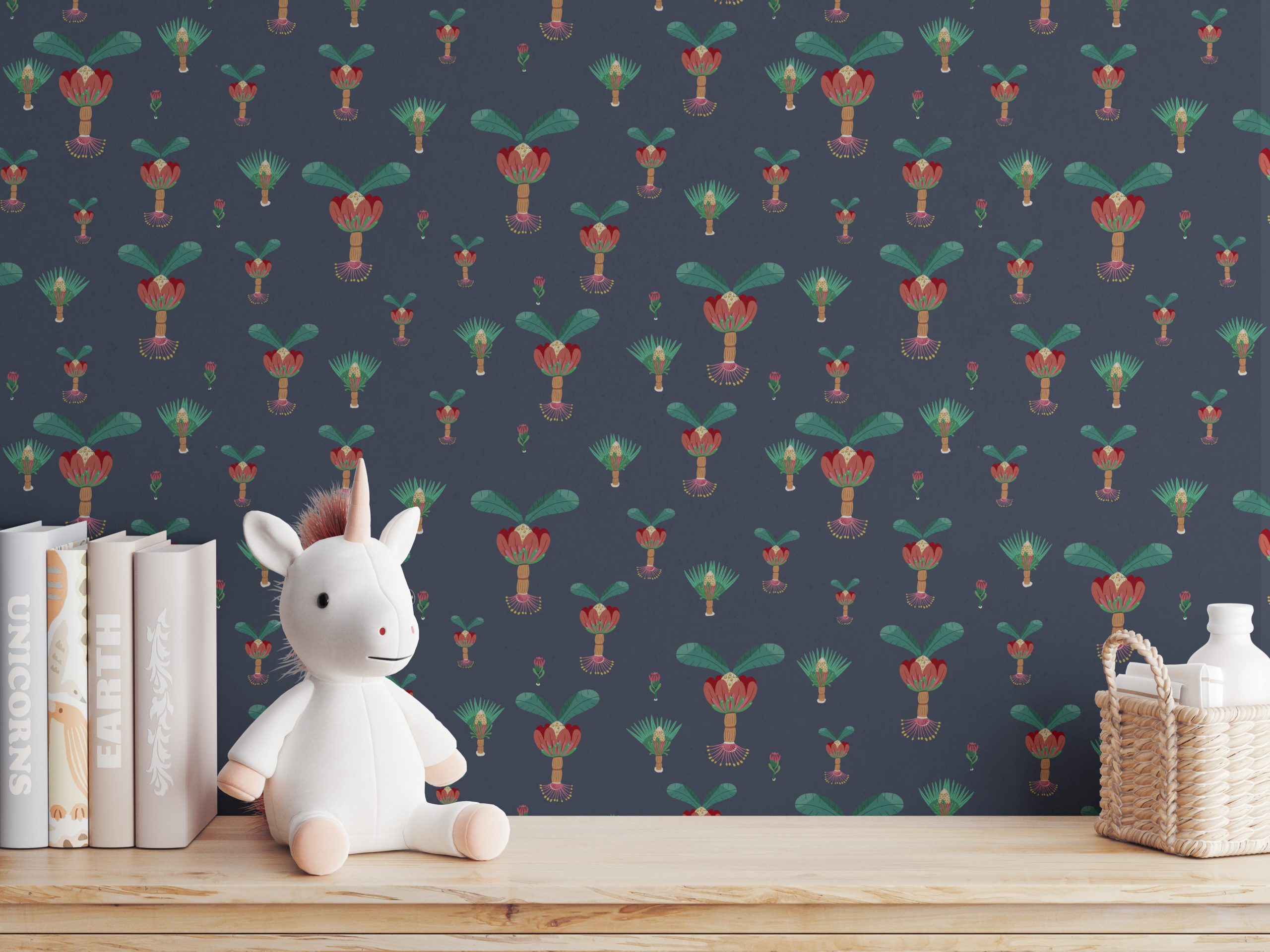
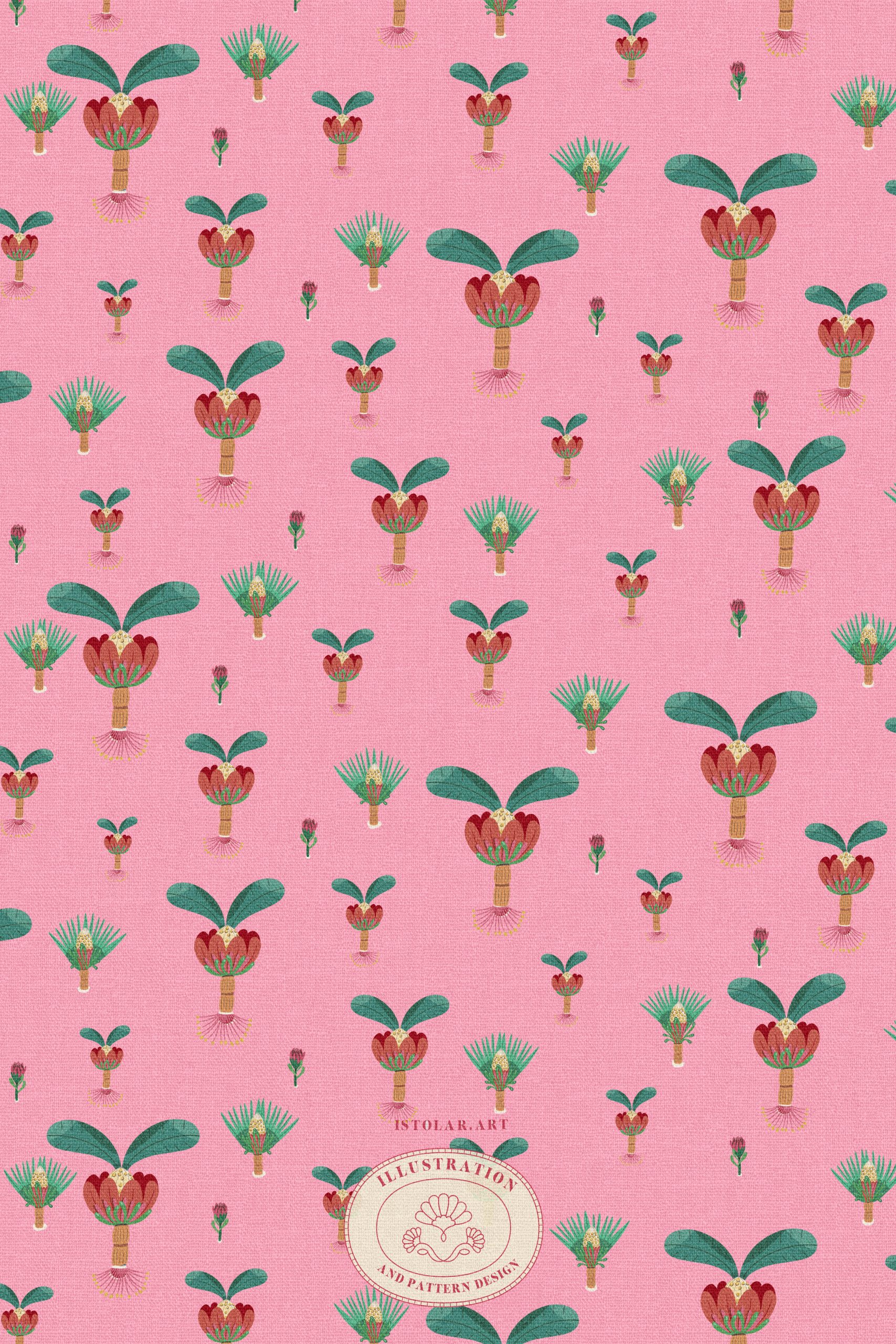
Trees, connected to one another, would communicate and exchange nutrients through a network of roots shaped like artichoke flowers — why not? (the illustrator makes the call).
Victor Hugo speaks of it:
“The sky of tin gives way to a sky of copper. Night takes a step. The things of shadow come alive. The trees speak softly to one another…”
Victor Hugo” Night”
« Le ciel d’étain au ciel de cuivre Succède. La nuit fait un pas. Les choses de l’ombre vont vivre. Les arbres se parlent tout bas… »
Victor Hugo” Nuitt”
A motif with fewer elements than the earlier components of this collection, and a deliberately very square repeat that nonetheless remains somewhat dense. I see it more as suited to gift wrap or small-scale fabric. It shares a similar vibe with a previous motif (I only realized this afterward — if it feels too redundant, I’ll exclude it from the collection). To be seen…
The design showcases bold, arched fronds with purple ribbing and woven terracotta trunks, punctuated by smaller fern-like icons that balance
This is a seamless half-drop (staggered) repeat with a strong vertical orientation. The motifs are arranged in alternating columns, creating a “wave” effect that softens the verticality and prevents the eye from seeing harsh, horizontal tiling lines. The large palm trees serve as anchors, while smaller architectural plant icons and fern fronds fill the negative space. The density is medium-high, offering a lush, densely forested feel that remains organized.
A staggered half-drop repeat that creates a rhythmic, diagonal flow across the surface.
A light and deep blue background creates a”Midnight Jungle” vibe !
EN: Savannah Spring” is a whimsical spot-cluster, half-drop repeat. The clean separation between motifs ensures a fluid, frictionless transition across the surface. This design introduces a generous use of negative space, allowing each illustrated cluster (composed of vibrant orange blooms, cool teal fronds, and soft gray safari animals)to breathe and remain distinct without overcrowding the composition.
FR: Cette déclinaison du motif “savane au printemps” délaisse son fond sombre et mystérieux au profit d’une base crème plus lumineuse, transformant le design en une composition botanique plus ouverte et printanière. Cette palette en tons clairs adoucit les motifs graphiques, conférant au motif une esthétique naturaliste. Un ensemble sophistiqué et baigné de lumière.
Suivant les fonds choisis, ce motif peut relever du ton vintage ou il peut tout aussi bien offrir une esthétique polyvalente et intemporelle, parfaitement adaptée au design de surface contemporain.
From blue to cream
This iteration of the “Savannah Spring” pattern swaps a moody base for a luminous cream background, transforming the design into a fresh, daytime botanical display. The high-key palette softens the graphic motifs, lending the pattern a naturalist vibe. Sophisticated and light filled.
This design offers a versatile, timeless aesthetic for contemporary surface design.
I tried to re-visite the “toile de Jouy” lay out with a more numeric style (with sharp lines).
EN: Designed as a staggered, all-over layout, made of a tossed vignette (each vignette is a whole mini eco-system) to create a sense of discovery across the surface. The composition is grounded in generous negative space, allowing the eye to move fluidly between details such as gray elephants, zebras, hypo and Savannah fauna without visual fatigue.
The palette, is made of sage and emerald greens, mustard-gold sand, and slate-lavender accents
FR la structure est faite de vignettes paysagères réparties en quiconce. L’agencement intègre des espaces négatifs généreux, permettant au regard de circuler avec fluidité entre la faune et la flore de la savane.
Le motif fusionne une illustration volontairement plate (pas de volume, juste des textures légères) à des contours nets.
L’ensemble dégage une esthétique à la fois intemporelle et actuelle, peut être évocatrice d’images d’enfances dont tout le monde peut cependant s’emparer.
La palette chromatique associe des verts-sauge et émeraude, un sable jaune moutarde, de roches lavande-ardoise et d’une eau bleu poudré,
EN: MY diamond repeat pattern features mirrored tigers frame a palm tree, interlocked with bold fan-like jungle foliage. It is organized in a structured, vertical-mirrored alignment that creates a series of interlocking diamond-shaped “rooms”. The aesthetic draws heavily from heritage folk ornament and muralist traditions, textures elements updated with clean (sharp edges), contemporary line-work.
FR: Mon motif en répétition losange met en scène des tigres en miroir encadrant un palmier, entrelacés avec un feuillage de jungle audacieux en forme d’éventail. Il est construit sur un alignement symétrique, structuré selon un axe vertical, créant une succession de « pièces ». L’esthétique s’inspire des ornements folkloriques patrimoniaux et des traditions muralistes, tout en actualisant les éléments texturés grâce à un tracé contemporain, net, aux contours francs.
EN: The mirrored tigers design feels graphic and modern, but it draws on ancient visual systems associated with protection, balance, and power which could explain why mirrored tigers feel immediately “iconic” even to Western audiences.
This structure can be found in contemporary illustration as well as in Indian classic images, where they appear in various art forms, from terracotta to miniature painting to textiles. At least, that was the archetypal mental image I had in mind prior to making this repeat
As a matter of fact I can say that, in a rather intuitive than intellectualized way, this design reinterprets an ancient visual grammar through a contemporary lens. The motif is simplified, flattened, and placed within a modern repeat system, translating ceremonial iconography into a graphic surface pattern. Stripped of narrative hierarchy yet retaining its symbolic charge, the mirrored tiger becomes both ornament and icon, as a dialogue between historical imagery and contemporary design language.
FR: Si le motif des tigres en miroir semble résolument graphique et moderne, il puise pourtant sa force dans des systèmes visuels ancestraux associés à la protection, à l’équilibre et au pouvoir. Cela explique sans doute pourquoi cette figure possède un caractère “iconique” immédiat, même pour un public occidental.
On retrouve cette structure symétrique aussi bien dans l’illustration contemporaine que dans l’imagerie classique indienne, où elle traverse les arts décoratifs, de la terre cuite à la peinture miniature jusqu’aux textiles. C’est précisément cette image mentale archétypale que j’avais à l’esprit en concevant ce raccord.
À vrai dire, de manière plus intuitive qu’intellectualisée, ce design réinterprète une grammaire visuelle ancienne à travers un prisme contemporain. Le motif est ici simplifié, aplati et intégré dans un système de répétition moderne, traduisant ainsi une iconographie cérémonielle en un motif de surface graphique. Dépouillé de sa hiérarchie narrative tout en conservant sa charge symbolique, le tigre en miroir devient à la fois ornement et icône — un véritable dialogue entre imagerie historique et langage formel actuel.
EN
In art history, two animals facing each other is a longstanding decorative/compositional device known as confronted animals. This symmetrical pairing often suggests balance, duality, protection, or guardianship. In many early contexts, it’s linked to ritual or symbolic meanings, not just surface decoration.
If the visual grammar is identical, the mirroring tigers appear in varying cultural creations. My intention here is to quickly explore why the mirrored tiger feels immediately “iconic” even to Western audiences. It seems that more or less consciously we’ve seen them all over the places
In China and East Asia, mirrored tiger are found on temple reliefs, architectural decoration, embroidered rank badges, folk textiles and paper cuttings. They are often associated with military power, protection, warding off evil
In Persia and the Islamic World, the tiger sometimes blends with lion imagery, the species varies but the confronted animal logic, but the visual grammar is identical, and can be a symbol of royal authority, and cosmic order
In Central Asia, tigers as well as snow leopards are found on felt rugs, metalwork, textiles. They are usually emblems of power and clan symbols.
In Southeast Asia (Thailand, Indonesia, Cambodia) they are also found on temple reliefs, batik, ceremonial textiles: generally influenced by Indian and Chinese visual systems, but with local flavor. From there, the specific motif becomes more decorative and surface-driven, closer to modern pattern design logic
In Europe Lions are generally dominant, but the structure is identical. They are found within medieval bestiaries groups and renaissance textiles generally conveying exotic power and dominance.
FR
En histoire de l’art, la représentation de deux animaux se faisant face est un procédé décoratif et compositionnel ancien connu sous le nom d’animaux affrontés. Ce jumelage symétrique suggère souvent l’équilibre, la dualité, la protection ou la garde. Dans de nombreux contextes anciens, il est lié à des significations rituelles ou symboliques qui dépassent la simple décoration de surface.
Si la grammaire visuelle reste la même, les tigres en miroir apparaissent dans des créations culturelles très variées. Mon intention est ici d’explorer brièvement pourquoi le tigre en miroir semble immédiatement “iconique”, même pour un public occidental. Il semble que, plus ou moins consciemment, nous en ayons déjà vu partout :
* En Chine et en Asie de l’Est : les tigres en miroir se retrouvent sur les reliefs des temples, les décors architecturaux, les insignes de rang brodés, les textiles folkloriques et les papiers découpés. Ils sont souvent associés à la puissance militaire, à la protection et à la fonction de repousser les forces du mal.
*En Perse et dans le monde islamique : le tigre se confond parfois avec l’imagerie du lion. Bien que l’espèce varie, la logique des animaux affrontés et la grammaire visuelle sont identiques, symbolisant souvent l’autorité royale et l’ordre cosmique.
*En Asie centrale : les tigres, tout comme les léopards des neiges, figurent sur des tapis de feutre, l’orfèvrerie et les textiles. Ils sont généralement des emblèmes de pouvoir et des symboles claniques.
*En Asie du Sud-Est (Thaïlande, Indonésie, Cambodge) : ils sont présents sur les reliefs de temples, les batiks et les textiles cérémoniels. Influencés par les systèmes visuels indiens et chinois, ils possèdent toutefois une saveur locale. À partir de là, le motif devient plus décoratif, préfigurant la logique du design de motifs moderne.
*En Europe : si le lion est généralement dominant, la structure demeure identique. On les retrouve dans les bestiaires médiévaux et les textiles de la Renaissance, véhiculant généralement une idée de puissance exotique et de domination.
“With this pattern, I sought to create a composition with delicate line work that is both modern, graphic, and poetic (with some occasional vintage accent depending on the background color effect), The animals and plants read as stylized icons with fine interior detailing. I arranged the narrative vignettes in aconversational way, with no strict symmetry, quite the contrary, and I used negative spaces to allow each scene to breath. (I already had a few overlapping, packed hero patterns in the ” green cathedral / jungle”collection at that time), I needed to create a more airy repeat.)
“Inspired by the airy, illustrative elegance of Japanese Echino (with no geometrical shapes though) textiles, this pattern uses a tossed elements’ system.
It was paramount for me that the placing of the elements allows a “wandering eye” effect. The layout mimics a tossed repeat that feels accidental but is technically precise, with no rigid, mirrored symmetry but a search for asymmetrical balance