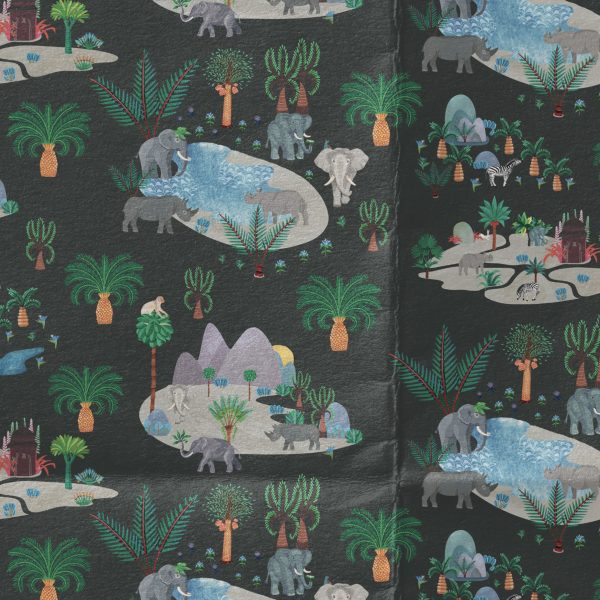
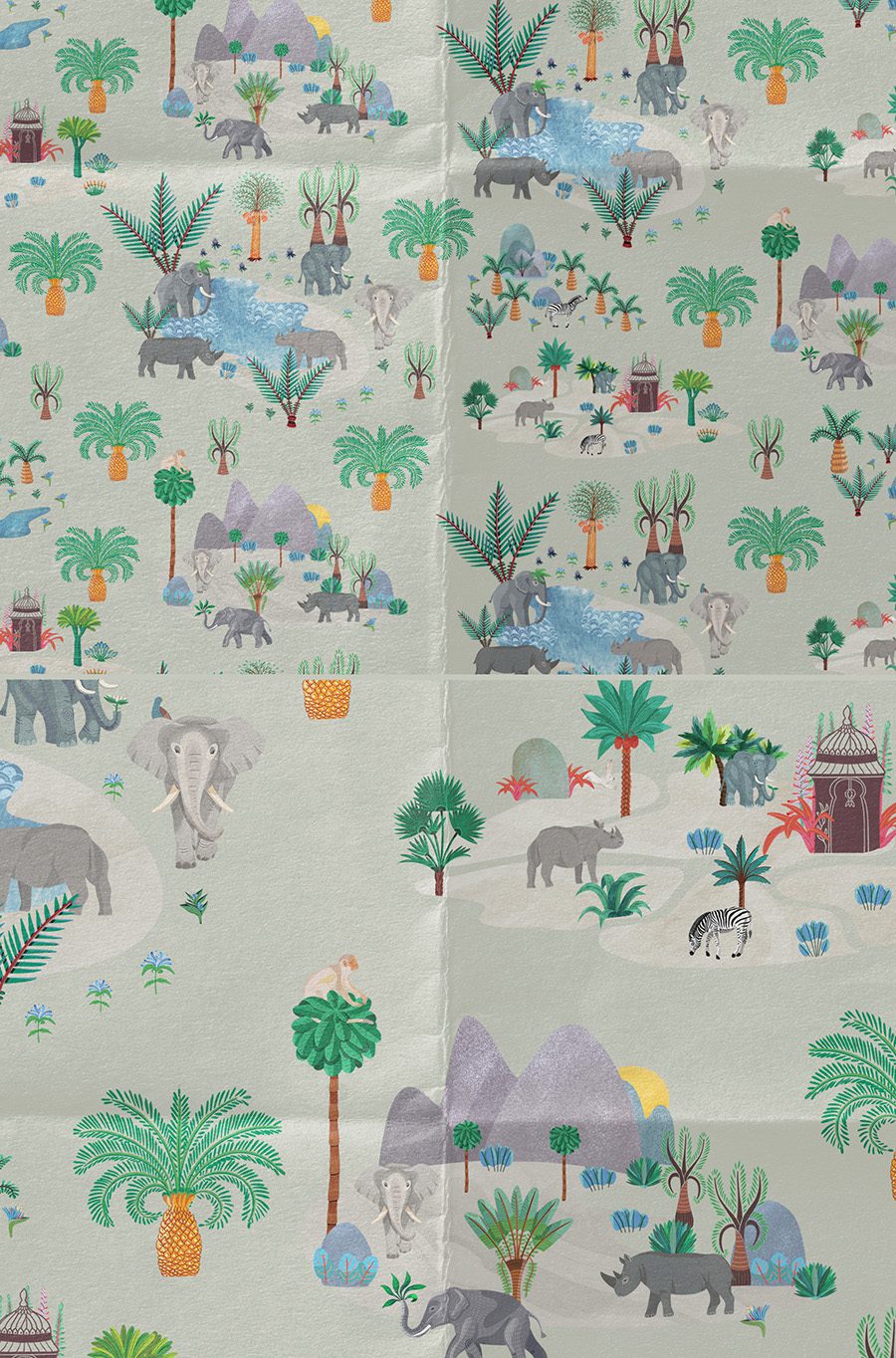
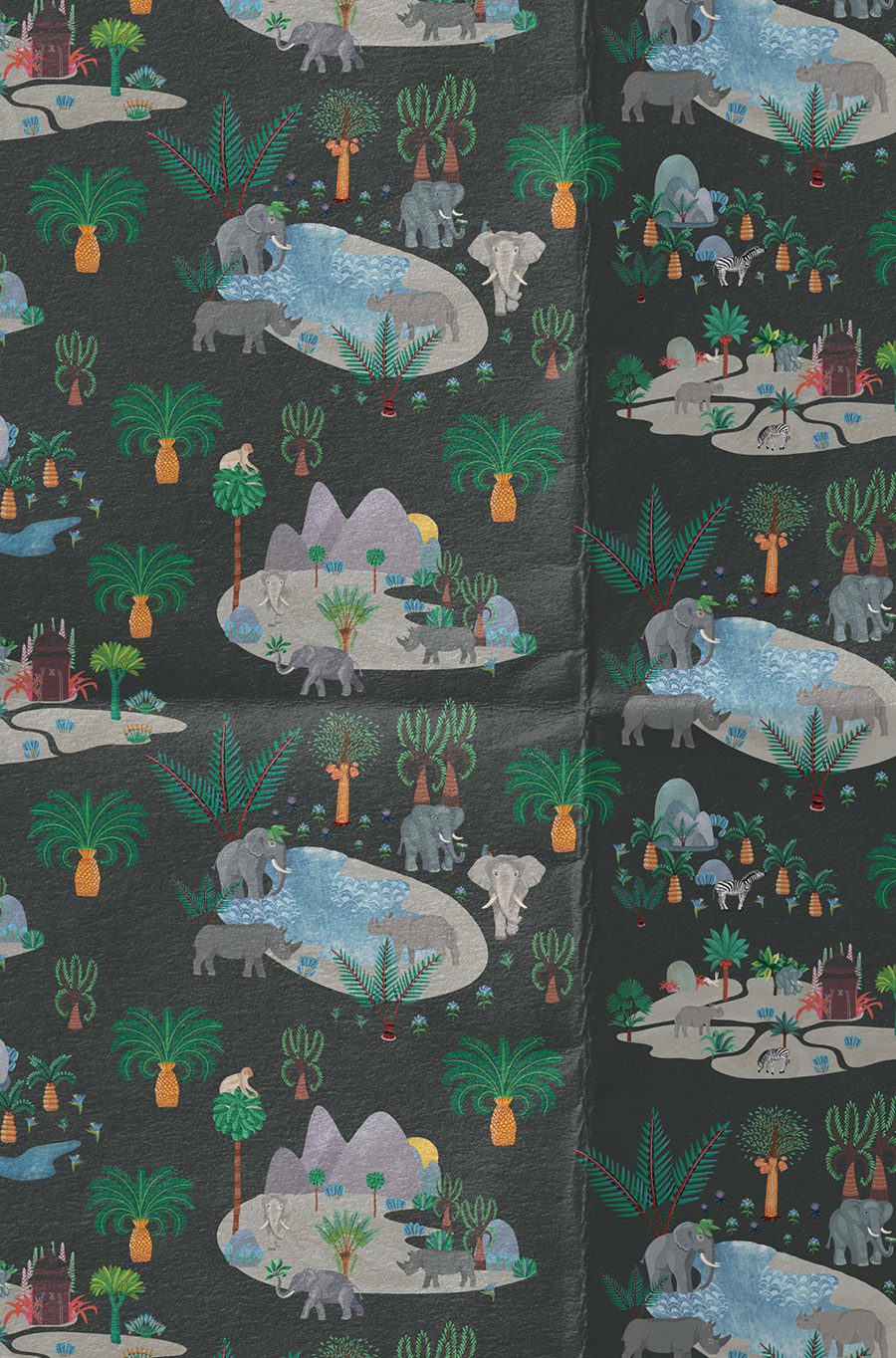
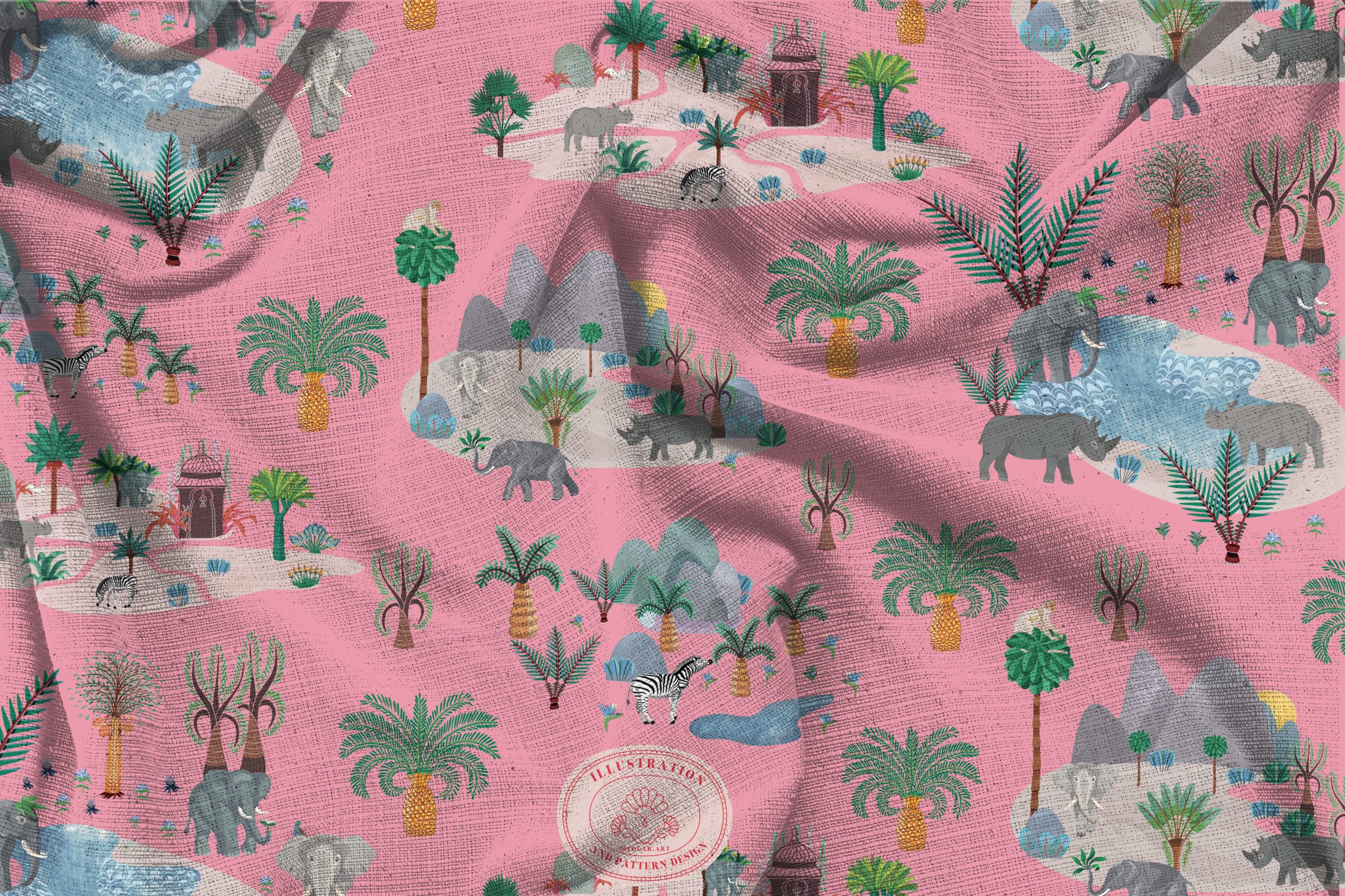
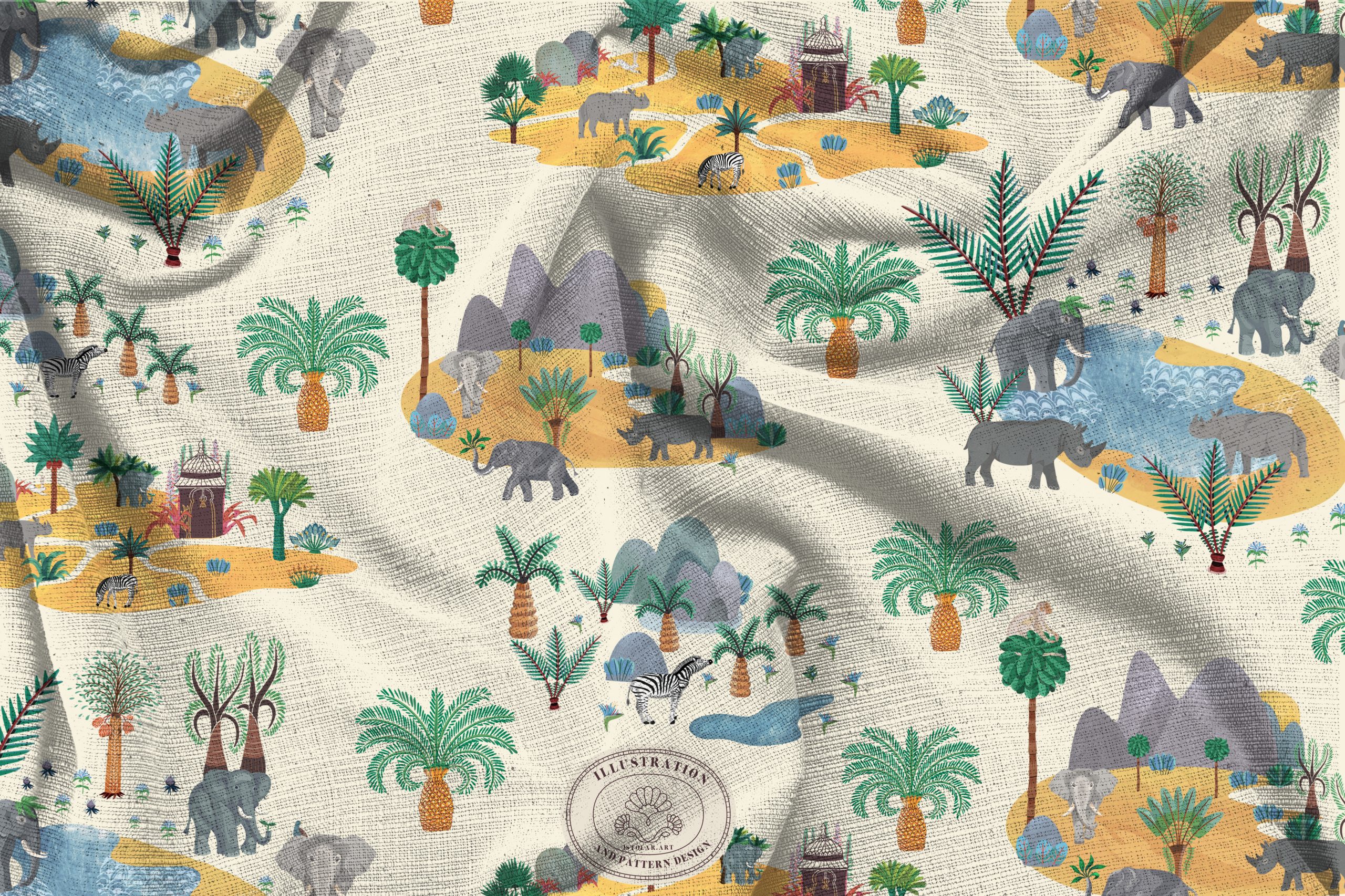
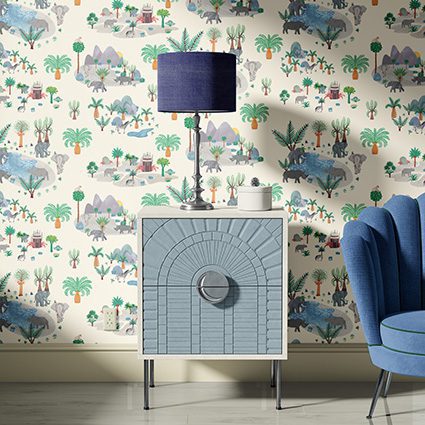
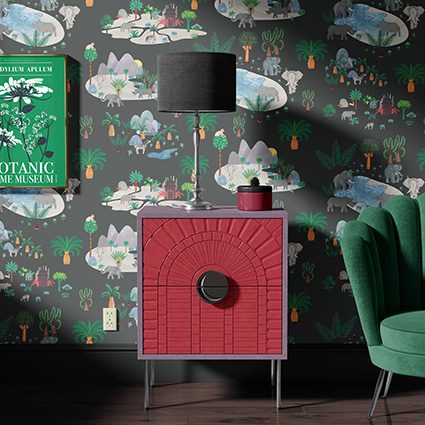
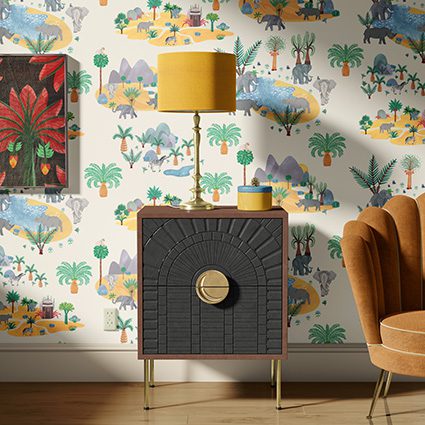
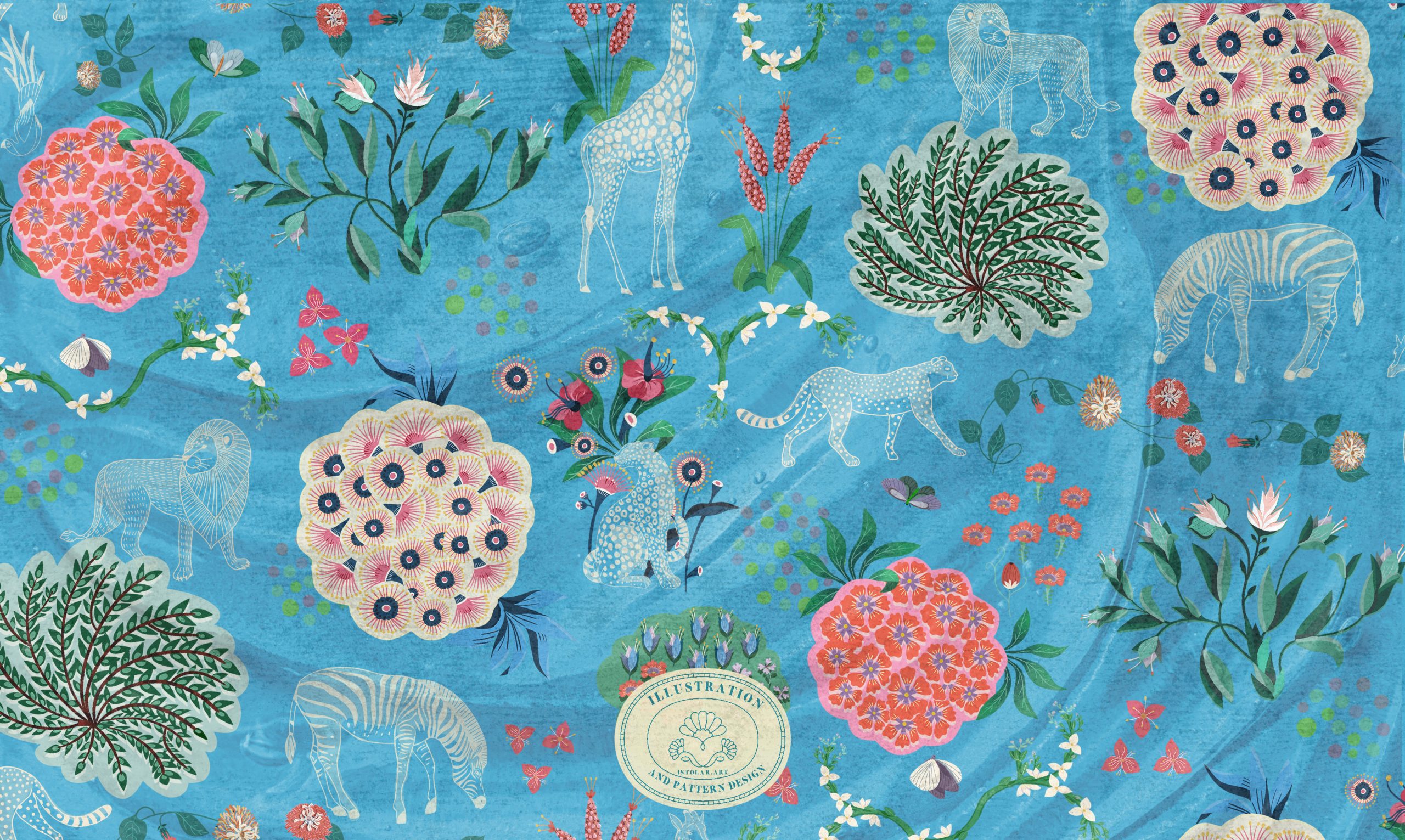
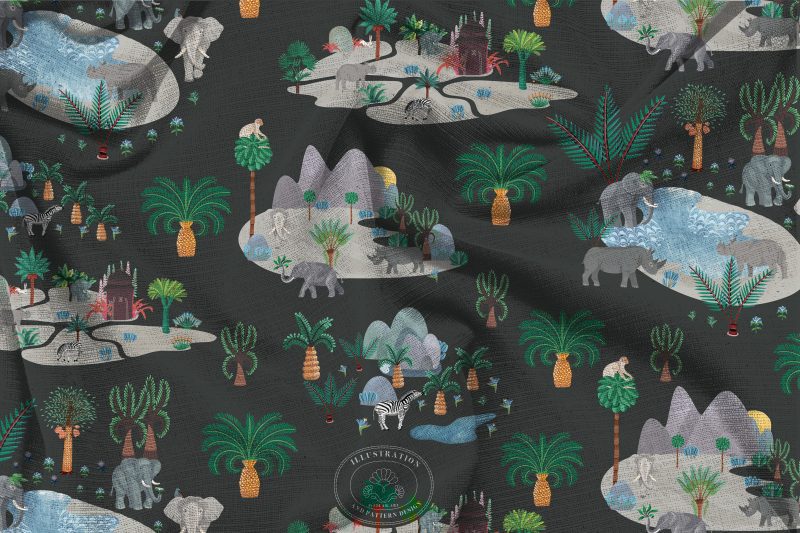
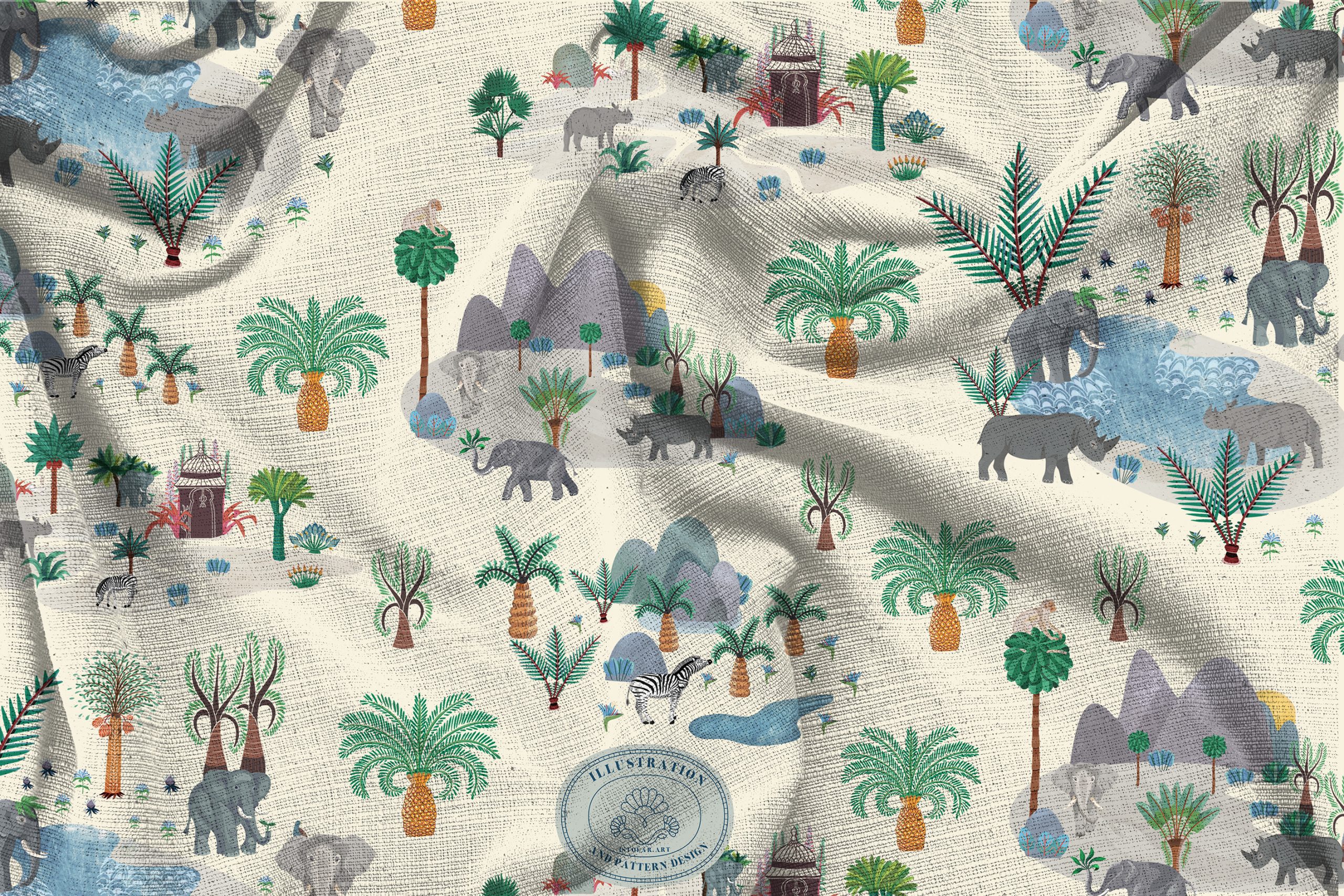
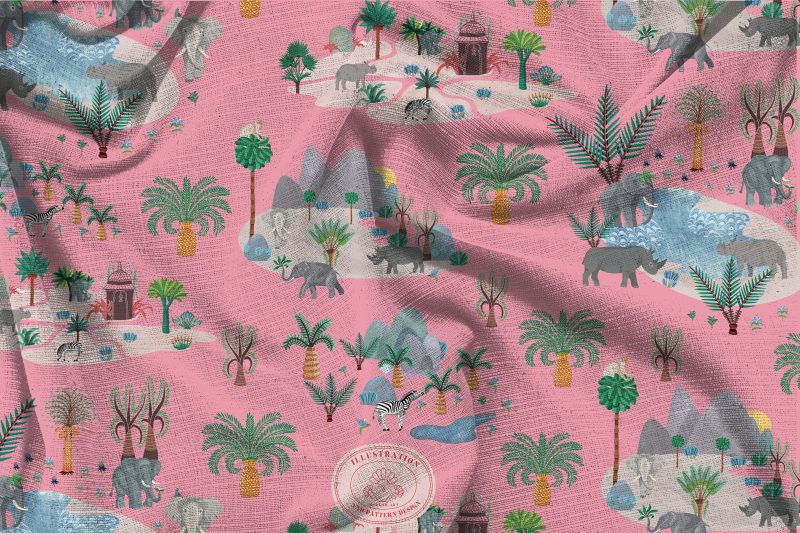
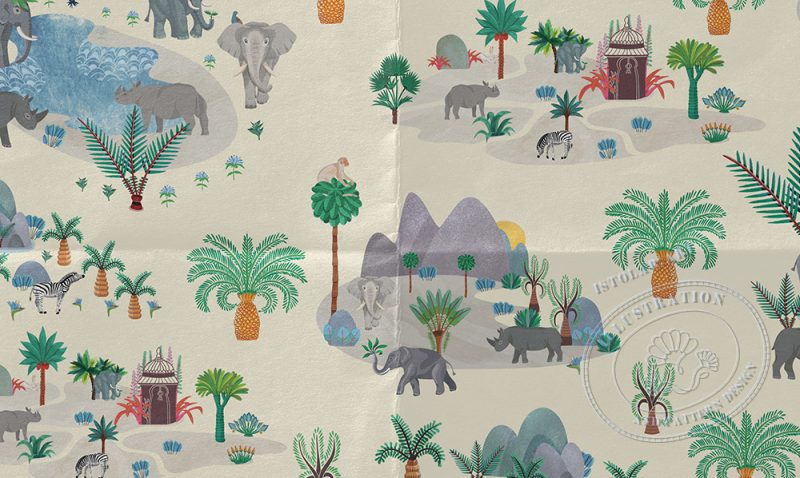
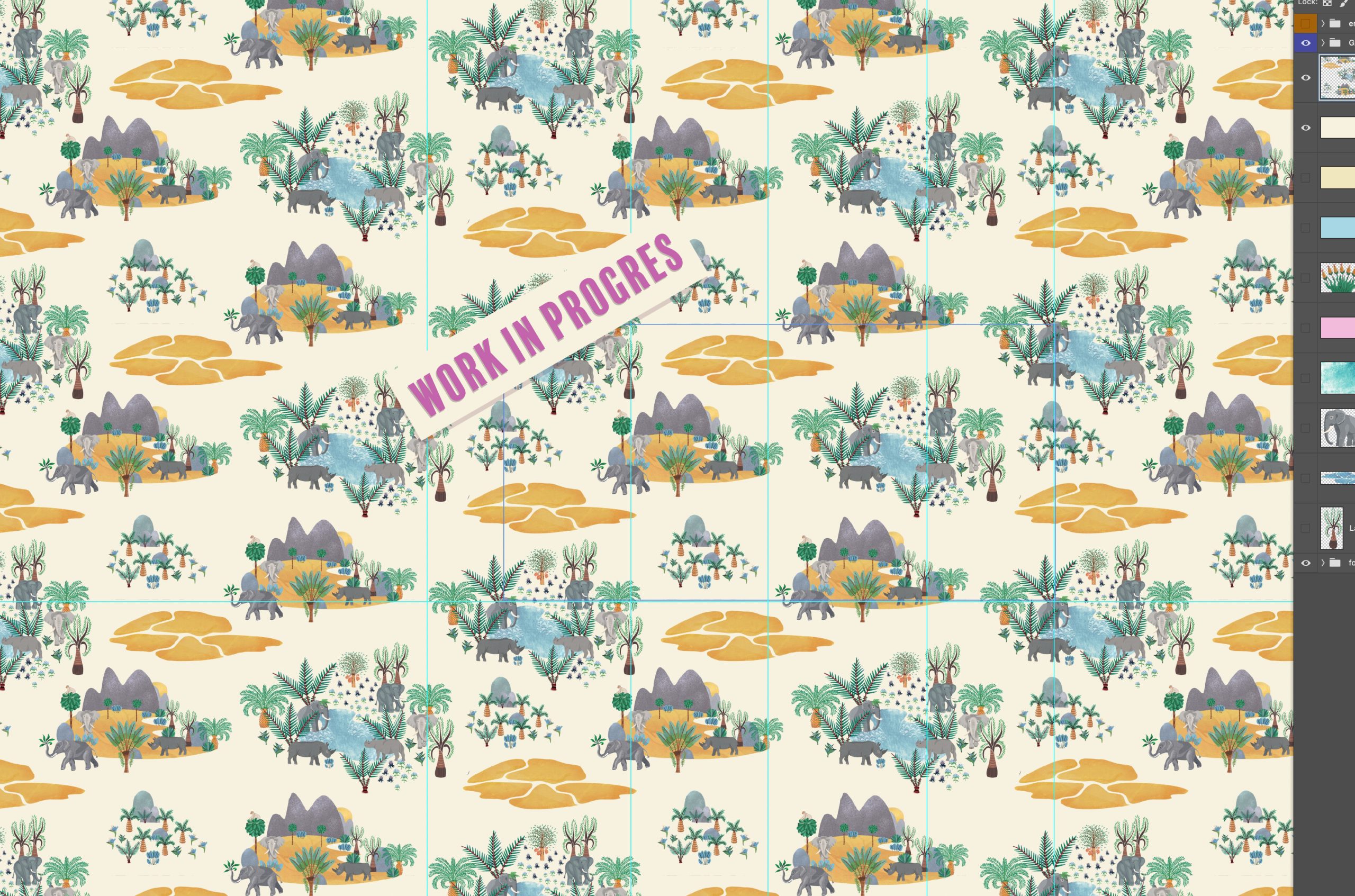
I tried to re-visite the “toile de Jouy” lay out with a more numeric style (with sharp lines).
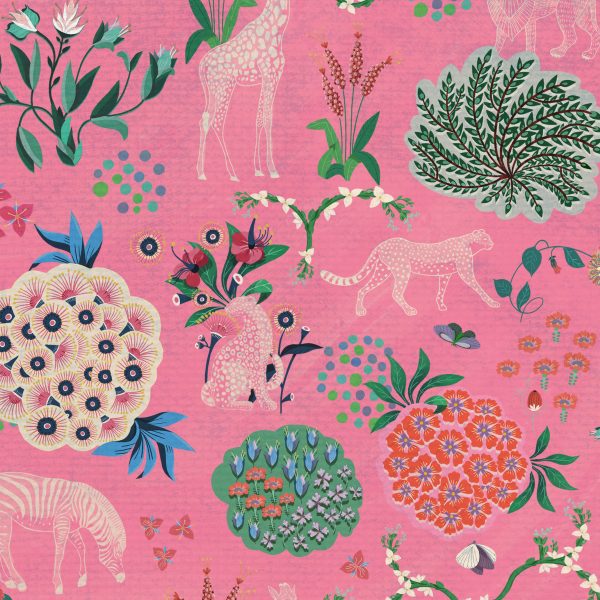
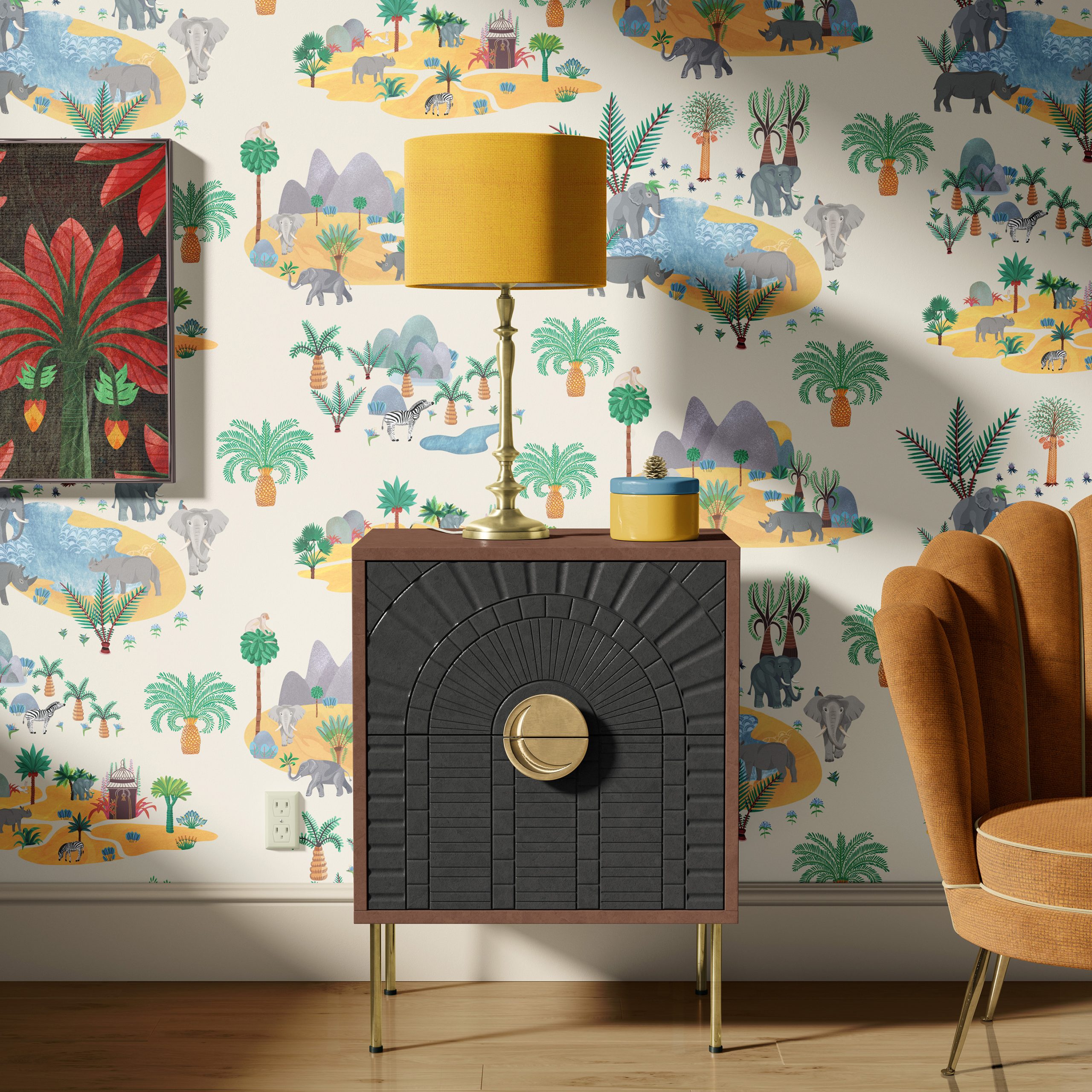
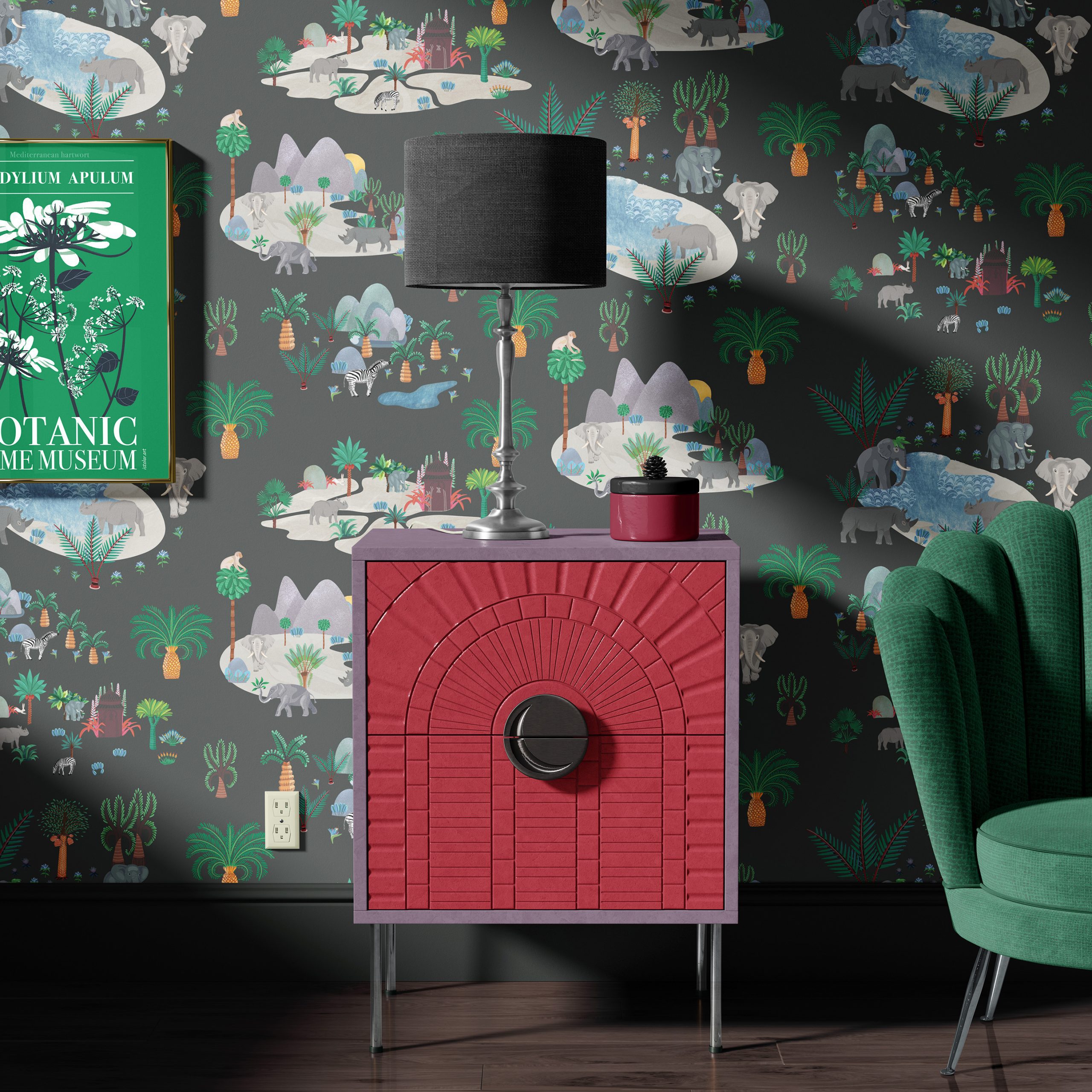
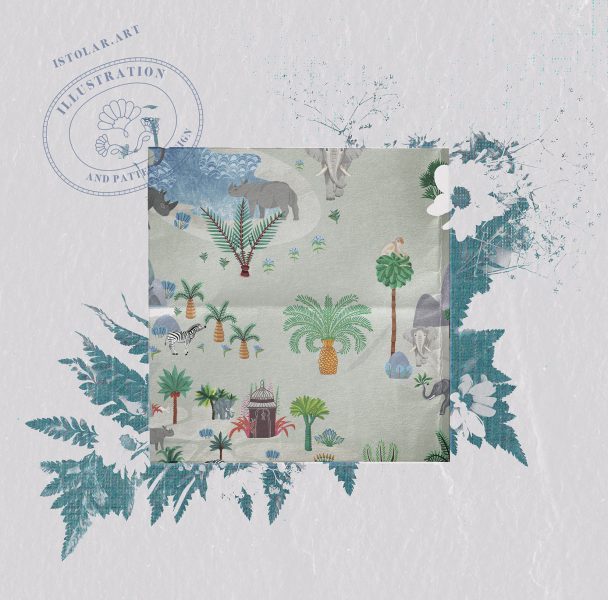
EN: Designed as a staggered, all-over layout, made of a tossed vignette (each vignette is a whole mini eco-system) to create a sense of discovery across the surface. The composition is grounded in generous negative space, allowing the eye to move fluidly between details such as gray elephants, zebras, hypo and Savannah fauna without visual fatigue.
The palette, is made of sage and emerald greens, mustard-gold sand, and slate-lavender accents
FR la structure est faite de vignettes paysagères réparties en quiconce. L’agencement intègre des espaces négatifs généreux, permettant au regard de circuler avec fluidité entre la faune et la flore de la savane.
Le motif fusionne une illustration volontairement plate (pas de volume, juste des textures légères) à des contours nets.
L’ensemble dégage une esthétique à la fois intemporelle et actuelle, peut être évocatrice d’images d’enfances dont tout le monde peut cependant s’emparer.
La palette chromatique associe des verts-sauge et émeraude, un sable jaune moutarde, de roches lavande-ardoise et d’une eau bleu poudré,
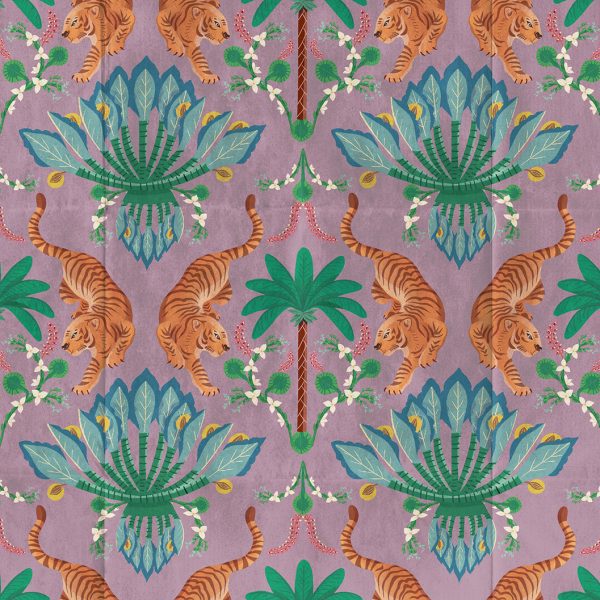
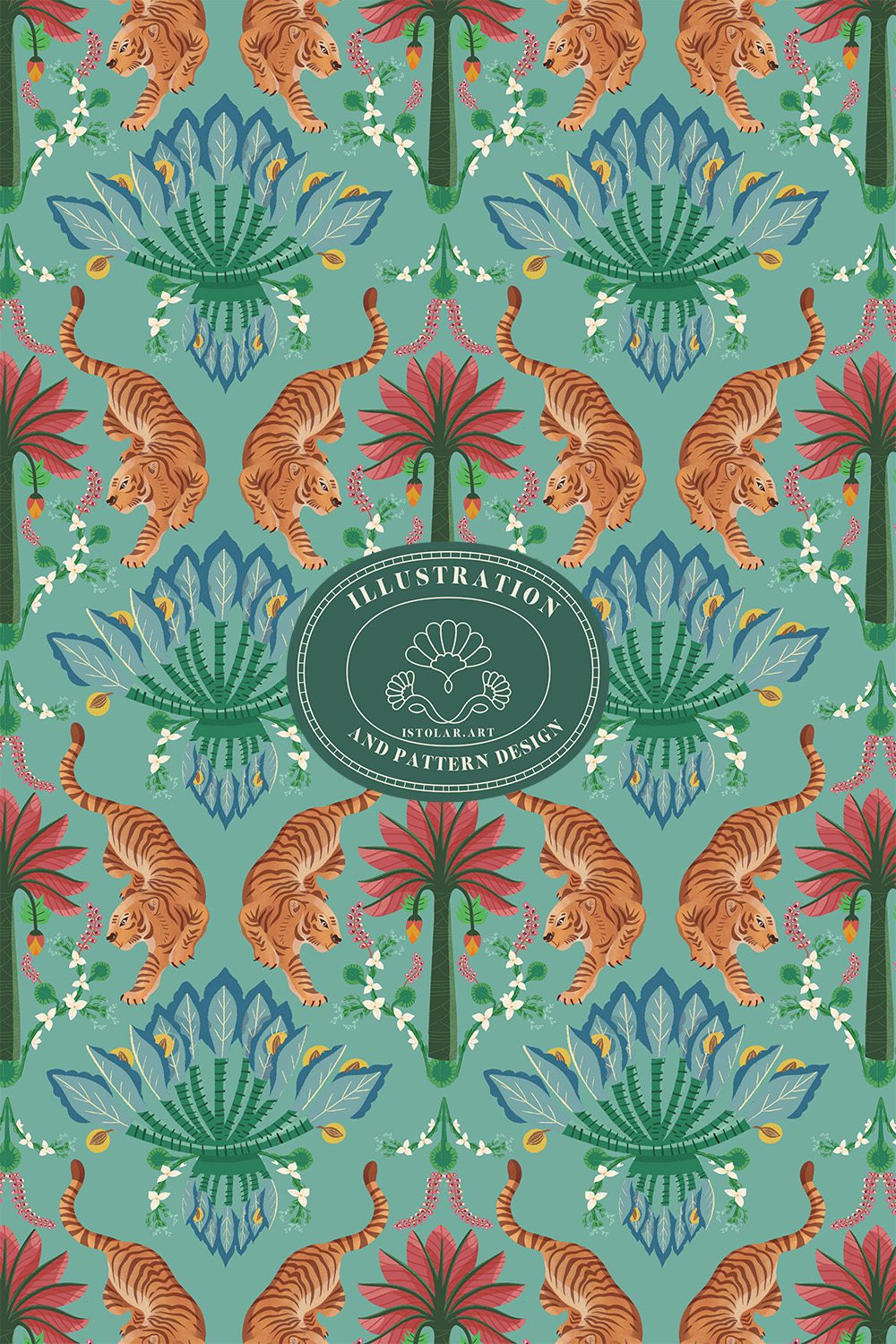
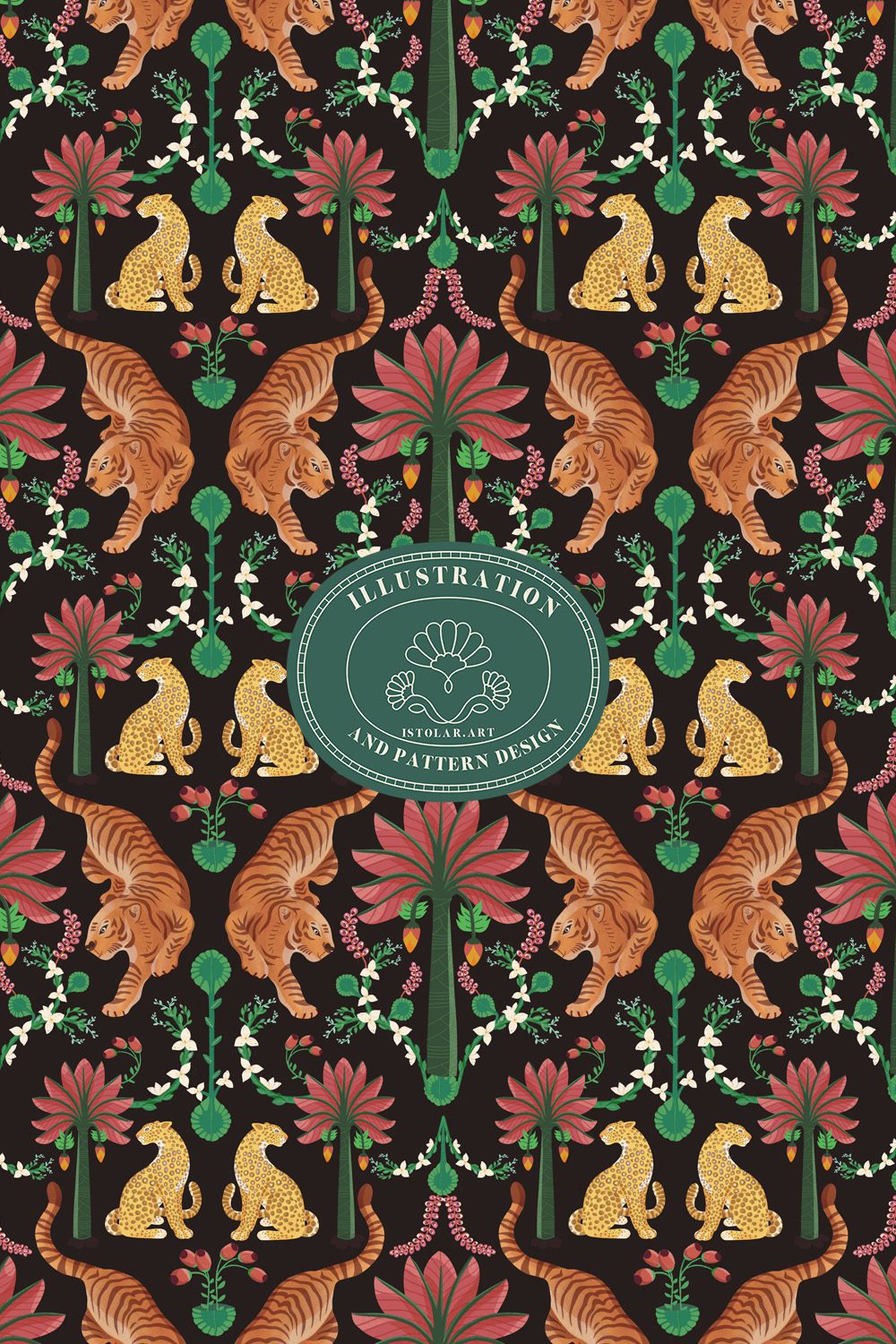
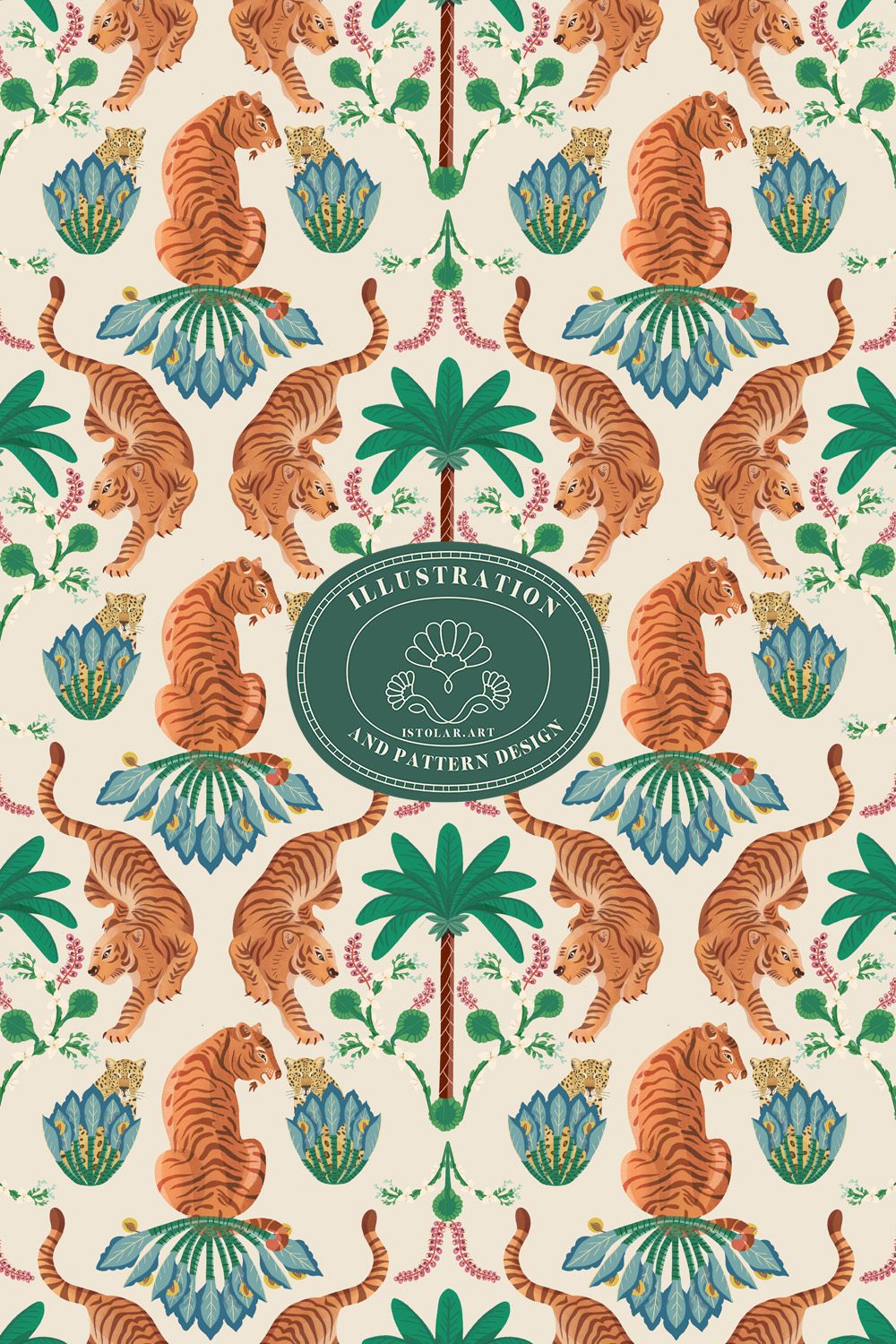
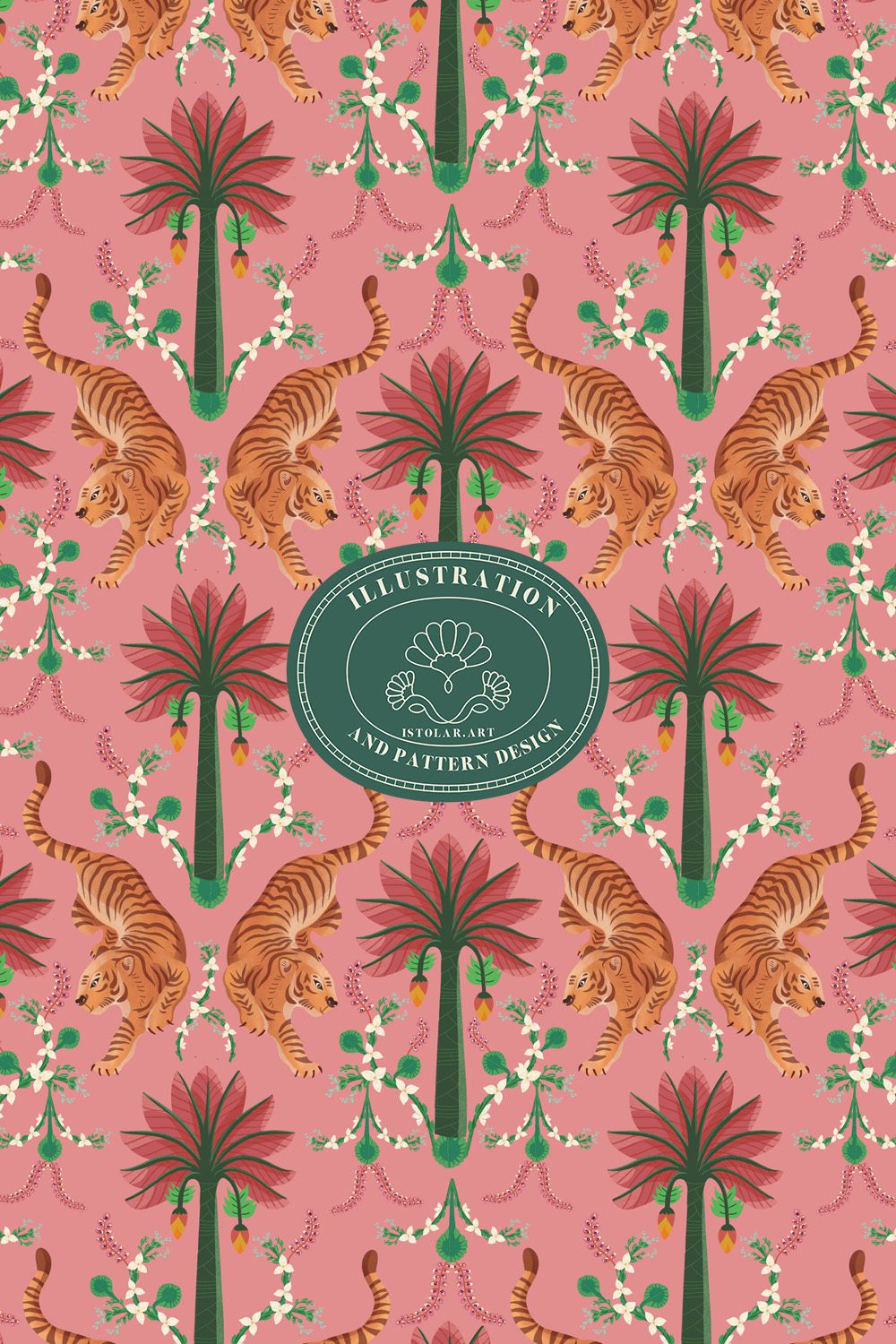
FR: Le motif met en scène des tigres en miroir encadrant un palmier, entrelacés avec un feuillage de jungle en forme d’éventail. L’alignement est symétrique, structuré selon un axe vertical. Apres realisation, je dirais que l’esthétique des motifs s’enracine dams l esthétique des ornements folkloriques patrimoniaux et des traditions muralistes.
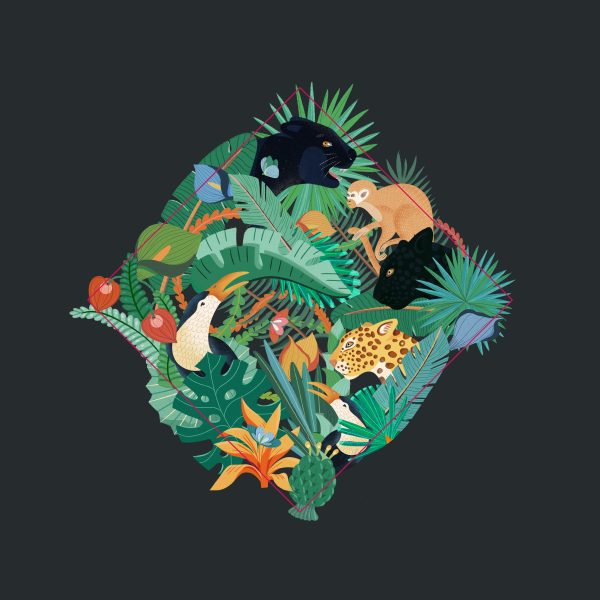
EN: The diamond repeat pattern features vertically mirrored tigers framing palm trees, interlocked with bold fan-like jungle foliage. It creates a classic series of interlocking diamond-shaped “rooms”. I would say that the aesthetic draws from heritage folk ornament and muralist traditions.
FR: Si le motif des tigres en miroir semble résolument graphique et moderne, il puise pourtant sa force dans des structures visuelles anciennes. On retrouve de telles structure symétrique aussi bien dans l’illustration contemporaine que dans l’imagerie classique indienne, où elle traverse les arts décoratifs, de la terre cuite à la peinture miniature jusqu’aux textiles.
À vrai dire, de manière plus intuitive qu’intellectuelle, ce design ré-interprète une grammaire visuelle ancienne. Le motif est ici simplifié, aplati et intégré dans un système de répétition moderne, traduisant une iconographie en un motif plus graphique.
EN: The mirrored tigers design feels graphic and modern, but it draws on ancient visual systems as the ones that can can be found in contemporary illustration as well as in Indian classic images, where they appear in various art forms, from terracotta to miniature painting to textiles.
As a matter of fact I can say that, in a rather intuitive than intellectual way, this design reinterprets an ancient visual grammar through a contemporary lens. The motif is simplified, flattened, and placed within a modern repeat system, translating into a graphic pattern.
EN
In art history, two animals facing each other is a longstanding decorative/compositional device known as confronted animals. This symmetrical pairing often suggests balance, duality, protection, or guardianship. In many early contexts, it’s linked to ritual or symbolic meanings, not just surface decoration.
This visual grammar is identical, the mirroring tigers appear in varying cultural creations.
In China and East Asia, mirrored tiger are found on temple reliefs, architectural decoration, embroidered rank badges, folk textiles and paper cuttings. They are often associated with military power, protection, warding off evil
In Persia and the Islamic World, the tiger sometimes blends with lion imagery, the species varies but the confronted animal logic, but the visual grammar is identical, and can be a symbol of royal authority, and cosmic order
In Central Asia, tigers as well as snow leopards are found on felt rugs, metalwork, textiles. They are usually emblems of power and clan symbols.
In Southeast Asia (Thailand, Indonesia, Cambodia) they are also found on temple reliefs, batik, ceremonial textiles: generally influenced by Indian and Chinese visual systems, but with local flavor. From there, the specific motif becomes more decorative and surface-driven, closer to modern pattern design logic
In Europe Lions are generally dominant, but the structure is identical. They are found within medieval bestiaries groups and renaissance textiles generally conveying exotic power and dominance.
FR
En histoire de l’art, la représentation de deux animaux se faisant face est un procédé décoratif et compositionnel ancien connu sous le nom d’animaux affrontés. Ce jumelage symétrique suggère souvent l’équilibre, la dualité, la protection ou la garde. Dans de nombreux contextes anciens, il est lié à des significations rituelles ou symboliques qui dépassent la simple décoration de surface.
Si la grammaire visuelle reste la même, les tigres en miroir apparaissent dans des créations culturelles très variées.
* En Chine et en Asie de l’Est : les tigres en miroir se retrouvent sur les reliefs des temples, les décors architecturaux, les insignes de rang brodés, les textiles folkloriques et les papiers découpés. Ils sont souvent associés à la puissance militaire, à la protection et à la fonction de repousser les forces du mal.
*En Perse et dans le monde islamique : le tigre se confond parfois avec l’imagerie du lion. Bien que l’espèce varie, la logique des animaux affrontés et la grammaire visuelle sont identiques, symbolisant souvent l’autorité royale et l’ordre cosmique.
*En Asie centrale : les tigres, tout comme les léopards des neiges, figurent sur des tapis de feutre, l’orfèvrerie et les textiles. Ils sont généralement des emblèmes de pouvoir et des symboles claniques.
*En Asie du Sud-Est (Thaïlande, Indonésie, Cambodge) : ils sont présents sur les reliefs de temples, les batiks et les textiles cérémoniels. Influencés par les systèmes visuels indiens et chinois, ils possèdent toutefois une saveur locale. À partir de là, le motif devient plus décoratif, préfigurant la logique du design de motifs moderne.
*En Europe : si le lion est généralement dominant, la structure demeure identique. On les retrouve dans les bestiaires médiévaux et les textiles de la Renaissance, véhiculant généralement une idée de puissance exotique et de domination.
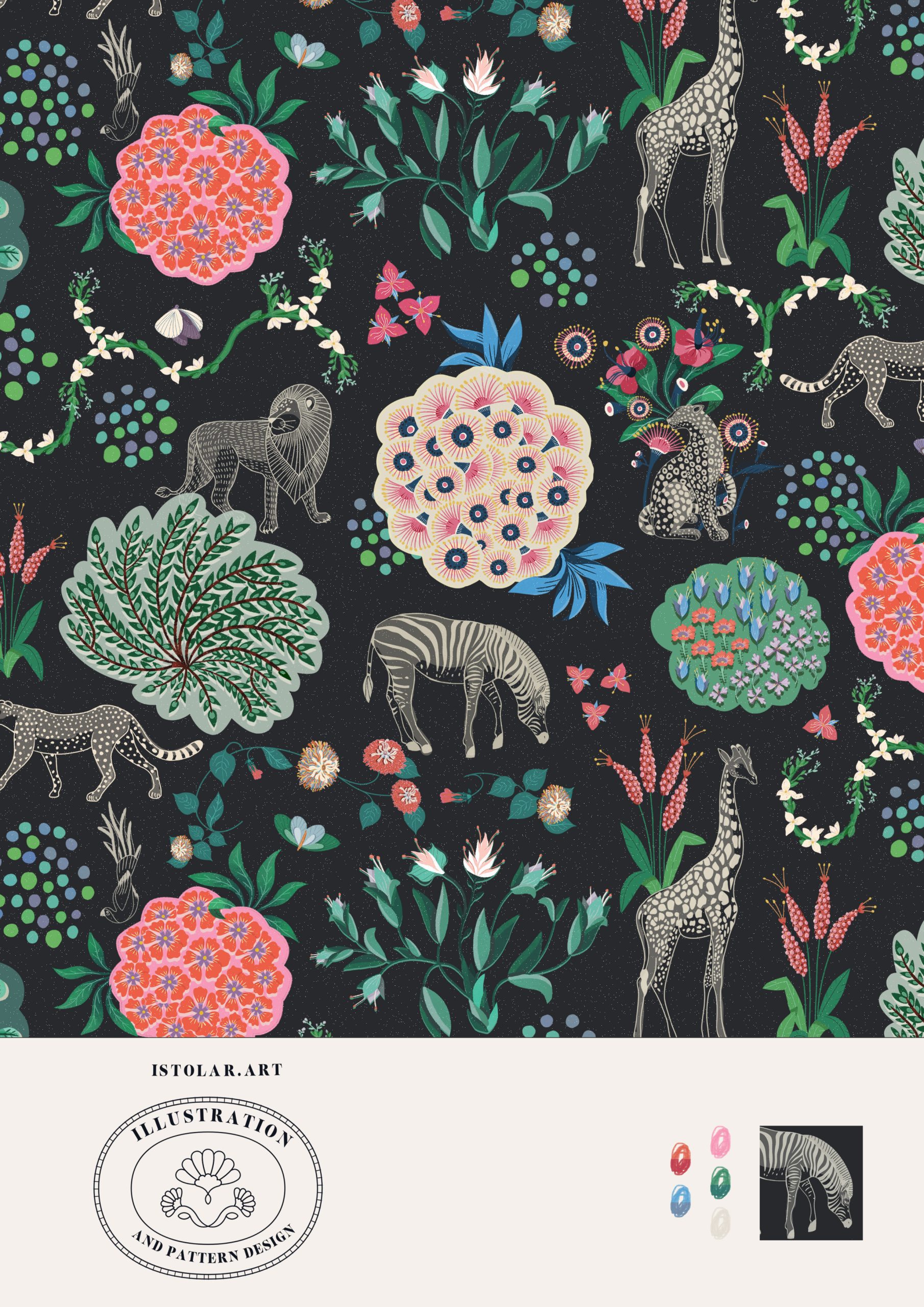
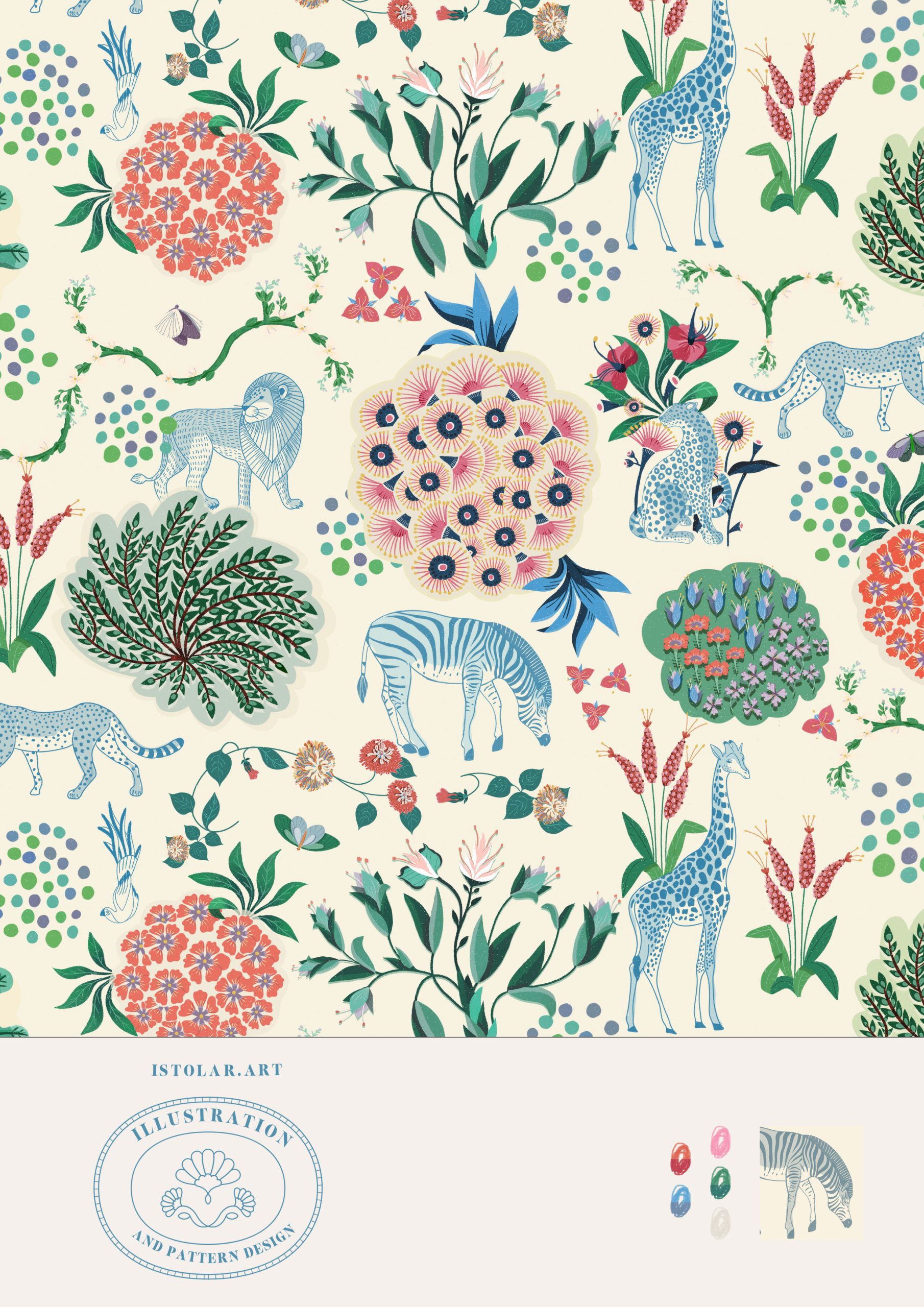
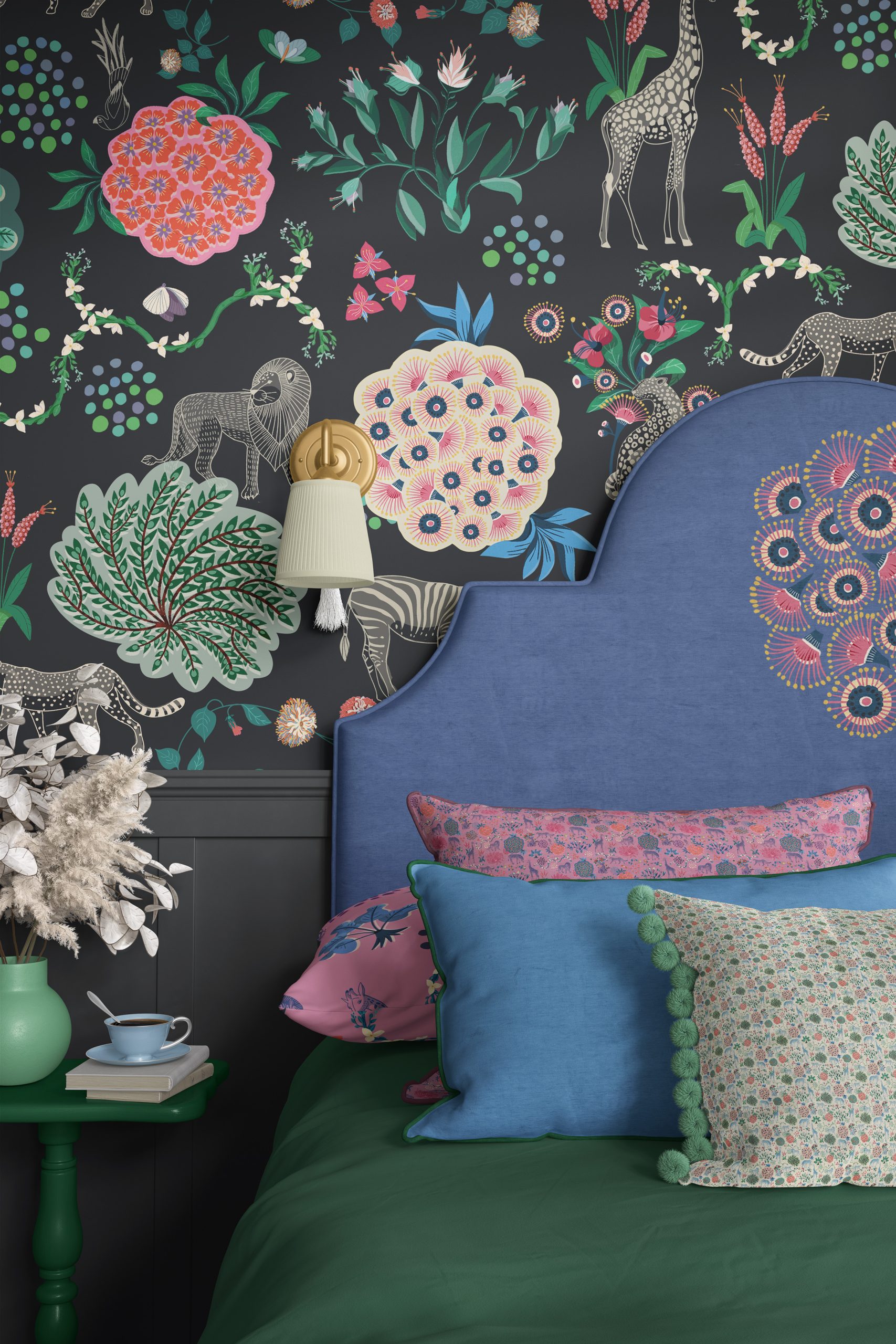
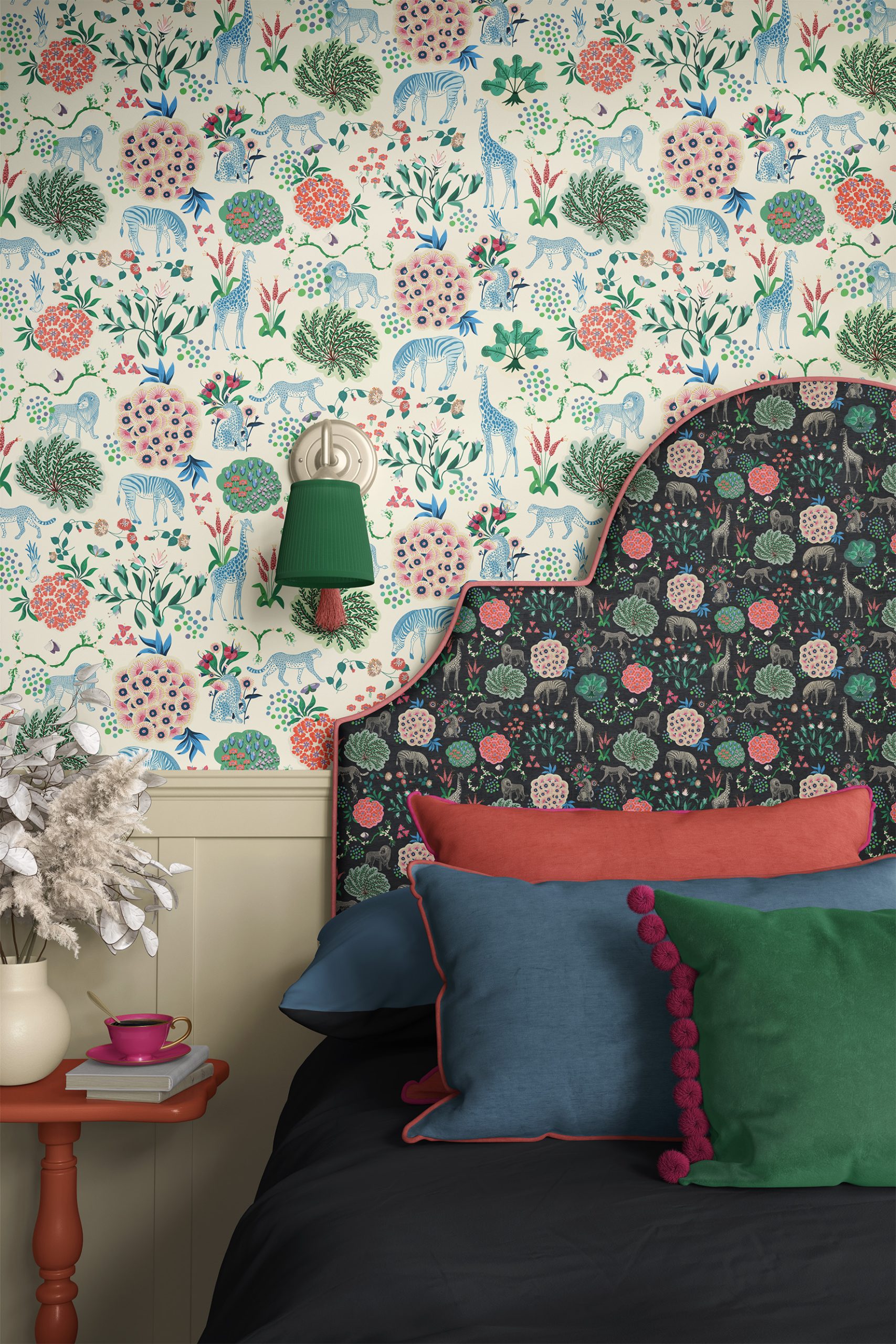
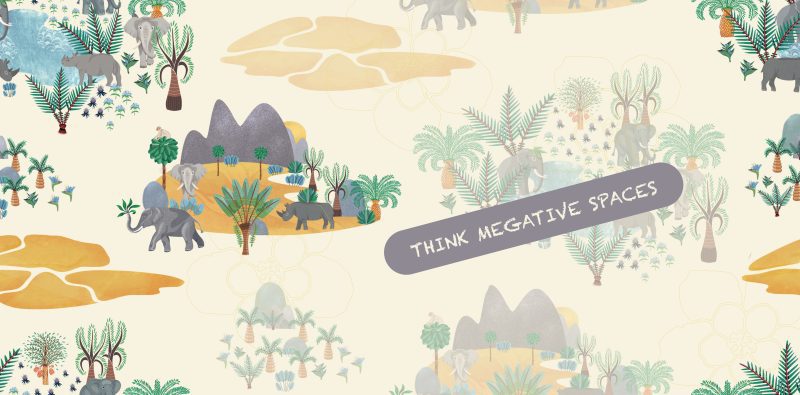
Avec ce motif, j’ai cherché à créer une composition au trait délicat, à la fois graphique et poétique, avec par moments une touche vintage, selon l’effet produit par la couleur du fond. Les animaux et les plantes sont traités comme des icônes stylisées, enrichies de détails intérieurs très fins.
J’ai organisé les petites vignettes narratives de manière à ce qu’elles semblent dialoguer entre elles, sans symétrie stricte, bien au contraire. Les espaces négatifs permettent aux scènettes de respirer.
Inspiré par l’élégance légère et illustrative des textiles japonais d’Echino (mais sans les formes géométriques), ce motif repose sur un système d’éléments disposés en semis. Le placement des éléments crée un effet de « regard qui vagabonde ». La composition reprend le principe d’un tossed repeat qui semble spontané, presque accidentel, tout en étant techniquement très précis : il n’y a pas de symétrie rigide ou en miroir, mais plutôt une recherche d’équilibre asymétrique. »
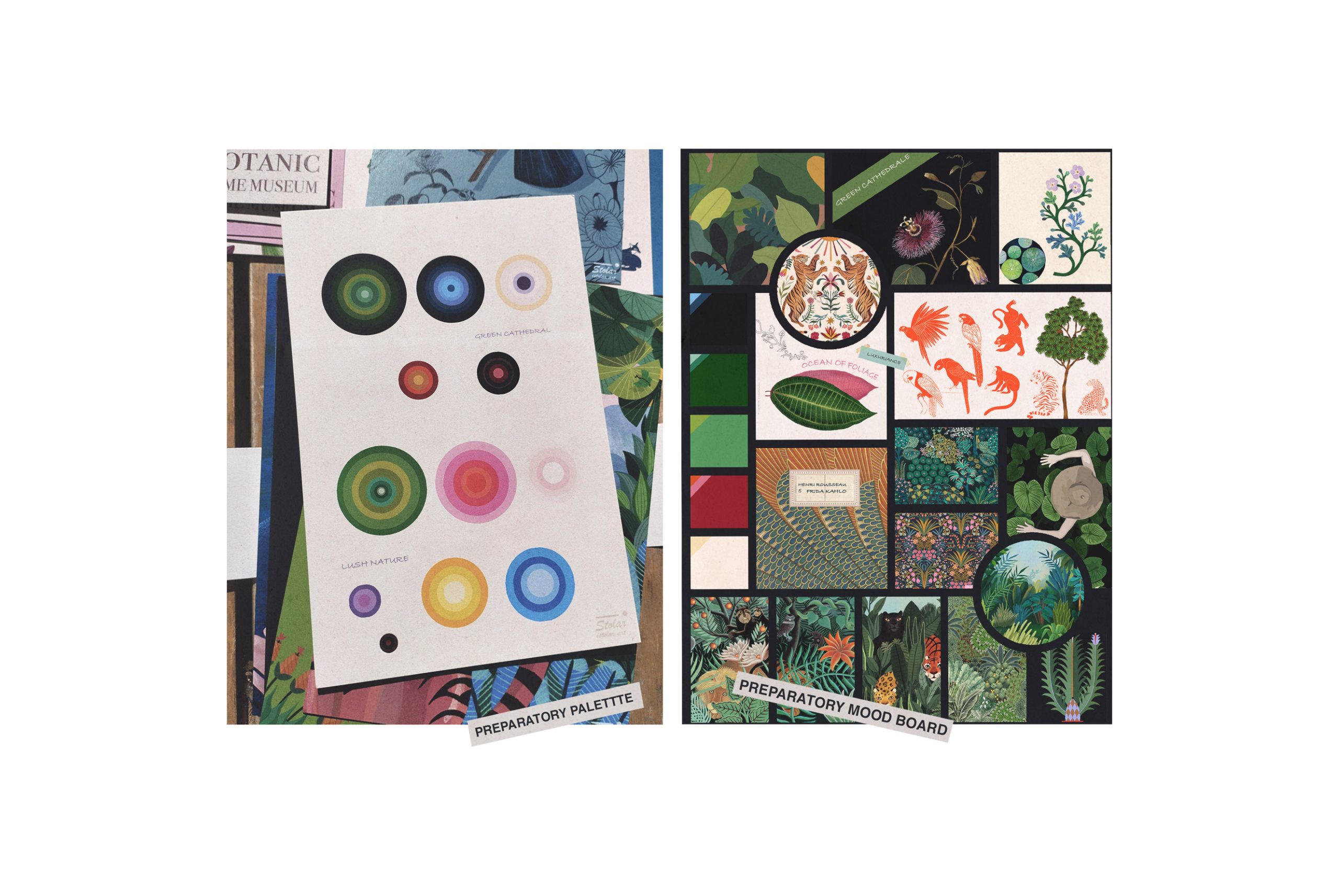
“With this pattern, I sought to create a composition with delicate line work that is both graphic and poetic (with some occasional vintage accent depending on the background color effect), The animals and plants read as stylized icons with fine interior detailing. I arranged the narrative vignettes in aconversational way, with no strict symmetry, quite the contrary, and I used negative spaces to allow each scene to breath. (I already had a few overlapping, packed hero patterns in the ” green cathedral / jungle”collection at that time), I needed to create a more airy repeat.)
“Inspired by the airy, illustrative elegance of Japanese Echino (with no geometrical shapes though) textiles, this pattern uses a tossed elements’ system.
The placing of the elements allows a “wandering eye” effect. The layout mimics a tossed repeat that feels accidental but is technically precise, with no rigid, mirrored symmetry but a search for asymmetrical balance
(by the way one of the best teacher in the pattern making world).
Elle enseigne à faire de magnifiques patterns / Jouy classic avec illustrator.
J’ai gardé le principe (celui du “half drop”) de son cours en restant dans Photoshop.
.. du pixel et du grain s’il vous plait !
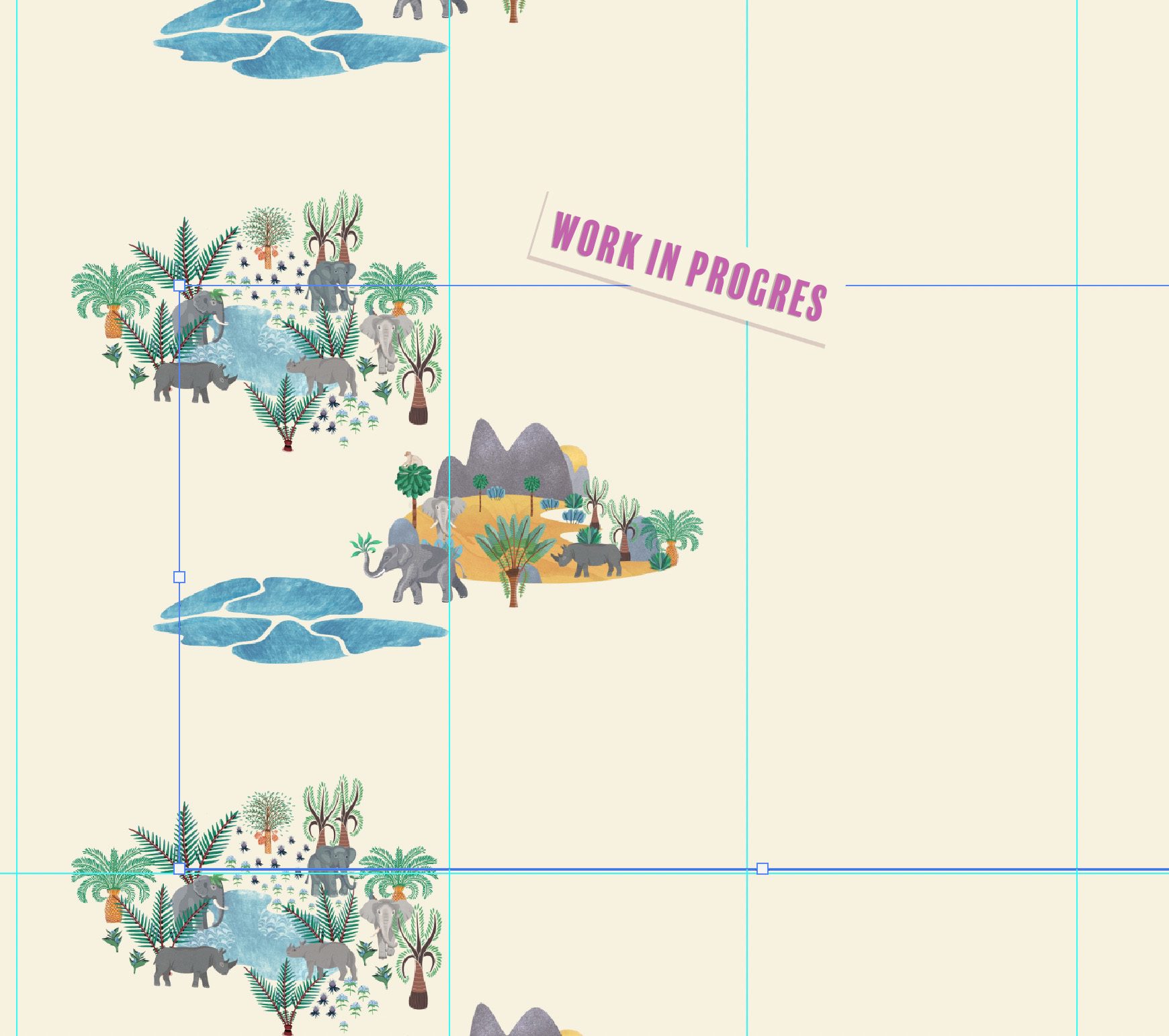
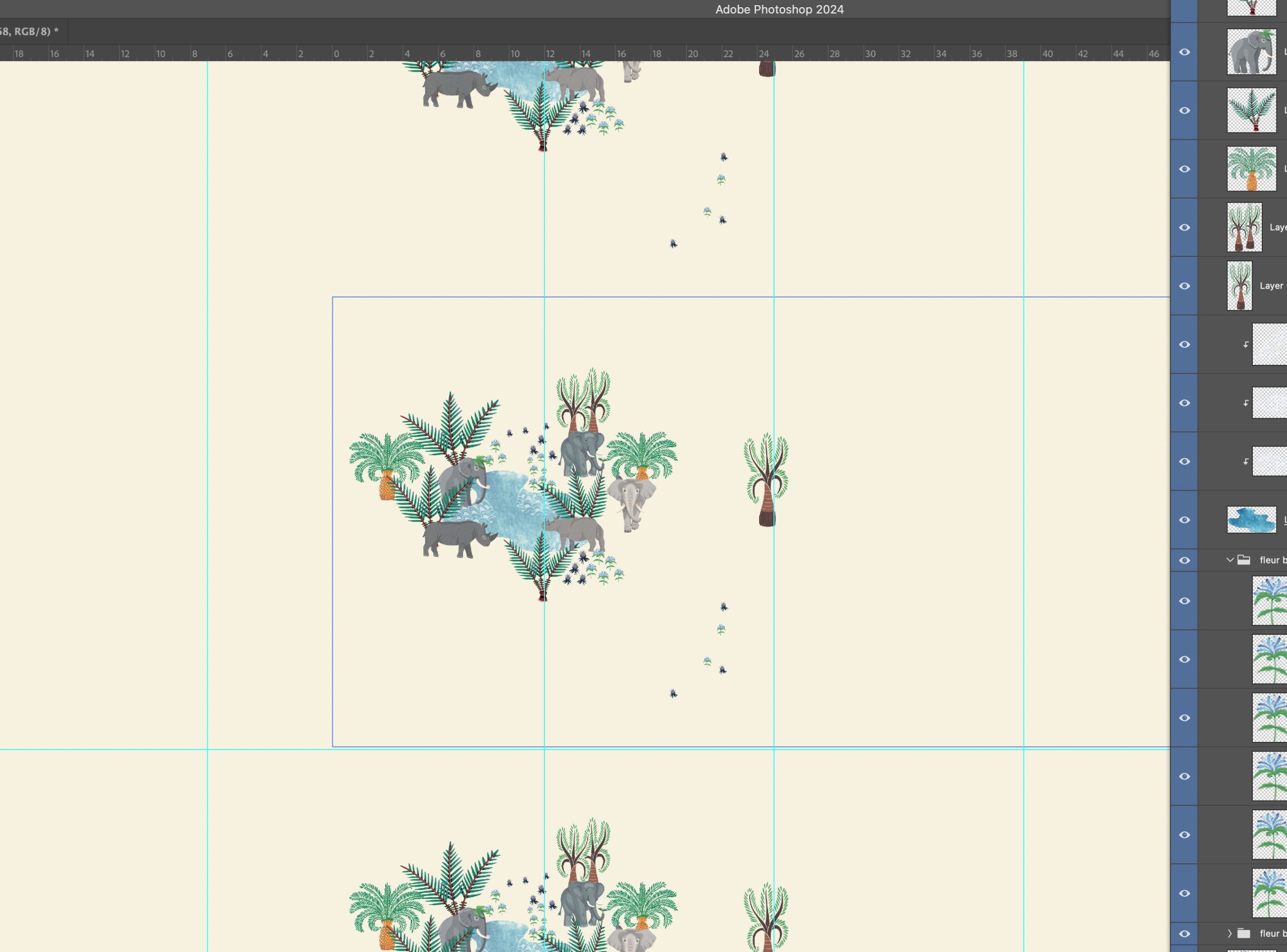
… et j’ai mixé le principe avec l’utilisation du “pattern preview” de Photoshop, dont je fais une utilisation un peu intuitive . C’est-à-dire qu’il y a une répétition mathématique /Halfdrop puis je joue avec des ajustements intuitifs pour harmoniser les pleins et les vides, sachant que u la structure type “toile de Jou est composées d’ilots flottants mêlés et juxtaposés.
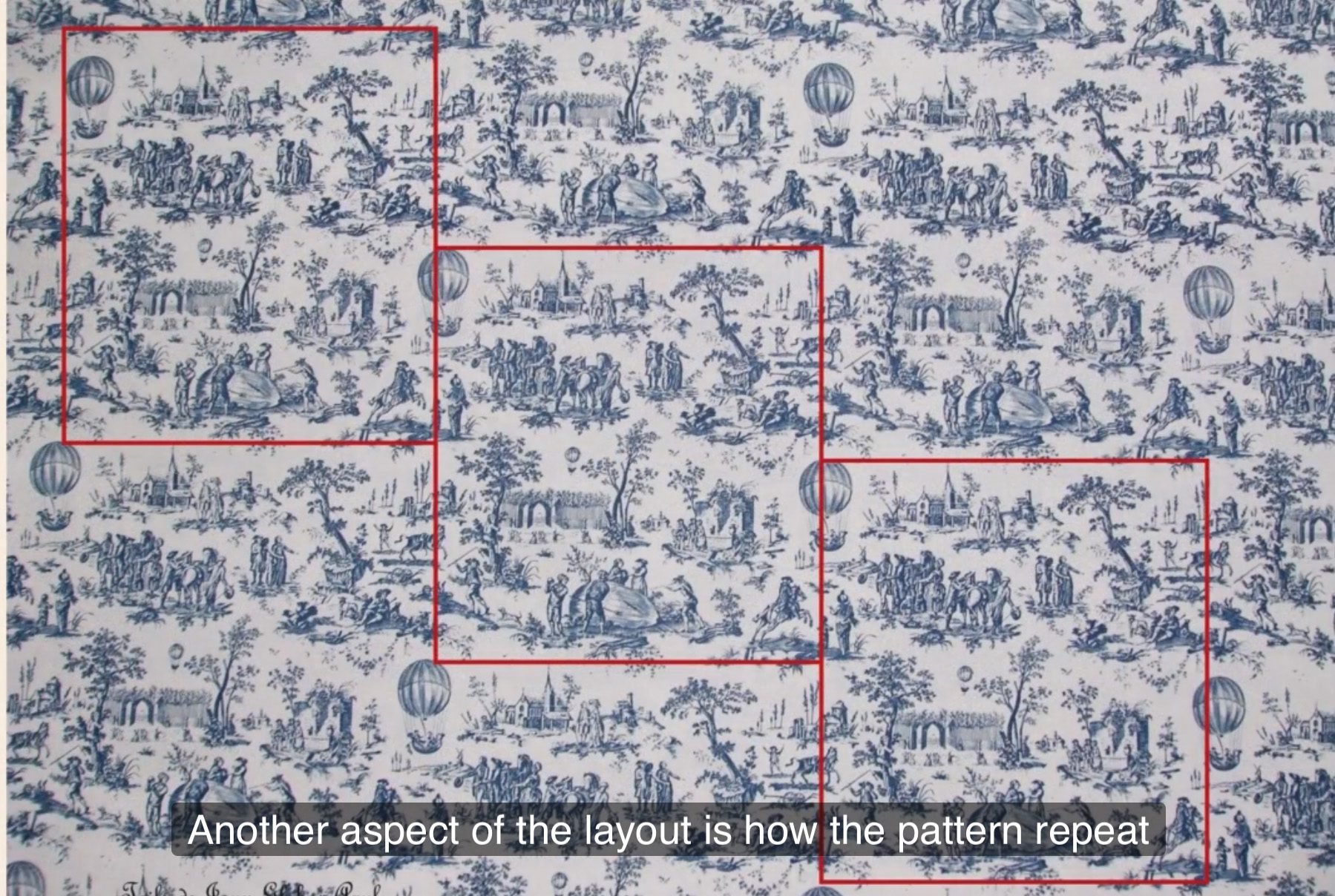
Je lui emprunte un de ces slides pour illustrer le fameux principe
Les motifs organisés en grandes scènes figuratives (pastorales, mythologiques, exotiques, historiques) et répétés de manière rythmée sur toute la surface du tissu. Les scènes sont encadrées de zones vides ou d’espaces respirants. Cette alternance pleins/vides donne un effet d’équilibre et de délicatesse. Les motifs sont souvent placés selon une composition en diagonale, où les scènes se répondent en quinconce pour éviter une répétition trop mécanique. Parfois, la disposition est plus horizontale, avec des scènes alignées.
Dans les motifs classiques, les scènes sont construites par un dessin très fin, presque gravé. Les éléments naturels (arbres, rochers, nuages) servent de liens visuels entre les scènes. Les personnages sont fréquemment placés dans des mises en scène dynamiques (conversation, danse, travail, navigation…). La Toile de Jouy est traditionnellement imprimée en une seule couleur sur fond clai: rouge carmin, bleu indigo, vert, sépia, gris. Cette monochromie renforce l’effet de gravure ancienne et met en valeur la structure du dessin. Chaque scène raconte quelque chose (un moment de vie, un paysage, un mythe). Mais l’ensemble forme avant tout un motif décoratif, la narration ne doit jamais empêcher la lecture harmonieuse du textile.
I was surprised to progress with this jungle pattern while being away for a week from the desk and my computer. I could concentrate, create a bubble and try out a new diamond lay out.
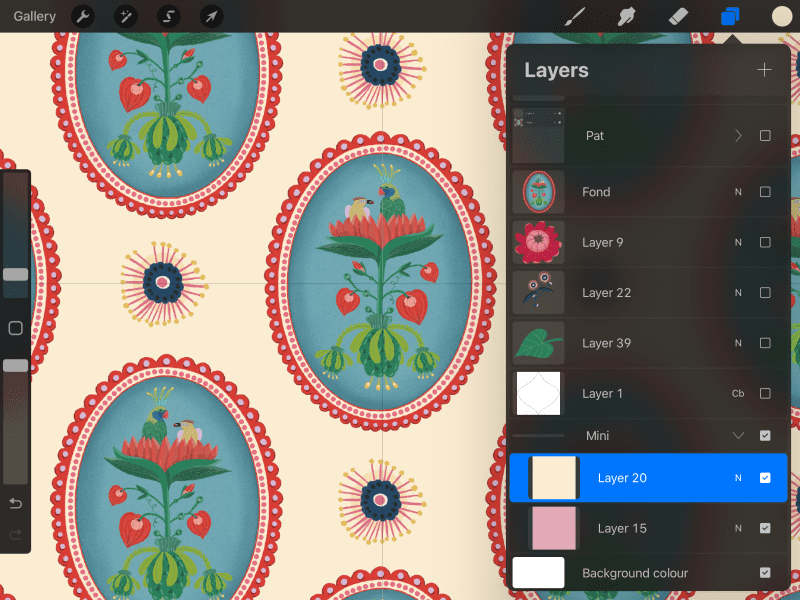
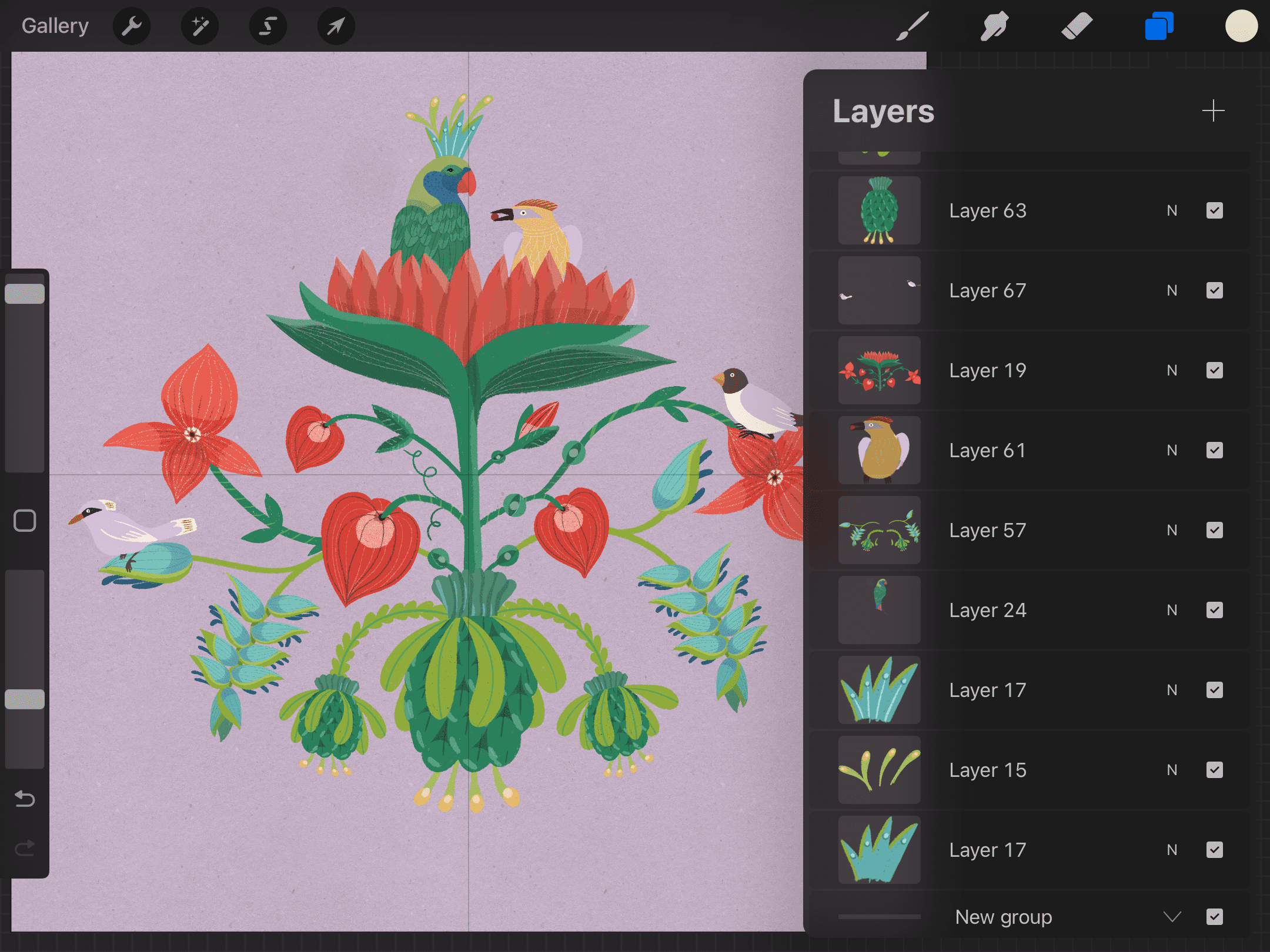
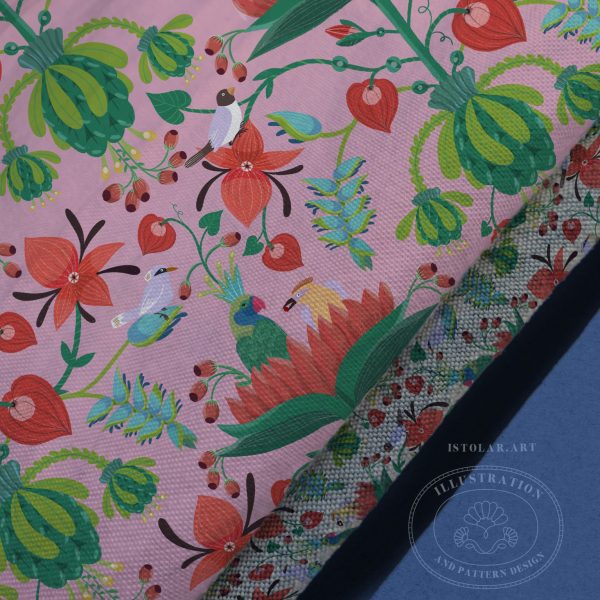
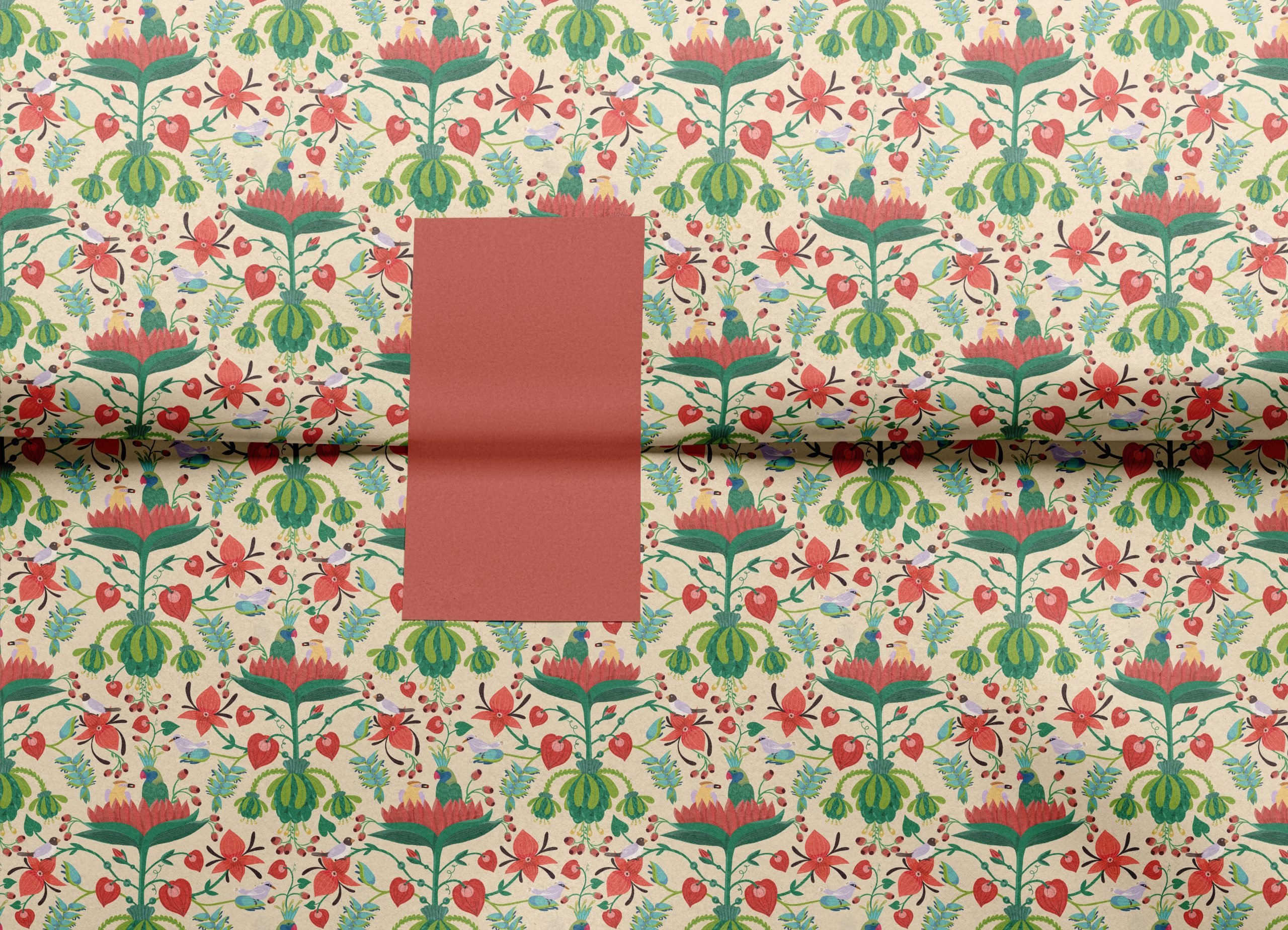
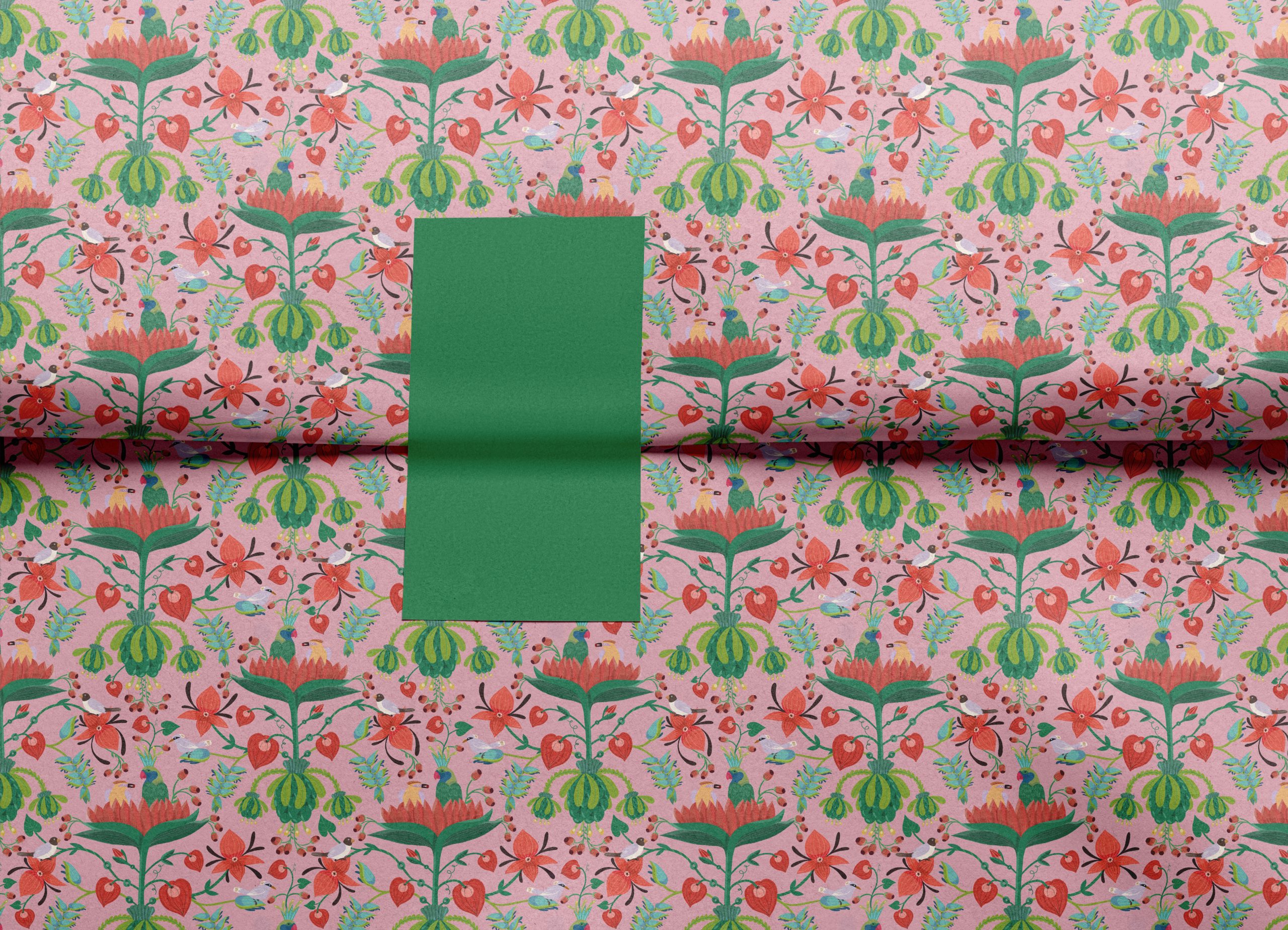
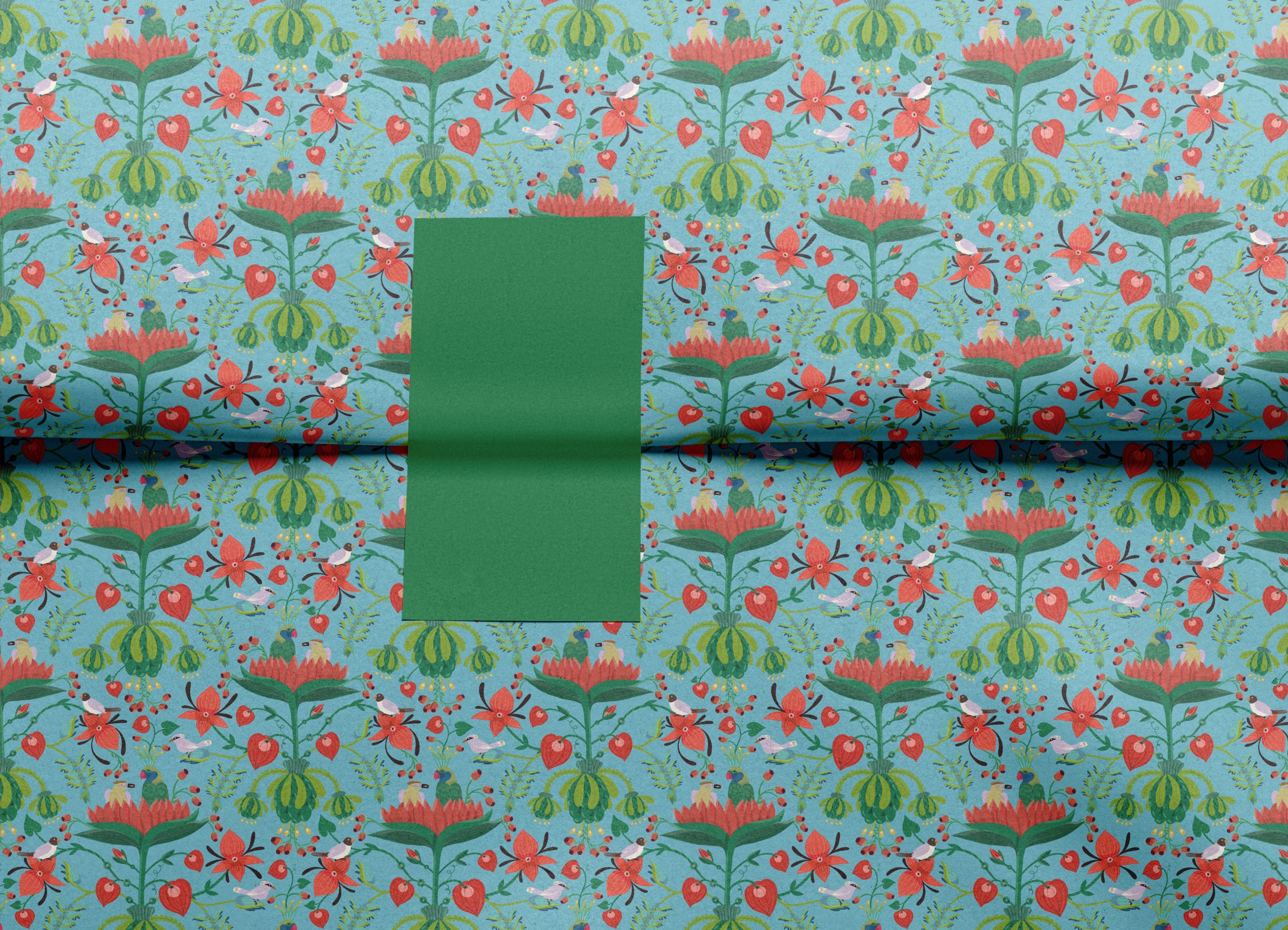
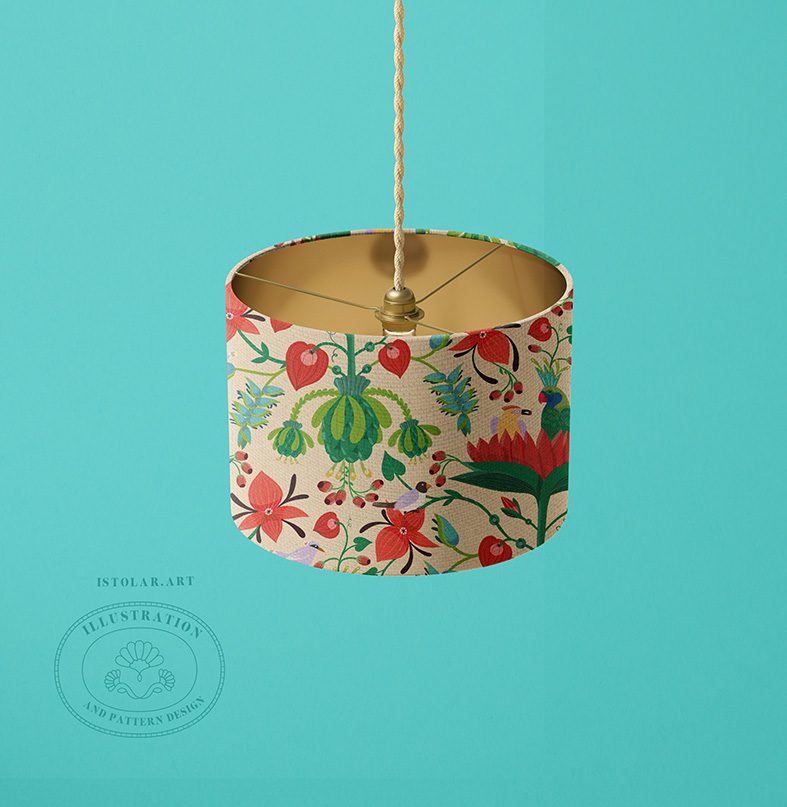
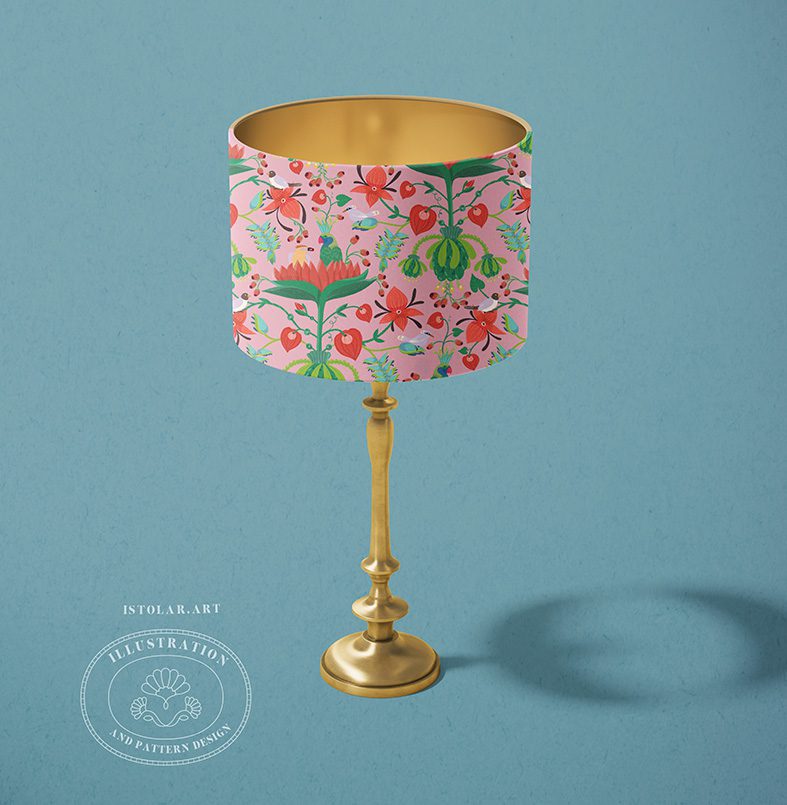
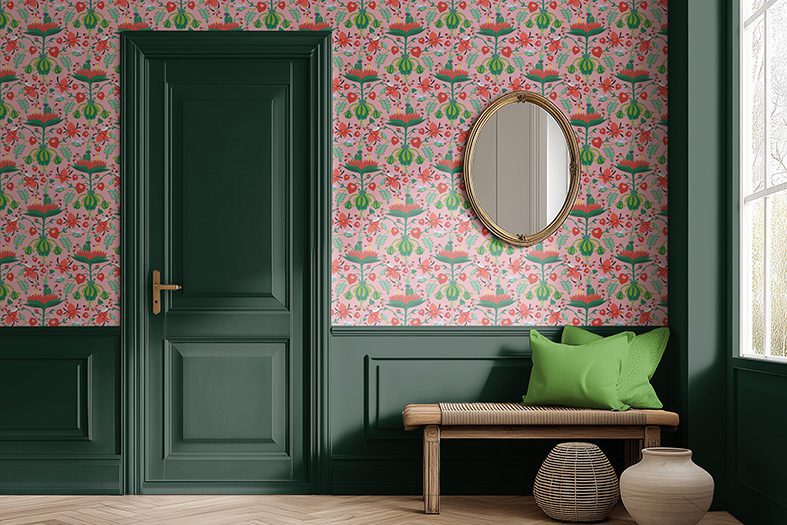
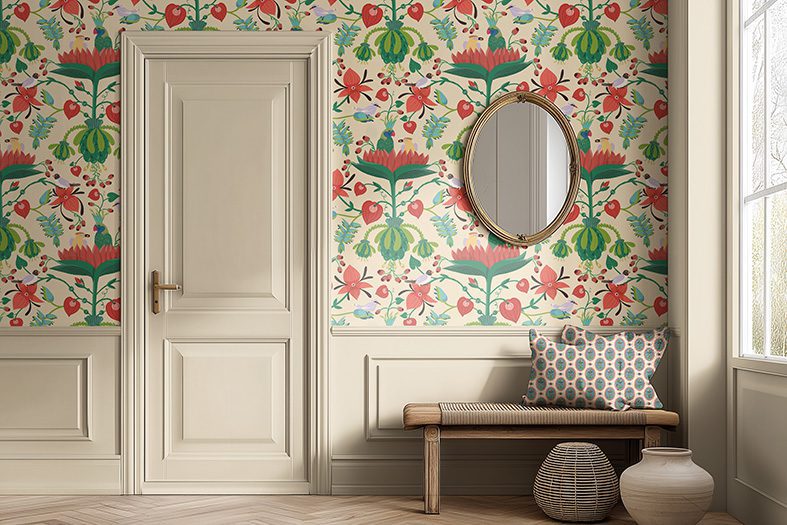
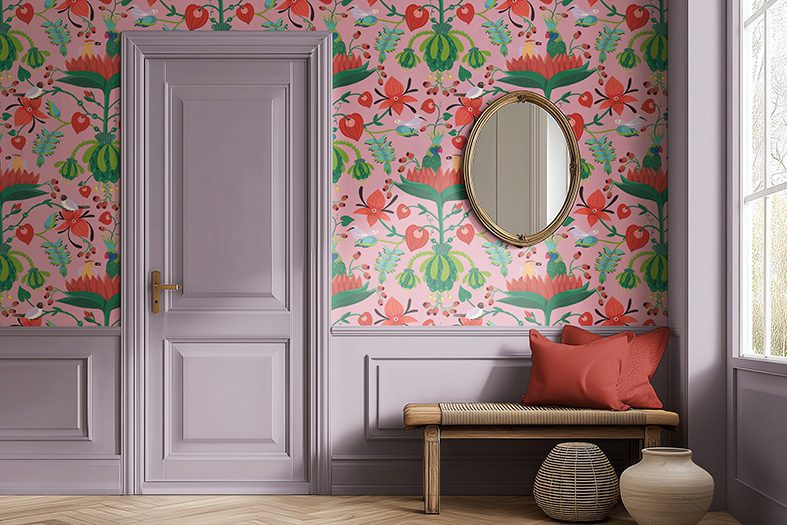
Un motif tropical vibrant, un univers qui semble venu de l univers d un art populaire. Il est structuré autour de grandes fleurs exotiques «héroïques», éclatantes et aux formes architecturales qui ancrent la composition et côtoient des lianes sinueuses. Elles sont entourées d’oiseaux de taille intermédiaire, des perroquets et des oiseaux chanteurs, perchés au milieu de lanternes de physalis en forme de cœur et fortes fleurs de la famille de l’heliconia, tout un réseau de végétation secondaire composé de feuillages et de plantes retombantes.
Un petit détail à remarquer: la fleur du palais semble presque flotter, émergeant d’un bulbe qui évoque un artichaut inversé. Qui a dit qu’un motif sans raccord ne laissait pas de place à l’imagination ?
ENG: I like to think the scenario takes place in Brasil 🙂
A vibrant folk-inspired tropical repeat featuring oversized red jungle blooms, curling vines, playful perched parrots and songbirds surrounded by heart-shaped physalis lantern flowers, heliconia like plant and and botanical details from the jungle. This pattern features large vivid, architectural “hero” blooms that anchor the composition, surrounded by medium-scale birds and trailing botanical infill.
One little detail to be noticed: the palace flower is kind of flying, emerging from a reverse artichoke like bulb. Who sais seamless ornament does not make room for imagination?
Plus bas dans le palais, la jungle se densifie, abritant félins, oiseaux, singes et autres habitants d’une végétation incroyablement luxuriante. You can see it here
Further down the palace, the jungle is thickening and sheltering felines, birds, monkeys and other inhabitants of an incredibly lush greenery. you can see it here
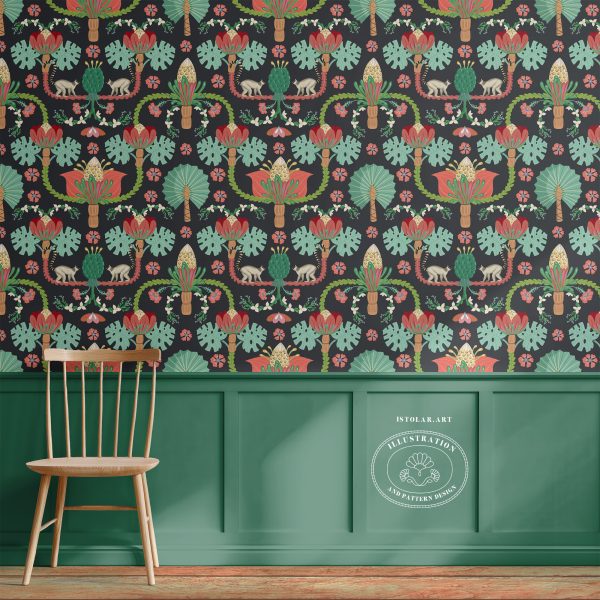
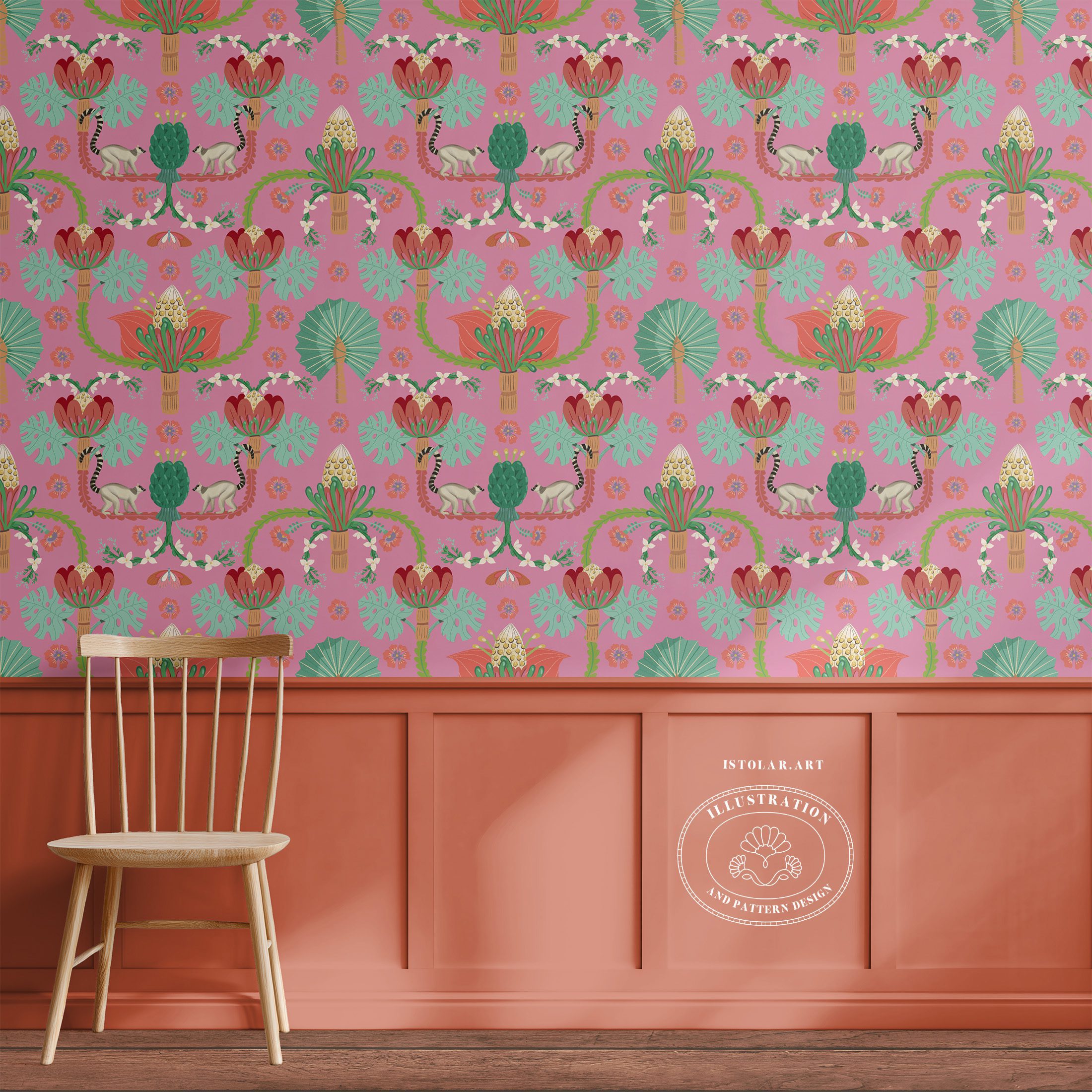
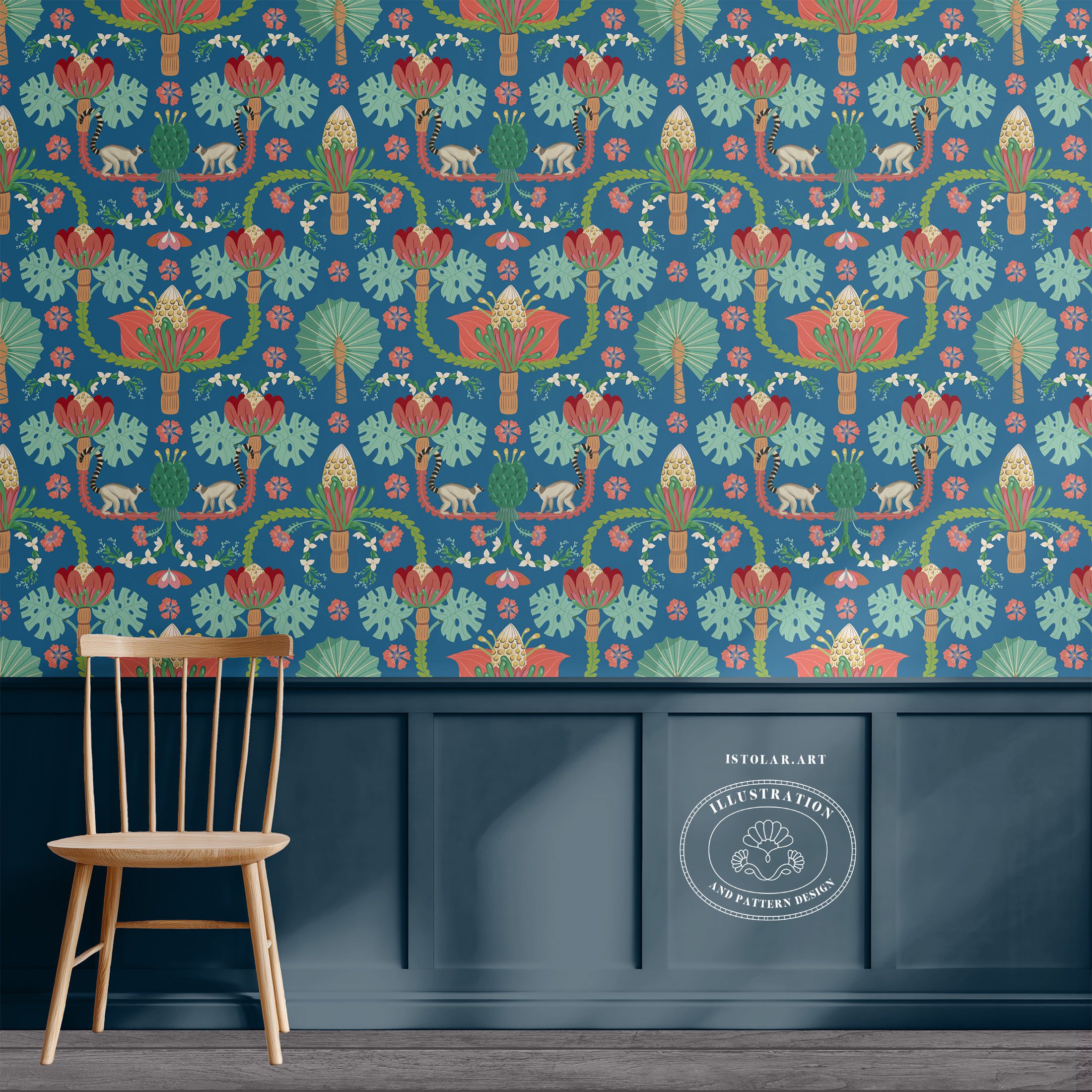
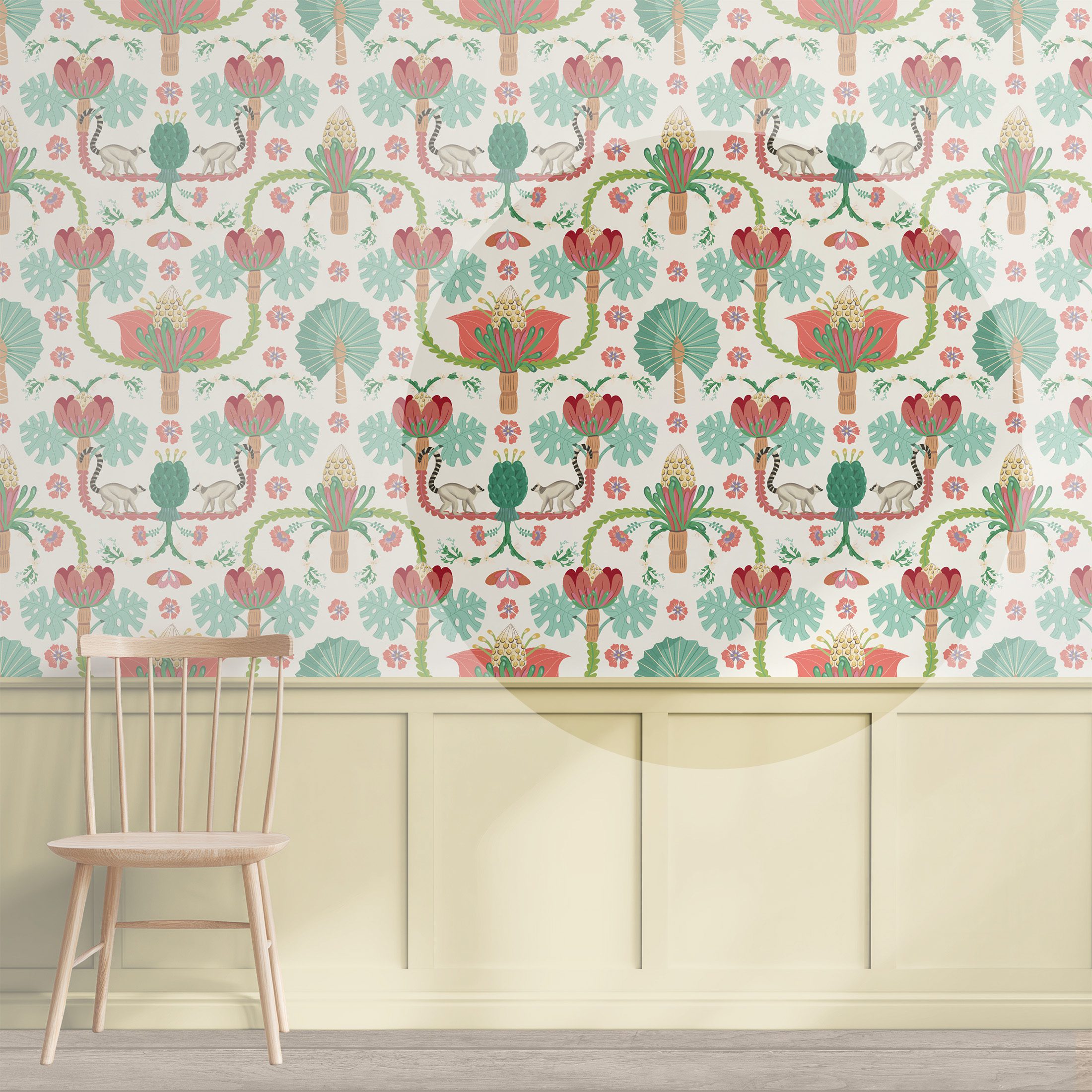
FR: Ce motif sans raccord associe une végétation luxuriante et style ornemental et décoratif. Sa composition évoque une architecture. Je cherchais à évoquer la richesse des jardins équatoriaux et des paysages exotiques, mais de manière assez maîtrisée, en jouant avec les lémuriens en miroir, les fleurs tropicales surdimensionnées et les feuilles de monstera vert menthe, organisés selon une structure verticale en treillis.
Les imposantes fleurs rouges et les larges feuilles ancrent la composition. Disposées en colonnes, prennent elles prennent des allures de totems. Entre elles, les motifs associés tels que les lémuriens et fleurs, equilibre l’espace tandis que les petites fleurs et les lianes assurent les transitions et maintiennent une continuité visuelle fluide.
Le style graphique se situe environ à la rencontre du “folk art” et d’un graphisme contemporain aux aplats francs, et des lignes dessinées à la main dans une simplification décorative assumée J’espère que la rencontre entre une structure ornementale classique et une faune tropicale fantaisiste donne au motif une allure à la fois intemporelle et contemporaine.
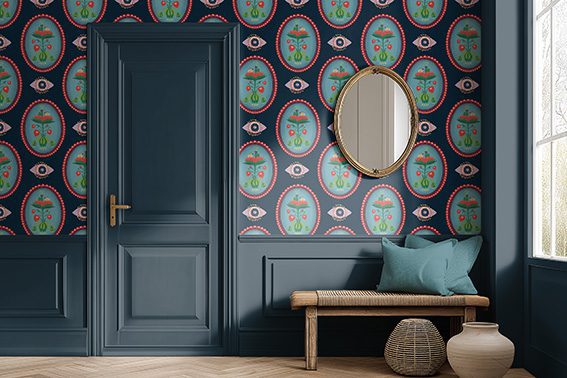
ENG : This seamless pattern blends lush botanical forms with an ornamental, decorative rhythm. It feels architectural rather than tossed. I was looking to evoke the richness of equatorial gardens and exotic landscapes but in a very curated way, playing with the mirrored lemurs, oversized tropical blooms, and minty monstera leaves arranged in a vertical lattice on various ground: deep teal-blue, pink, cream or charcoal.
The large Hero dramatic red florals and big leaves anchor, stack in columns work as “totems” while paired motifs (lemurs and blossoms) form balanced compartments between them, while smaller blossoms and vines act as connectors to maintain smooth visual continuity across the tile edges.
The illustration style is, let’s say, as if folk-art meets contemporary flat graphic, with sharp shapes, hand-drawn line accents, and decorative simplification. I hope that the combination of classic ornamental structure with playful jungle wildlife makes it feel timeless with a contemporary
Stylized botanical illustration, base for this seamless pattern
Le full drop ne fonctionnait pas parfaitement : Œil pas assez perdu ! Meme si en papier peint macro ca fait son effet regardez: jungle wall paper I
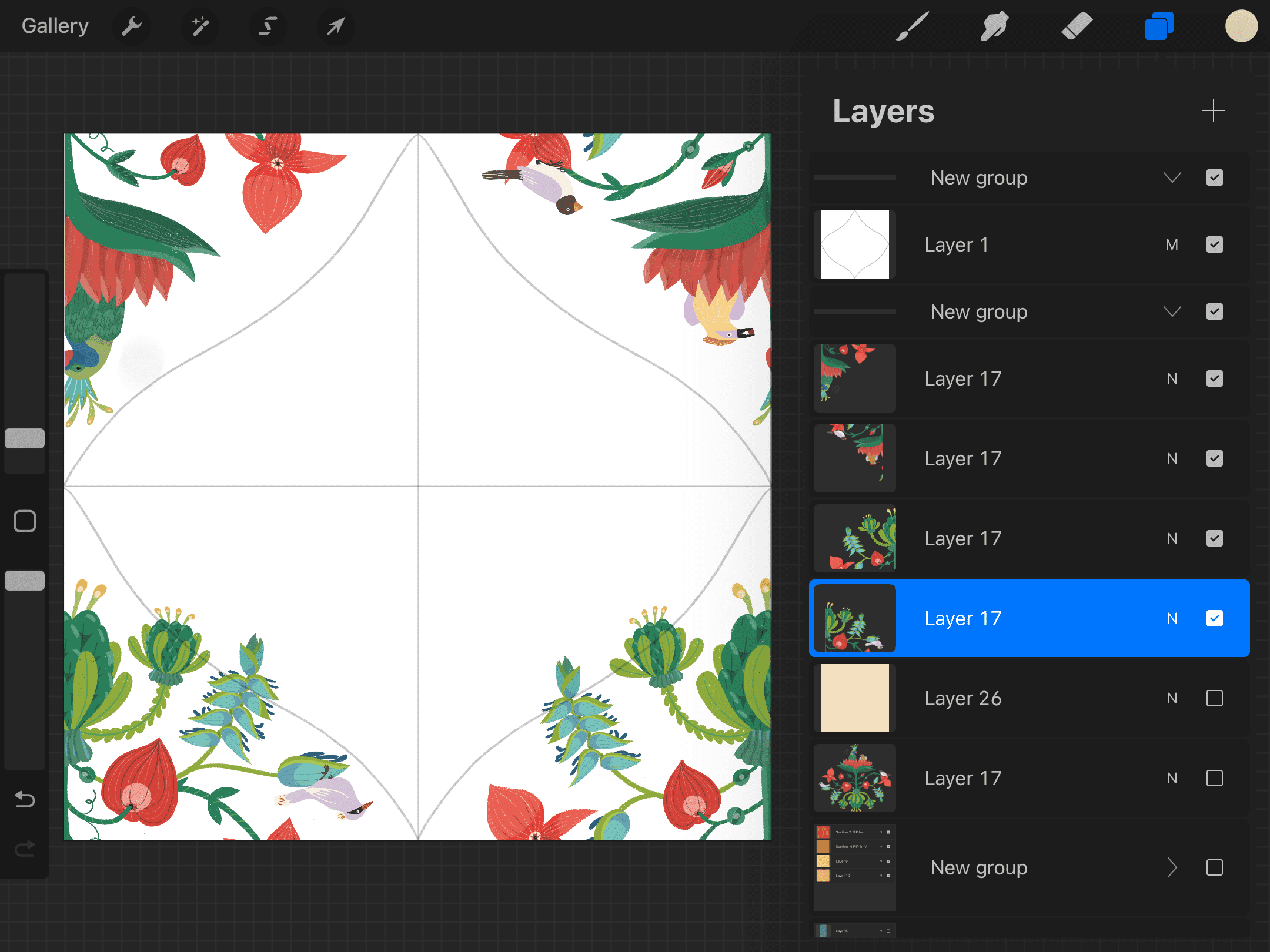
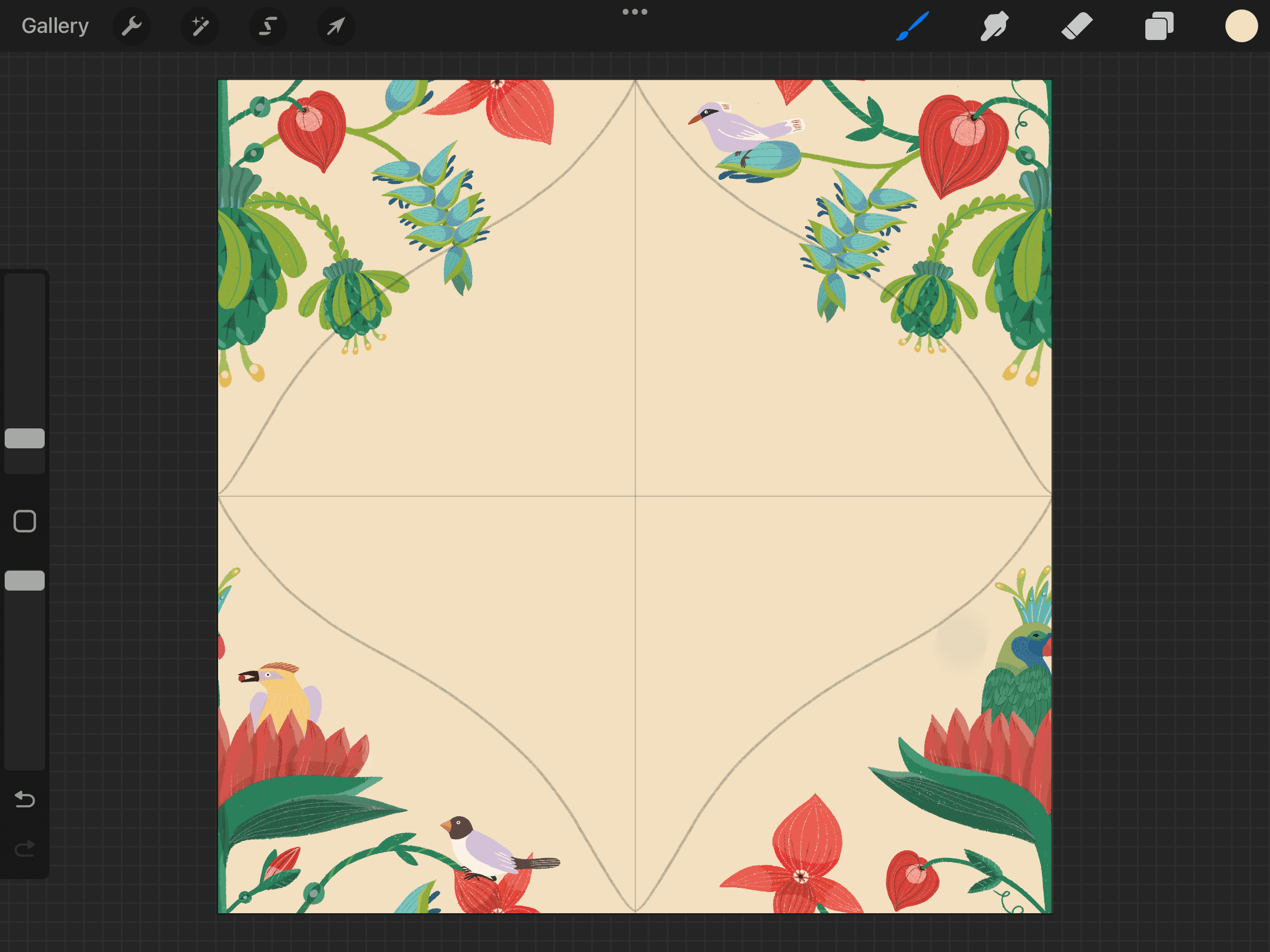
Alors voici une partie du processus du Half drop sur Photoshop.
Cette partie (video making of) n’est que la partie fun, la partie quasi mathématique du “offset: , celle qui cliqu,. la magie du seamless pattern!
Le casse-tête a eu lieu avant (malheureusement je n’ai pas capté l’écran du processus).
ici, J’ai voulu tester la méthode sur un motif complexe. La mise en place du losange fut laborieuse (parce que bien trop dense). La prochaine fois, je ferai un “ditsy pattern “selon les mêmes principes. Ça va me paraître facile en comparaison… et il y aura de l’air.:-)
 isa
isa